
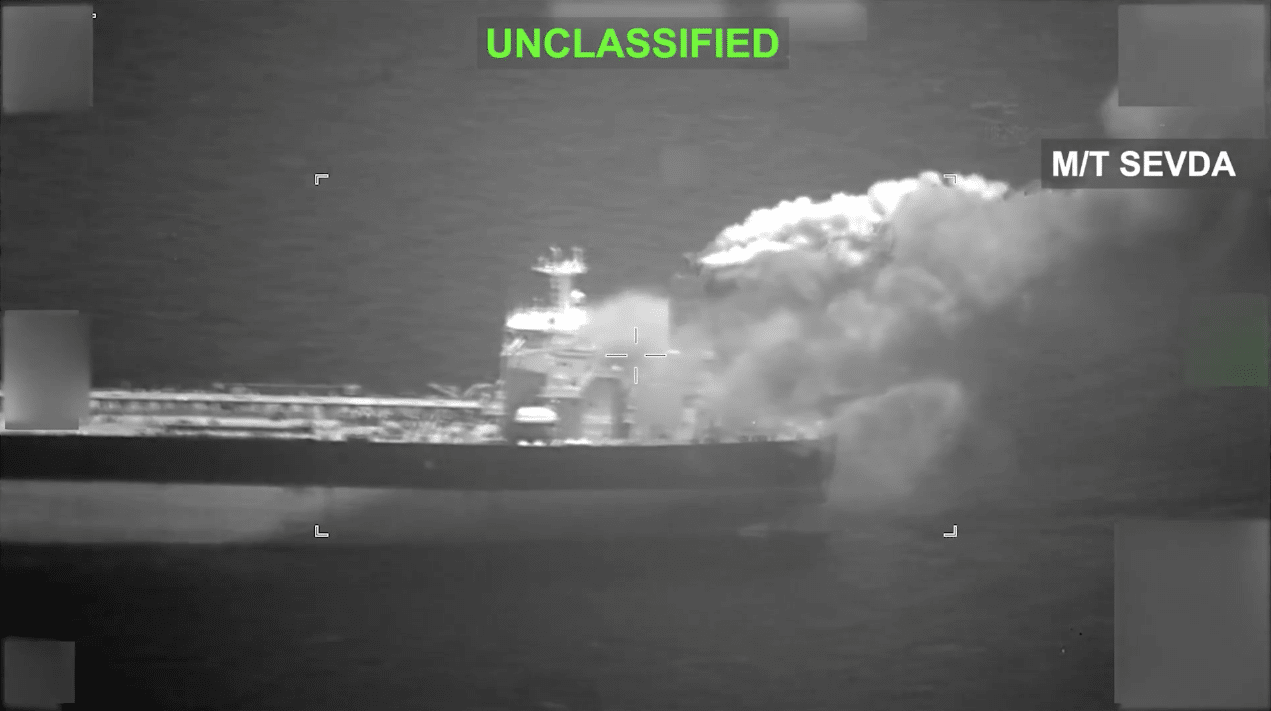
A U.S. Navy F/A-18 Super Hornet fired precision munitions down the smokestacks of two Iranian-flagged oil tankers Friday, disabling both vessels in the Gulf of Oman before they could reach an Iranian port in violation of the American naval blockade.
U.S. Central Command identified the ships as M/T Sea Star III and M/T Sevda, both struck by a Super Hornet from USS George H.W. Bush (CVN 77) and both empty of cargo at the time of the interdiction.
CENTCOM published video of the strikes, which threaded munitions through the ships’ narrow exhaust stacks to disable propulsion without sinking the vessels.
U.S. forces disabled two Iranian tankers, Sea Star III and Sevda, after the vessels attempted to breach the American naval blockade and enter an Iranian port.
According to the U.S. military, an F/A-18 Super Hornet fighter jet launched from the USS George H.W. Bush conducted… pic.twitter.com/BHXV776NVp
— Visegrád 24 (@visegrad24) May 8, 2026
Friday’s tanker strikes were not the only method the Navy has employed this week. On May 6, a Super Hornet from USS Abraham Lincoln (CVN 72) disabled the Iranian-flagged M/T Hasna by firing several 20mm cannon rounds into its rudder, destroying its steering and stopping the ship’s advance toward an Iranian port.
Three Iranian tankers have been disabled in three days, and CENTCOM said its forces have also redirected more than 50 other vessels to enforce blockade compliance.
“U.S. forces in the Middle East remain committed to full enforcement of the blockade of vessels entering or leaving Iran,” said Adm. Brad Cooper, CENTCOM commander. “Our highly trained men and women in uniform are doing important work.”
The tanker operations unfolded alongside a separate confrontation in the Strait of Hormuz. Overnight Thursday into Friday, Iranian forces reportedly launched missiles, drones and small boats at three U.S. Navy guided-missile destroyers transiting the strait, a barrage that CENTCOM intercepted before striking Iranian military facilities it said were responsible.
No American ships were hit, and the command said it “does not seek escalation but remains positioned and ready to protect American forces.”
Following unverified claims by IRGC-affiliated media that U.S. Navy ships were struck, CENTCOM posted images of the three destroyers operating in the Arabian Sea.
Photos of USS Truxtun (DDG 103), USS Rafael Peralta (DDG 115), and USS Mason (DDG 87) operating in the Middle East. The three destroyers are currently sailing in the Arabian Sea supporting the blockade against Iran. As of today, CENTCOM forces have redirected 57 commercial… pic.twitter.com/iFHp1HHMac
— U.S. Central Command (@CENTCOM) May 8, 2026
The United Arab Emirates also reported a separate Iranian missile and drone attack on UAE territory Friday, adding to a strike on the UAE’s Fujairah oil port on May 4 that was serious enough to prompt closed-door talks at the United Nations Security Council.
A ceasefire has nominally held since approximately April 8, though Washington insists it remains in effect despite the ongoing military activity.
Secretary of State Marco Rubio said Friday he expects Iran to respond to a U.S. peace proposal later in the day, one that would see Iran ease pressure on the Strait of Hormuz while the U.S. gradually lifts the blockade over 30 days, with nuclear talks to follow.
Iran said the offer is “under review,” and Trump posted on social media after the overnight Hormuz firefight that “great damage” had been done to Iranian ships and urged Tehran to accept the deal.





F-18 with a couple of Supertankers kills painted on the side! Long deployments but at least the boys are having some fun.