
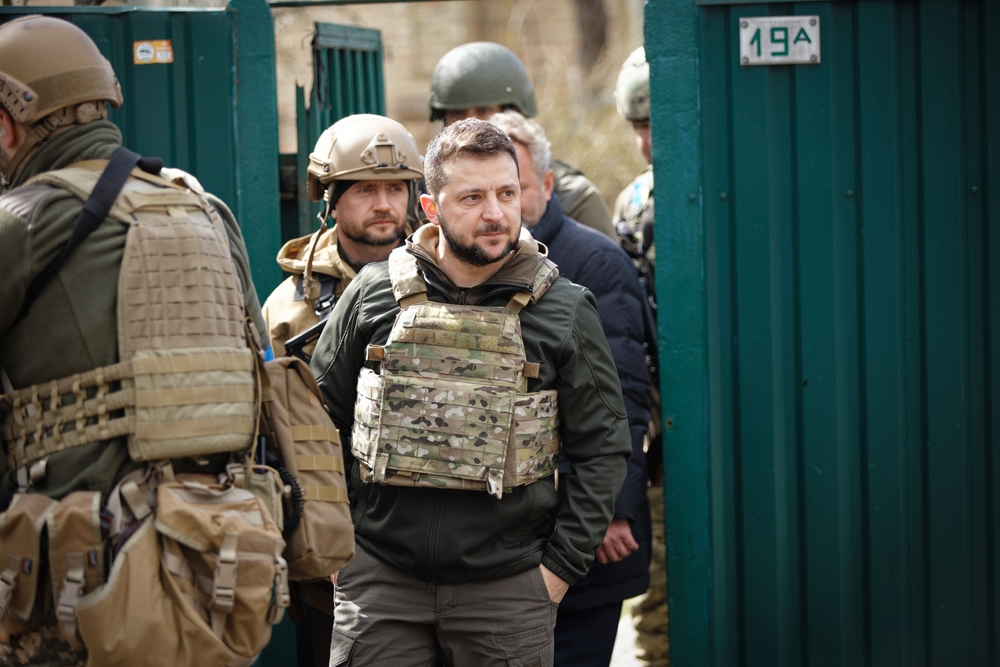
Ukrainian President Volodymyr Zelensky announced May 6 that Ukraine will draft legislation to legalize private military companies, instructing the Interior Ministry, intelligence agencies, and the Presidential Office to deliver a bill by the end of 2026. PMCs are currently prohibited under Ukrainian law.
“Our export of security, after this war and for veterans, must be a real business opportunity,” Zelensky said during his evening video address. He described the initiative as a response to global demand for private security services, noting that “leading countries in the world engage their citizens to work in so-called private military companies.”
Interior Minister Ihor Klymenko said the initiative is intended to create a “transparent and controlled model” for specialized security and protection services that would fully comply with Ukraine’s Constitution.
The announcement formalizes an idea Zelensky first raised publicly on June 4, 2025, when Russia’s ceasefire memorandum demanded Ukraine dissolve “nationalist formations” and private military companies. Zelensky responded at the time: “I will now start thinking about it after such ultimatums.”
Three Bills, No Floor Vote
Lawmakers have tried to legalize PMCs at least three times without success.
The most recent, Draft Law No. 11214, was introduced on April 26, 2024 by MP Serhiy Hryvko of Zelensky’s Servant of the People party. Titled “On International Defense Companies,” the bill would authorize PMCs to organize security for individuals and legal entities, protect facilities, provide tactical training, conduct mine clearance, use weapons and equipment, and establish permanent deployment bases in Ukraine.
The bill would also allow PMCs to purchase or lease military equipment from foreign companies and Ukrainian military units and to operate abroad while paying taxes to the Ukrainian budget.
Eligibility requirements for PMC employees under the bill include Ukrainian citizens, foreigners, and stateless persons aged 21 or older with at least one year of service in the Armed Forces of Ukraine, the National Guard, or other Ukrainian military formations.
The Defense Ministry backed the bill in July 2024 but attached substantial conditions. In a statement reported by United24 Media, the ministry said the draft as written conflicted with the Constitution of Ukraine.
The Ministry also flagged conflicts with international treaties, including the Additional Protocols to the 1949 Geneva Conventions and the Montreux Document, a 2008 multinational agreement from Switzerland that specifies governance practices for private military and security companies operating in armed conflict zones.
The agreement is not legally binding but is widely referenced in international defense law.
Veterans, Revenue, and Wagner
Zelensky framed the initiative explicitly as a postwar economic policy. “Our export of security, after this war and for veterans, must be a real business opportunity,” he said in his May 6 address, describing demand for Ukrainian fighters as a function of their battlefield record: “The whole world sees that the Ukrainian warrior is truly strong, truly experienced.”
The scale of the challenge is considerable. Ukraine fields an estimated 880,000 to 1 million troops, Business Insider reported, a figure representing roughly six percent of the country’s total workforce. Integrating that population into a civilian economy already strained by years of wartime disruption will represent one of the largest demobilization challenges in modern European history.
Supporters argue legalization addresses two problems at once. A licensed PMC sector gives veterans a legal market for skills that have no direct civilian equivalent, and it captures tax revenue that currently escapes the Ukrainian state.
The ban has historically not eliminated demand for Ukrainian fighters abroad. It has simply pushed the business offshore. Companies recruit Ukrainian personnel, train them on Ukrainian soil, and deploy them internationally while registering their legal addresses in countries like Bulgaria, paying nothing to Kyiv.
Proponents have raised this complaint since at least February 2020, when parliamentarian Vasylevska-Smahliuk described the practice.
Ukrainian PMCs would enter a global private security market currently dominated by Russian entities, including the reconstituted remnants of the Wagner Group, with combat credentials few competitors could match. Proponents argue that advantage translates directly into export contracts, and that Ukraine capturing that market share is preferable to Russian firms filling the vacuum.
Private military companies are currently illegal under Ukrainian law, but the ban has not stopped the industry from operating in the shadows. In March 2021, Ukraine’s Security Service raided and disarmed a training camp run by DBC Corp., a security contractor founded by former soldiers of the paramilitary Donbas Battalion.
The Kyiv Post reported at the time that the company had accumulated stockpiles of military-grade weapons and that investigators suspected ties to oligarch Ihor Kolomoisky, who denied involvement.
Zelensky’s instruction was for the law to be “adopted this year.” It remains unclear whether the new legislation will be an amendment to the existing Draft Law No. 11214 or an entirely new bill drafted by the Presidential Office and Interior Ministry working group.
The PMC announcement came in the same address where Zelensky discussed separate legislation to regulate civilian firearm ownership for the first time.









Translation: Grasping at straws and using the last of the resources.