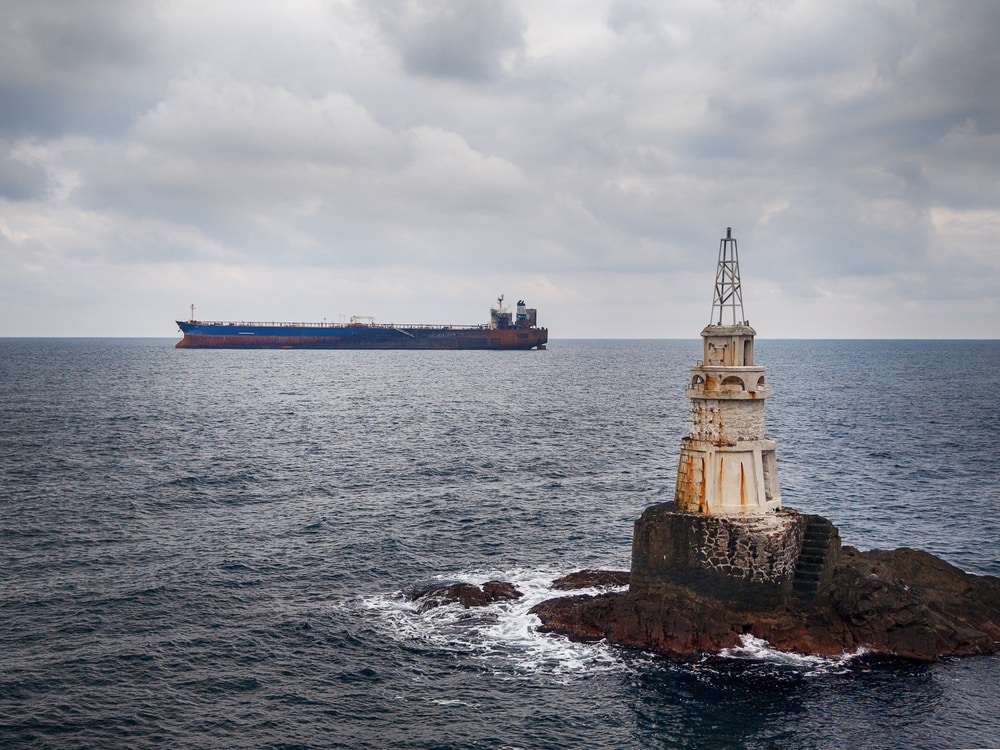
Russia appears to have armed a liquefied natural gas (LNG) carrier in the Baltic Sea with heavy machine guns, according to surveillance photographs taken by Estonia’s border authorities.
The images, first reported by European media outlets, including Follow the Money, show two heavy machine guns mounted on the bridge wings of Gazprom’s Marshal Vasilevskiy while it was operating in the Gulf of Finland in May.
One of the photographs also appears to show protective barriers surrounding the weapons.
NEW: Russia armed its LNG carrier Marshal Vasilevskiy with 12.7mm Utes heavy machine guns to defend against naval drones and possible European boarding attempts.
Photos from Baltic media show at least two gun positions flanking the bridge.
The ship is Russia’s only floating… pic.twitter.com/E9wHhWSUmx
— Clash Report (@clashreport) June 29, 2026
Analysts quoted by multiple media outlets identified the guns as likely Russian-made 12.7 mm Kord heavy machine guns.
The vessel has reportedly been making regular voyages from Russia’s LNG facilities to Kaliningrad, the country’s heavily militarized exclave between Poland and Lithuania on the Baltic coast.
The region serves as a key strategic outpost and provides an alternative port to terminals near St. Petersburg that have come under attack. It is also connected by pipeline to Russia’s domestic gas network.
Estonian officials confirmed the photographs were taken in May and said they had never before seen similar weapons mounted on a commercial Russian vessel.
Analysts said the weapons were likely intended to deter possible Ukrainian attacks on Russian energy shipping.
While some said the guns could engage small surface craft and low-flying drones at distances of up to about two kilometers (1.2 miles), others said they would be of limited use against aerial drones but could help deter attempts to approach or board the vessel.
The development follows a series of incidents involving Russian energy vessels. In March, the Russian-flagged LNG carrier Arctic Metagaz was damaged by an explosion in the Mediterranean, which Moscow blamed on Ukrainian naval drones. Ukraine did not claim responsibility.
Russia has also accused Western countries of interfering with its shipping and has increasingly used naval escorts to protect some tanker movements.