
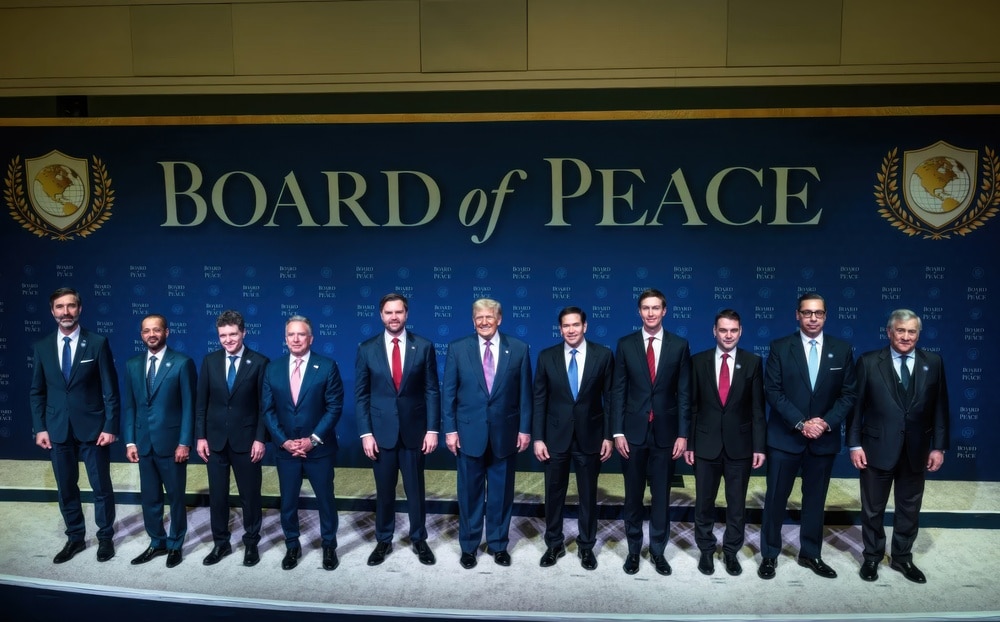
A leaked draft resolution shows President Donald Trump’s Board of Peace is considering broad legal immunity for its members and affiliated personnel operating in Gaza, according to documents first reported by The Guardian.
The four-page draft, labeled “sensitive but unclassified,” would shield members of the Board of Peace, its administrative arm known as the Office of the High Representative (OHR), Palestinian technocrats, international military personnel and contractors from “any arrest, detention or legal proceedings in the courts or other entities in Gaza.”
The Board of Peace, established under a U.N. mandate to oversee Gaza’s administration through Dec. 31, 2027, is led by a seven-member executive board that includes Trump’s son-in-law Jared Kushner, special envoy Steve Witkoff, White House chief of staff Susie Wiles and national security adviser Marco Rubio.
According to the draft dated June 2026, Trump, as chair of the Board of Peace, would have the authority to waive an individual’s legal immunity with the approval of a majority of the board. It is unclear whether the proposed immunity would extend beyond Gaza’s legal system to international courts.
The draft also proposes allowing the Board of Peace to acquire public property in Gaza “free of charge.”
According to The Guardian, a person familiar with the discussions told the newspaper that the proposed resolution had not been shared with Palestinian officials.
The Board of Peace denied creating an impunity framework for its members.
“There is no operative resolution or immunity framework,” a Board of Peace official said in a statement. “Any suggestion that this process is designed to create lawlessness or impunity is wrong, misleading and gets the issue entirely backwards.”
The official also rejected claims that Trump would have authority over immunity decisions.
“The suggestion that the President will have a role in establishing or waiving immunity in Gaza [is] categorically false,” the official said, adding that “the Board will ensure all personnel, contractors, and participating entities follow applicable law and operate under clear rules, oversight, and accountability mechanisms.”
The statement did not specify what oversight or accountability measures would be implemented.