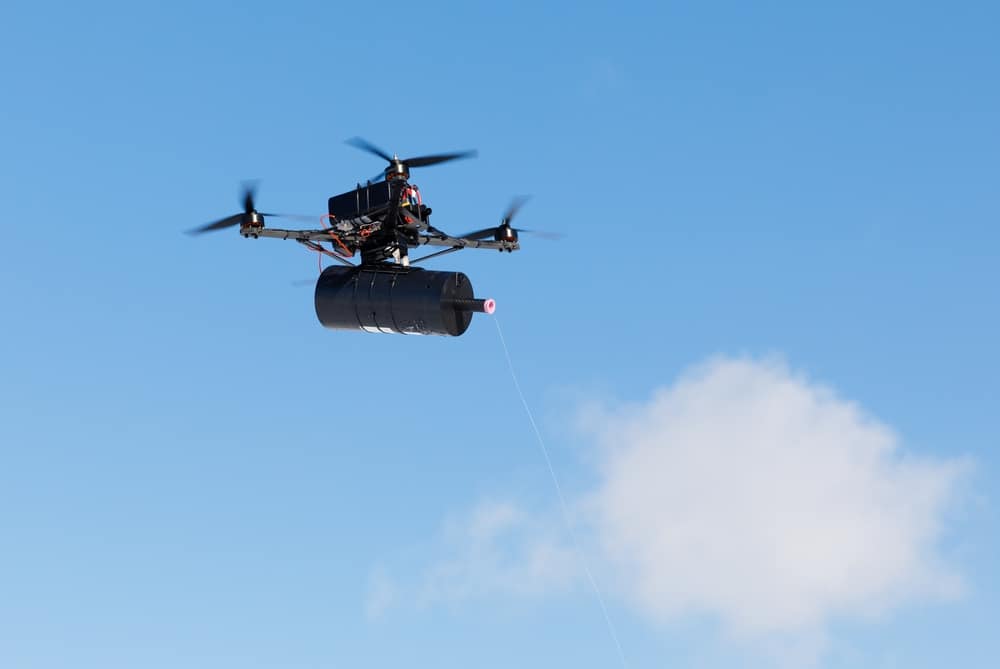
Footage recorded by a Russian military drone appears to show a fiber-optic first-person-view (FPV) drone losing its connection after a concentrated beam of light strikes the thin cable linking it to its operator. The video has circulated widely online but remains unverified, and Ukrainian officials have not confirmed the use of directed-energy weapons against fiber-optic control lines.
Fiber-optic FPV drones have become increasingly common in Russia’s war against Ukraine because they are immune to electronic jamming. Rather than relying on radio signals, the drones remain physically tethered to operators by a spool of cable that unwinds during flight. Severing that cable is one of the few ways to neutralize the drone before it reaches its target.
Very interesting footage from Russians indicating that Ukrainian Forces use laser light beam to fry fiber optic on “waiter” drones.
Quite unexpected turn of the warfare, take notes. pic.twitter.com/C1zDkBo8oU
— Dimko Zhluktenko 🇺🇦⚔️ (@dim0kq) March 10, 2026
Serhii “Flash” Beskrestnov, an advisor to Ukraine’s Ministry of Defense and military radio-technology specialist, responded sarcastically to Russian claims about the footage on Telegram. “Russians say we have found a way to counter fiber optics. With this thing we also scan brains and abduct people,” he wrote.
Ukraine has previously acknowledged developing directed-energy systems to counter drones. Ukrainian engineers demonstrated a prototype laser called Sunray to The Atlantic in February, describing a compact system capable of burning small drones out of the sky within seconds.
The footage appeared days after retired U.S. Rear Admiral Mark Montgomery told Babel that Ukraine could field battlefield lasers within one to two years, compared to four to six years for the U.S. military. “Will it work against a ballistic missile in a year or two? No. But against Shahed drones, yes,” Montgomery said.