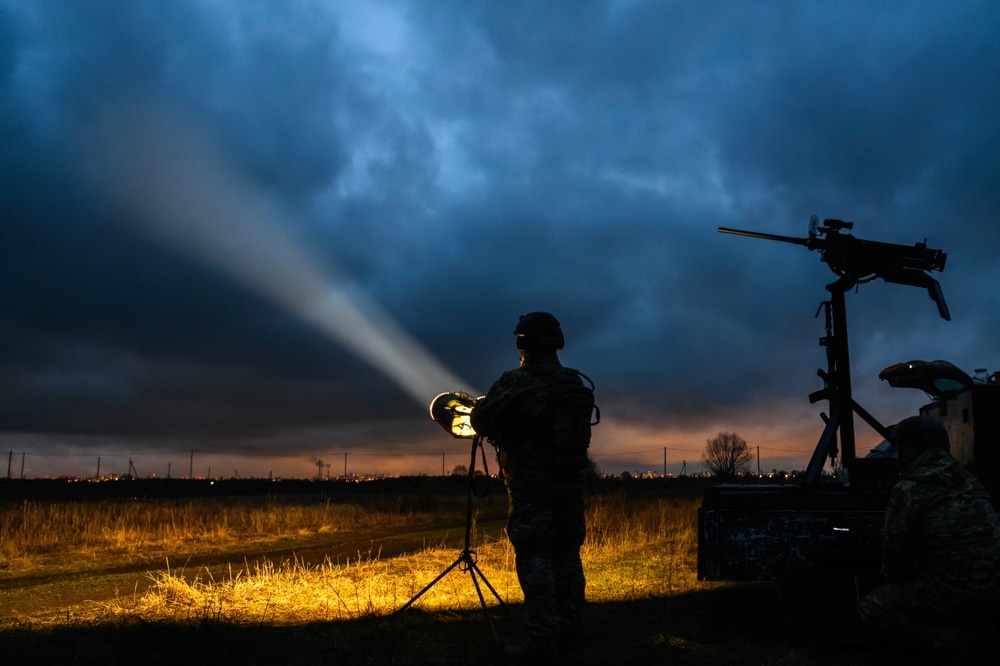
Thirty companies have received authorization from Ukraine’s Ministry of Defence to establish private air defense units, with several already conducting combat missions and collectively downing more than 20 Russian unmanned aerial vehicles (UAVs), the ministry announced June 8.
Thirty companies have already joined the pilot project aimed at integrating the private sector into Ukraine’s air defense system. The MoD has granted these companies authorized status to conduct air defense activities. https://t.co/uxqBwkFBNl
— Defense of Ukraine (@DefenceU) June 8, 2026
The pilot project, launched in late 2025 at the ministry’s initiative, was designed to strengthen protection of personnel and industrial facilities at enterprises regularly targeted by Russian drone strikes.
Participating companies operate under the command of the Air Force Command of the Armed Forces of Ukraine (AFU), making private air defense a formally integrated layer of the country’s broader air defense grid rather than an independent or unregulated force.
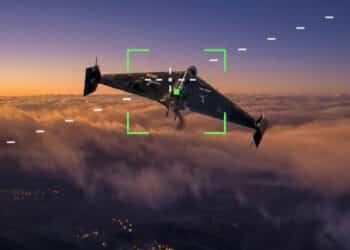
The units have downed Shahed-type one-way attack drones and Zala-type reconnaissance UAVs. The most operationally significant result came April 17, when a private group in Kharkiv Oblast intercepted a jet-powered Shahed-type loitering munition traveling at more than 400 km/h, the first confirmed intercept of that threat category by a non-state fire group. Standard propeller-driven Shaheds typically travel at roughly 180–200 km/h, making the jet variant approximately twice as fast and considerably harder to track and engage.
“This is a new level of complexity,” Defence Minister Mykhailo Fedorov said following the intercept. “The enemy is scaling up the use of jet-powered drones, which are faster and more difficult to intercept.”
Private air defense just downed a jet-powered Shahed at 400+ km/h for the first time. 19 enterprises are now forming private air defense groups, fully integrated into the Air Force’s unified command system. Next step: scaling. More targets downed, faster response -… pic.twitter.com/oa2dHXx11f
— Defense of Ukraine (@DefenceU) April 17, 2026
Of the 43 companies that have submitted applications since the project launched, 30 have been granted authorized status to conduct air defense activities.
The applicant pool spans multiple regions, including Kharkiv, Odesa, Kyiv, Poltava, and Zakarpattia oblasts, and represents a mix of ownership structures. Roughly half are critical infrastructure operators, while the remainder are private-sector companies.
Yuriy Myronenko, inspector general at the Ukrainian defence ministry and the principal architect of the project, told AFP that the goal is to give businesses “the possibility, at their own expense and with their own employees, to protect themselves against aerial threats.” The project was described by its designers as the first of its kind globally.
Fedorov has set a 2026 target of detecting 100% of aerial threats and destroying 95% of them.
The private sector’s contribution is one component of a broader multi-layered push that includes AI-powered interceptor drones developed by MaXon Systems, which passed combat testing in Kharkiv and automate approximately 95% of the interception process, and aerial interceptor launches from a modified An-28 aircraft that produced confirmed kills against Shahed-type drones in April.