
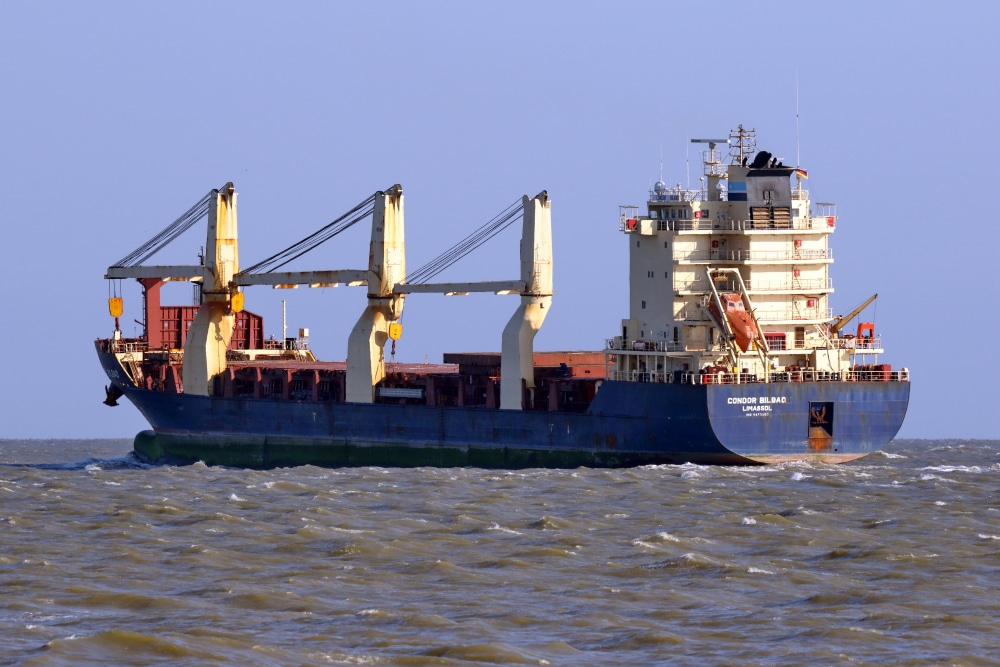
The Russian cargo ship Ursa Major, which sank off Spain’s southeastern coast in December 2024 after a series of unexplained explosions, may have been carrying nuclear submarine reactor components possibly destined for North Korea, according to a CNN investigation.
The Russian-flagged vessel, owned by the state-linked company Oboronlogistics, sank about 62 nautical miles off the coast of Murcia on Dec. 23, 2024, while reportedly traveling from St. Petersburg to Vladivostok. Two crew members were believed killed in the initial explosions, while 14 others were rescued.
The Ursa Major departed just two months after North Korean leader Kim Jong Un deployed troops to support Moscow’s war in Ukraine. CNN reporting suggests the incident may have involved a rare, high-stakes Western military operation aimed at preventing Russia from transferring advanced nuclear technology to North Korea.
Russian cargo ship Ursa Major sank after an engine room explosion in the Mediterranean.
14 crew members rescued; 2 missing. Ship, under US sanctions, was en route to Vladivostok carrying 380-tonne cranes.#UrsaMajor #Russia pic.twitter.com/N0CLHAAm4T
— BPI News (@BPINewsOrg) December 24, 2024
At the time of the incident, Oboronlogistics said the Ursa Major was carrying equipment for port infrastructure projects. However, images shared by open-source intelligence analysts showed cranes on board the vessel, raising the possibility they were intended for loading and unloading military supplies.
According to the Spanish government, the vessel may have been transporting components for two nuclear reactors “similar to those used by submarines.” Spain’s investigation concluded that the reactors aboard the Ursa Major were likely the VM-4SG model, commonly used in Russia’s Delta IV-class ballistic missile submarines.
Investigators also believe the ship may have been struck by a Barracuda-type supercavitating torpedo, believed to be possessed only by the U.S., several NATO countries, Russia and Iran.
According to public flight data, a U.S. nuclear detection aircraft later flew over the wreck site twice over the past year. The wreckage was also reportedly visited a week after the sinking by a suspected Russian spy ship, which triggered four additional explosions, according to a source familiar with the Spanish investigation.
In December 2025, North Korea released photographs of what it described as its first nuclear-powered submarine, showing leader Kim Jong Un standing beside the sealed hull of the vessel. The images did not show evidence of a functioning reactor inside.
Mike Plunkett, senior naval platforms analyst at defence intelligence firm Janes, told CNN that any decision by Russia to transfer nuclear reactor technology to North Korea would not be “undertaken lightly, and it’s only something that’s ever done between very close allies.”
If such a transfer had been attempted, he added, it would represent “a major move by Moscow” and something “very troubling, potentially, particularly if you’re South Korea.”









Good job, whoever did it.