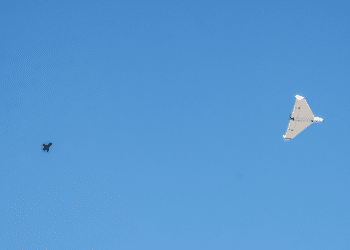
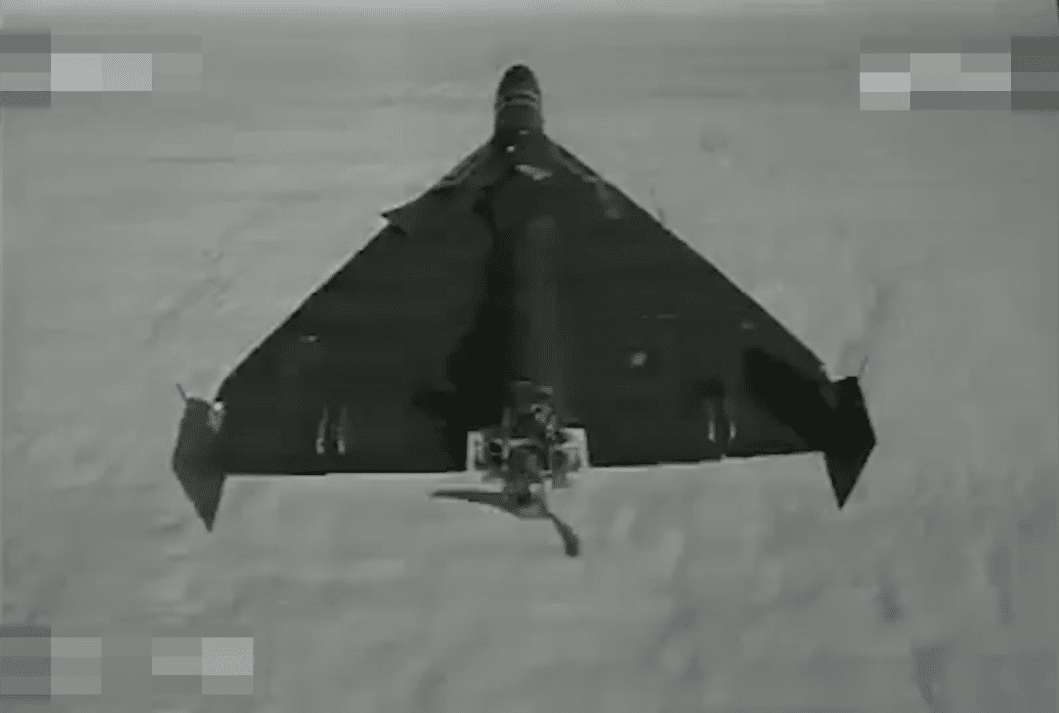
Russian forces have begun using Shahed strike drones to carry and release FPV drones mid-flight, according to video evidence shared by Serhiy Beskrestnov, an advisor to Ukraine’s Minister of Defense, on February 17.
Russian Shahed/Geran-type long-range UAV releasing an FPV drone over the Ukrainian city of Sumy.
An indication that the Russians have started employing Gerans in the role of an FPV drone carrier, just like they did with Molniya and Gerbera UAVs. pic.twitter.com/TjAFtsom5f
— Status-6 (War & Military News) (@Archer83Able) February 17, 2026
The footage, reportedly captured in Ukraine’s Sumy Oblast, marks the first confirmed visual proof of the Shahed operating as an FPV mothership. Beskrestnov, known by his callsign “Flash,” stated that each Shahed carries two FPV drones simultaneously.
“I am asking all anti-aircraft drone crews to pay attention to the possible presence of FPV on the Shahed,” Beskrestnov wrote in his Telegram post. “I ask all units of the Armed Forces of Ukraine to take note of the new risks.”
The development follows earlier warnings from Beskrestnov about factory-installed FPV mounting brackets discovered on Molniya and Gerbera-type loitering munitions. On February 3, he shared images of a crashed Gerbera fitted with an FPV mounting bracket, and video footage on February 9 showed a Gerbera releasing an FPV mid-flight.
Gerbera launching FPV drone pic.twitter.com/kQ55QXStMO
— TheComradeVortex (@ComradeVortex) February 9, 2026
LTE Networks and Ukrainian SIM Cards
According to Beskrestnov, Russian operators are exploiting Ukrainian mobile networks to control the dropped FPVs. After release, the drones navigate to areas with stable LTE coverage, allowing operators located in Russian territory to guide them onto targets. The FPVs can remain airborne for up to 45 minutes after deployment.
To access Ukrainian networks, Russian forces use Ukrainian SIM cards purchased in bulk without restriction. Beskrestnov has proposed passport-based SIM card sales with quantity limits as a countermeasure. While acknowledging the measure would not eliminate the problem entirely, he argued it would curtail large-scale abuse.
“Right now, any ‘waiter’ can buy 3,000 SIM cards without any problems and send them to Russia,” he said.
The proposed restrictions would require a parliamentary vote. Beskrestnov also mentioned temporary technical restrictions on data transmission in certain areas as an alternative, while acknowledging the social cost.
“We all understand how painful such actions are for the country,” he said. “Unfortunately, friends, this is war.”
Tactical Advantages
The mothership configuration addresses two limitations that have historically constrained FPV operations. Short range and operator vulnerability to counterstrikes have restricted their battlefield utility. By delivering FPVs via long-range platforms like the Shahed, Russian forces can conduct precision strikes hundreds of miles from launch sites while keeping operators safe inside Russian territory.
Dmitry Kuzyakin, chief designer at Russia’s Center for Integrated Unmanned Solutions, confirmed the rationale in a February 5 interview with Russian state media outlet TASS. He noted that while large drones fly far, FPVs offer superior maneuverability for engaging targets in dugouts, hitting specific windows, or striking moving vehicles.
The Shahed is not the first Russian drone repurposed for payload delivery. Ukrainian authorities previously discovered Shaheds modified to drop PTM-3 anti-tank mines over roads and fields, remotely mining Ukrainian supply routes.
On the same day the mothership video emerged, Russian strikes hit Sumy, damaging critical infrastructure, administrative buildings, educational institutions, and residential areas. Eight people were injured, according to Mezha.
Beskrestnov first warned on January 26 that Russian drones had begun using Starlink satellite communication terminals for attacks. He later reported that a Starlink-equipped UAV reached Dnipro.