A Russian intercontinental ballistic missile exploded shortly after launch Thursday at the Yasny test site in the Orenburg region near the border with Kazakhstan, releasing a possibly toxic purple cloud.
Footage circulating on social media captured the missile ascending briefly from the Yasny launch facility before losing control and detonating at an estimated altitude of 200 to 400 meters.
Local residents reported hearing a powerful blast, though authorities have not ordered evacuations or disclosed which missile system was involved.
Footage of a Russian ICBM test going (literally) upside down at the Yasny missile range today. pic.twitter.com/VEUf3GjvqA
— OSINTtechnical (@Osinttechnical) November 28, 2025
Ukrainian defence publication Defense Express reported that the unusual purple coloration of the cloud points to the possible use of “nitrogen tetroxide and unsymmetrical dimethylhydrazine propellants.” These chemicals, referred to colloquially as “amyl” and “heptyl,” are found in Soviet-era heavy missiles and their Russian successors.
Defense Express warned these substances pose severe health risks, stating that “heptyl has strong toxic and mutagenic effects and is deadly in high concentrations.”
A purple smoke cloud rose over Russia’s Yasny missile base in Orenburg region following an explosion, with locals reporting a failed rocket launch that detonated mid-air, Astra reports. pic.twitter.com/nxq20rnkSF
— WarTranslated (@wartranslated) November 28, 2025
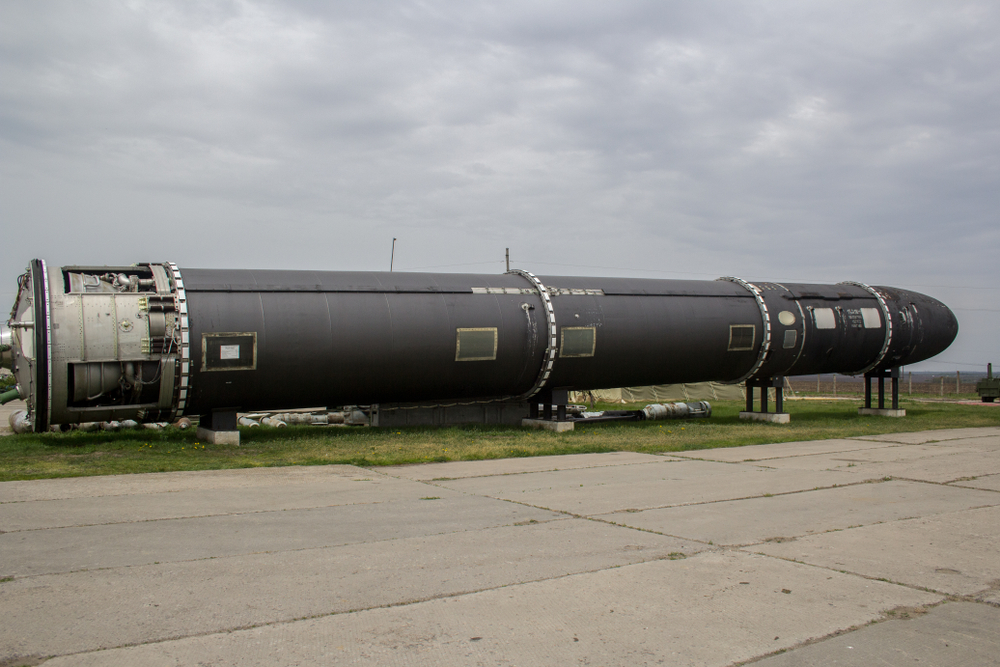
Analysts disagree on which weapon system failed. Defense Express pointed to several factors indicating the RS-28 Sarmat ICBM was likely involved: the Yasny site’s R-36-compatible silos, the chemical signature of the fuel, and the lack of any scheduled satellite launch. The outlet characterized these as a “very strong clue” pointing to the Sarmat.
Ukrainian defense publication Militarnyi offered a different analysis, suggesting the failed weapon could be a UR-100N ICBM carrying an Avangard hypersonic glide vehicle. Both missile types operate from Yasny, making identification difficult. The Avangard system entered limited service in 2019.
Another defense-focused publication, Defence Blog, reported that online aviation observers detected the deployment of an RC-135S Cobra Ball aircraft to Alaska, indicating possible U.S. intelligence collection efforts targeting Russian missile testing. The reconnaissance platform arrived at Anchorage and was joined by a second Cobra Ball from Kadena Air Base.
Yesterday, Cobra Ball 61-2662 deployed to Anchorage. It joins 62-4128 which flew in from Kadena some time ago. That flight was not tracked. It seems a Russian test missile is afoot that they do not want to miss. Could this be a Sarmat test from an alternate location since the… pic.twitter.com/81spz3MAIL
— MeNMyRC (@MeNMyRC1) November 26, 2025