
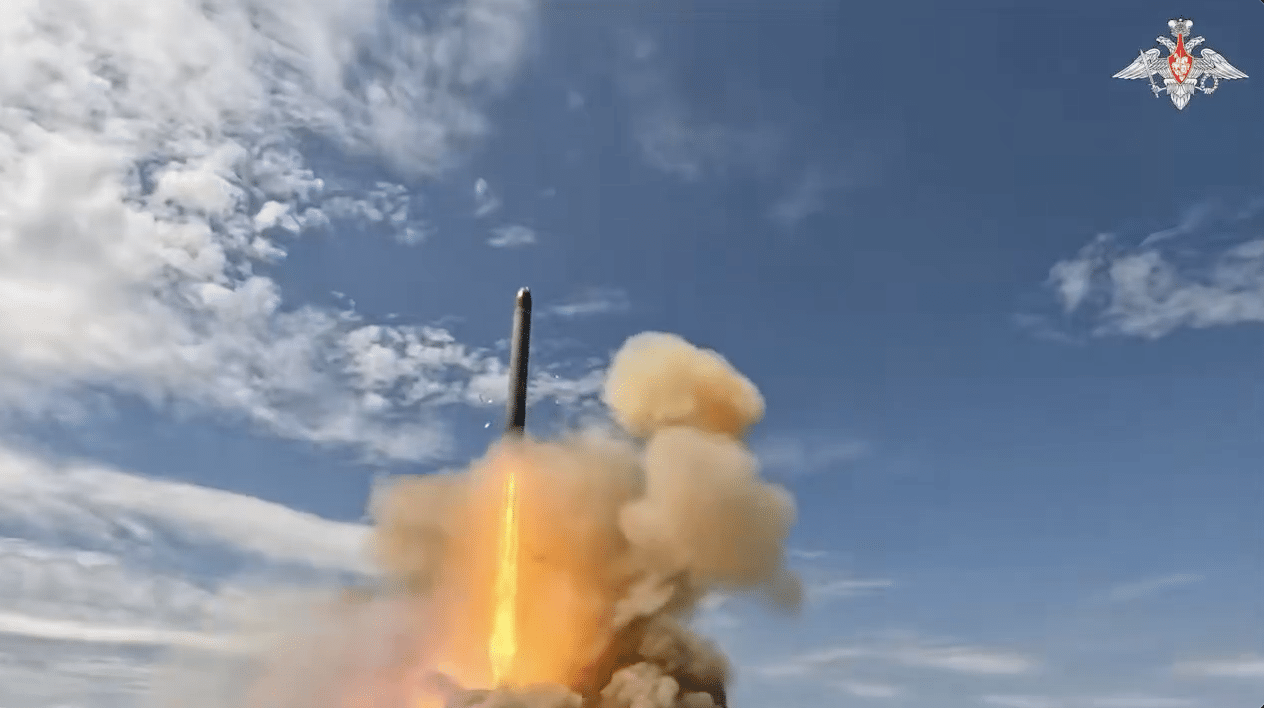
Russia said Tuesday it successfully tested the nuclear-capable RS-28 Sarmat intercontinental ballistic missile (ICBM) with President Vladimir Putin announcing plans to place the weapon into combat duty by the end of 2026.
The missile, known in the West as “Satan II,” is intended to replace around 40 aging Soviet-built Voyevoda missiles. Speaking in televised remarks, Putin described the Sarmat as “the most powerful missile in the world” and claimed its warhead yield is more than four times greater than Western equivalents.
🇷🇺 On May 12, President #Putin received a report on the successful test of the Sarmat missile.
💬 With 35,000+ km range, enhanced accuracy & the ability to overcome all existing & future missile defence systems, Sarmat is a formidable deterrence asset.https://t.co/waBvSOHm7I pic.twitter.com/rBchrCce1r
— MFA Russia 🇷🇺 (@mfa_russia) May 12, 2026
He said the missile has the “ability to penetrate all existing and future anti-missile defense systems” and has a range exceeding 35,000 kilometers (21,750 miles).
However, independent estimates on the system’s specifications differ. According to the U.S.-based nonprofit Missile Defense Advocacy Alliance, the missile has an estimated range exceeding 10,000 kilometers (6,200 miles) and can reportedly carry up to 16 independently targetable nuclear warheads.
By comparison, the U.S. LGM-30 Minuteman intercontinental ballistic missile has a range of about 11,000 kilometers (6,835 miles) and is deployed with a single warhead, although it was originally designed to carry up to three.
Russia first unveiled the Sarmat in 2018 as part of a broader nuclear modernization program that Putin said would render U.S. missile defense systems ineffective. Since then, the missile’s development has faced repeated setbacks and delays.
Prior to Tuesday’s launch, it had recorded only one publicly known successful test. One Sarmat test in September 2024 reportedly failed, with Western experts saying the launch left a large crater at the missile silo site.
Maxar collected new high-resolution satellite imagery yesterday (September 21st) that reveals the aftermath of a dramatic launch failure of a Russian RS-28 ICBM at a launch site in the Plesetsk cosmodrome. 📷@Maxar
Launch site before vs after pic.twitter.com/ikel3UBii6
— George Barros (@georgewbarros) September 22, 2024
Russia has expanded its next-generation weapons program with systems including the Avangard hypersonic glide vehicle, capable of traveling at speeds of up to 27 times the speed of sound, and the nuclear-capable Oreshnik intermediate-range ballistic missile, which has a range of up to 3,100 miles.
Russia is also in the “final stages” of developing the Poseidon underwater drone, designed to trigger a radioactive tsunami near enemy coastlines, and the Burevestnik nuclear-powered cruise missile, which is intended to have unlimited range.
🚨⚡️Putin says the Poseidon unmanned underwater vehicle and the Burevestnik global-range cruise missile are in their final development stages. pic.twitter.com/qW7lUm4OXd
— RussiaNews 🇷🇺 (@mog_russEN) May 12, 2026