
Russia launched its Oreshnik intermediate-range ballistic missile against Ukraine overnight Thursday into Friday, striking the western Lviv region approximately 60 miles from the NATO border with Poland. The attack marked only the second confirmed use of the nuclear-capable hypersonic weapon since it was first employed in November 2024.
Videos posted to social media, including CCTV footage, captured the strike and showed the illuminated reentry vehicles descending toward the ground.
Ukraine’s Air Force confirmed that Russia launched an Oreshnik medium‑range ballistic missile at Lviv region overnight. It was reported that the missile reached a speed of about 13,000 km/h. Footage reportedly shows the moment the so‑called Oreshnik hits the area. pic.twitter.com/X80w6LOgnH
— WarTranslated (@wartranslated) January 9, 2026
More footage of the Russian Oreshnik IRBM strike on Lviv Oblast. pic.twitter.com/9f5SLanvsr
— AMK Mapping 🇳🇿 (@AMK_Mapping_) January 8, 2026
The Russian Defense Ministry confirmed the strike on Telegram, claiming it was retaliation for what Moscow called a “terrorist attack” on President Vladimir Putin’s residence in Novgorod Oblast on December 29. Ukraine and the United States have both disputed that any such attack occurred, with Kyiv calling the accusation “an absurd lie” and President Trump saying he did not believe the strike happened.
“Today, in response to the Kyiv regime’s terrorist attack on the residence of the President of the Russian Federation in the Novgorod region, the Russian Armed Forces launched a massive strike using long-range, land- and sea-based precision-guided weapons, including the Oreshnik medium-range ground-mobile missile system,” the ministry stated.
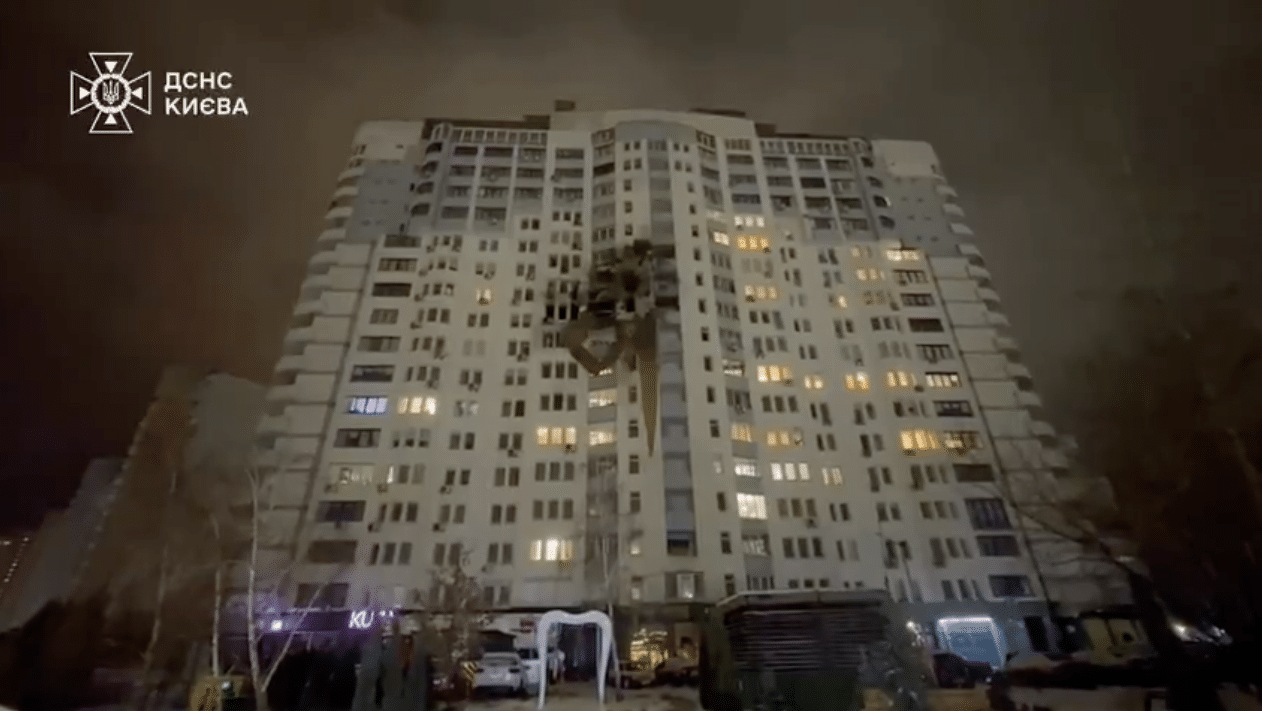
The Oreshnik was part of a larger bombardment that Ukrainian President Volodymyr Zelenskyy said included 242 drones, 13 ballistic missiles, 22 cruise missiles and the single IRBM. At least four people were killed in Kyiv, including an emergency medical worker, and 25 others were wounded as apartment buildings were struck across the capital.
In Kyiv and the region, the aftermath of the massive Russian strike is still being dealt with. All necessary services are deployed. Twenty residential buildings alone were damaged. Recovery operations after the strikes also continue in the Lviv region and other regions of our… pic.twitter.com/AMkwfKHOkC
— Volodymyr Zelenskyy / Володимир Зеленський (@ZelenskyyUa) January 9, 2026
🟥 The infographic map shows the trajectory of the air-missile attack carried out by Russian terrorists on Ukraine last night and at dawn today –
🚀 As you can see, the main direction of the attack was Kiev, to bomb which the Russians used hundreds of Shahid-type kamikaze… pic.twitter.com/QjyUtwfTrw
— The Battlefield (@TTheBattlefield) January 9, 2026
Ukraine’s Air Force reported the missile was launched from the Kapustin Yar test range in Russia and followed a ballistic trajectory at approximately 13,000 kilometers per hour (8,078 mph).
Putin has claimed no air defense system can stop the Oreshnik because it travels at speeds exceeding Mach 10.
While Moscow did not specify the target, Russian military bloggers and media reported the missile struck an underground natural gas storage facility in the Lviv region, according to CBS News. Ukrainian officials denied gas infrastructure was hit, with lawmaker Serhiy Nahornyak stating the facility was not targeted. However, officials did say that critical infrastructure was targeted without giving details.
Lviv Mayor Andriy Sadovyi reported that the automatic gas safety system in the village of Rudno was triggered by the shock wave, temporarily cutting gas supply to 376 households.
The Security Service of Ukraine displayed recovered fragments of the Oreshnik missile, including the stabilization and guidance unit, spare parts from the engine, fragments of the orientation mechanism, and nozzles from the firing platform.
The Security Service of Ukraine showed fragments of an Oreshnik missile used by Russia in an attack on the Lviv region and said the strike qualifies as a war crime. pic.twitter.com/pO6ovNvqyF
— KyivPost (@KyivPost) January 9, 2026
Initial assessments suggest the Oreshnik carried inert warheads rather than explosive or nuclear payloads, as was apparently the case in the November 2024 strike on Dnipro. Ukrainian intelligence officials have previously stated the missile carries six warheads, each containing six submunitions, for a total of 36 reentry vehicles.
Ukrainian military communications specialist Serhii Beskrestnov, known by the call sign “Flash,” dismissed Russian milblogger claims that the missile penetrated tens of meters into the ground.
He assessed the strike was intended to send a message rather than cause mass destruction, which explains the choice of target location.
“The Oreshnik strike on Lviv wasn’t intended to cause global damage. I believe it was a message to Europe about Russia’s capabilities and determination. That’s why a western city of Ukraine was chosen for the strike,” he wrote.
Beskrestnov cautioned against dismissing the weapon’s lethality based on its use with inert warheads, noting the Oreshnik was designed as a nuclear delivery system.
“Oreshnik is a very dangerous and effective weapon in its nuclear version. That’s why the missile was created. It has 6 separate, essentially autonomous nuclear submunitions,” he wrote. “It’s just that when firing 36 ‘shells’, this weapon is not effective and is purely a demonstration of its capabilities.”
Broader Attack Impact
The overnight barrage caused significant damage across Ukraine. In Kyiv, around half of the city’s apartment buildings, nearly 6,000 units, lost heat as temperatures dropped to minus 8 degrees Celsius (17.6 Fahrenheit), Mayor Vitali Klitschko said. Water supplies were also disrupted, leaving roughly half a million households without power.
Zelenskyy said 20 residential buildings were damaged in the capital alone.
“The aftermath is still being dealt with,” Zelenskyy wrote on social media. “Recovery operations after the strikes also continue in the Lviv region and other regions of our country. Unfortunately, as of now, it is known that four people have been killed in the capital alone. Among them is an ambulance crew member. My condolences to their families and loved ones.”
European leaders condemned the strike as an escalation designed to intimidate the West.
EU foreign policy chief Kaja Kallas said the attack was “meant as a warning to Europe and to the US.”
“EU countries must dig deeper into their air-defence stocks and deliver now,” Kallas said.
German Chancellor Friedrich Merz added: “Threatening gestures are intended to instill fear, but they will not work. We stand with Ukraine.”
Ukraine’s Foreign Minister said the use of an Oreshnik so close to EU and NATO borders posed a “grave threat” to European security and called on partners to increase pressure on Moscow.
A State Department spokesperson told Fox News Digital that the US remains committed to ending the war through diplomatic means, emphasizing it is the only path toward durable peace.