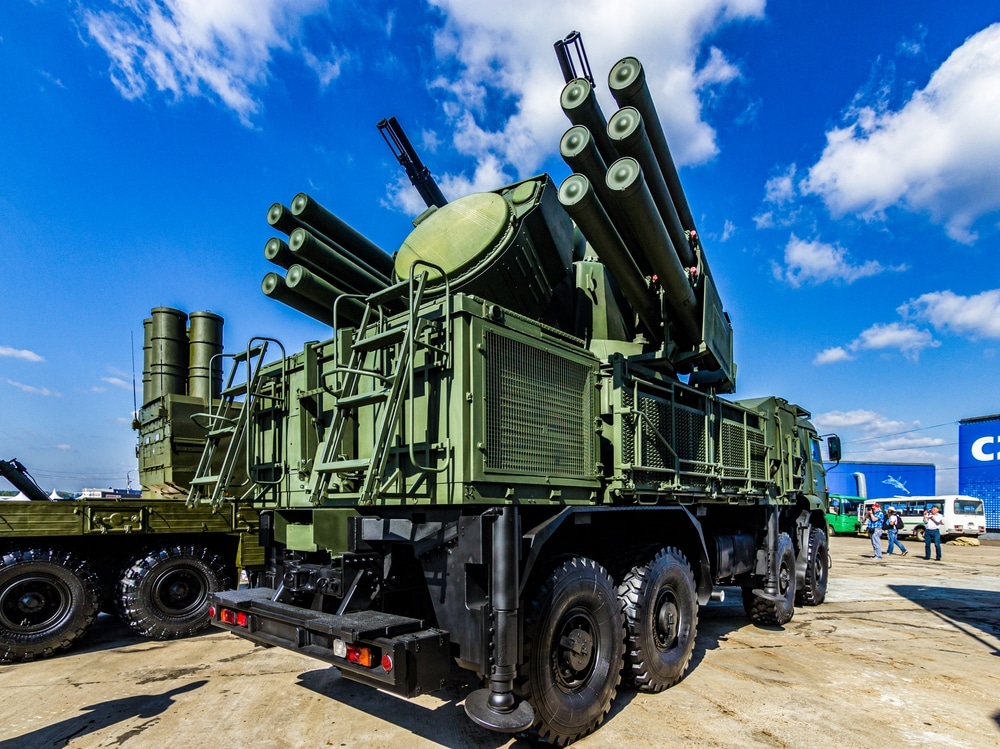
A Russian Mi-26 heavy-lift helicopter lowered a Pantsir-SMD-E air defense system onto the roof of a 42-story Moscow skyscraper this week, installing a counter-drone weapons platform at roughly 560 feet above street level while rain fell over the city.
Video of the operation, first posted by Massimo Frantarelli on X, shows the helicopter placing the system on the Nordstar Tower, an office building on Begovaya Street in Moscow’s Northern Administrative District, roughly two miles from the GRU’s Khodinka compound.
🚁Mil Mi-26T.. heavy transport helicopter.
Pantsir-SMD” ADMS?
🎥”chegara.siz” pic.twitter.com/WEAwTKQLsg— Massimo Frantarelli (@MrFrantarelli) May 27, 2026
The Pantsir-SMD-E is a newer variant of Russia’s Pantsir short-range air defense family, purpose-built for the counter-drone mission. Its most notable design change is what it does not have: the twin 30mm autocannons carried by earlier Pantsir models are gone. KBP Instrument Design Bureau dropped the guns entirely for the SMD-E variant, replacing them with missiles. Defense Express reported that the autocannons proved ineffective against small drone targets.
The system can reportedly carry up to 48 TKB-1055 anti-drone mini-missiles, each with a range of roughly four miles, or up to 12 of the larger 57E6 surface-to-air missiles capable of reaching targets at about 12 miles. A mix of both is also possible. The TKB-1055 rounds are quad-packed into each canister position, which allows the system to achieve a 48-round magazine.
The radar suite includes an active electronically scanned array with a detection range of about 15 miles and a millimeter-wave fire-control radar for guidance. First unveiled at Russia’s Army-2024 exhibition in August 2024, the SMD-E entered service roughly a year later, with Russian forces receiving the system in September 2025.
The removal of the autocannons also reduces weight, which matters when the system is being slung beneath a helicopter and placed on a civilian rooftop. The Mi-26, the largest operational transport helicopter in the world, can carry more than 44,000 pounds as a slung load.
Russia has previously built dedicated elevated towers around the Moscow region in order to give air defense systems a clear line of sight for its radar, and more time to hit its targets. Defense Express has previously compared those structures to the Flak towers Nazi Germany built during World War II to defend Berlin and other cities from Allied bombers.
The rooftop installation is part of a much larger air defense buildup around the Russian capital that has accelerated since 2023. German newspaper Bild reported earlier this month that Russia deployed more than 40 additional Pantsir systems around Moscow in 2025 alone, some transferred from other regions.
OSINT analyst Mark Krutov has tracked the total number of air defense systems added to Moscow’s defensive ring since 2023 at more than 100.
4/4 See the current map of the post-war installed AD systems in Moscow and Moscow Oblast here: https://t.co/52sztw3x69 pic.twitter.com/IlguoOLkFI
— Mark Krutov (@kromark) May 28, 2026
The urgency is not hard to explain. Ukraine’s long-range drone campaign has repeatedly reached the capital. On May 17, Ukraine launched what Russian state media described as the largest drone attack on Moscow in over a year. Russia’s Defense Ministry claimed it intercepted 556 Ukrainian drones overnight.
Ukrainian drone production has scaled to match the ambition. Ivan Kirichevskyi, a soldier with Ukraine’s 413th Unmanned Systems Regiment, told Euromaidan Press that production of the FP-1 and An-196 Lyutiy drones has reached volumes “comparable to or perhaps even exceeding” Russia’s Shaheds.
That capacity comes at a cost Russia may not have anticipated. A March 2026 report by the open-source intelligence outlet Tochnyi documented confirmed Ukrainian strikes on S-300, S-400, Tor, and Pantsir systems across Russia’s southern military districts, concluding that the cumulative effect has been a “progressive hollowing out” of Russian air defense coverage that production and repair cannot offset. Every Pantsir system defending a Moscow rooftop is one not defending an oil refinery, a military airfield, or a front-line position.