
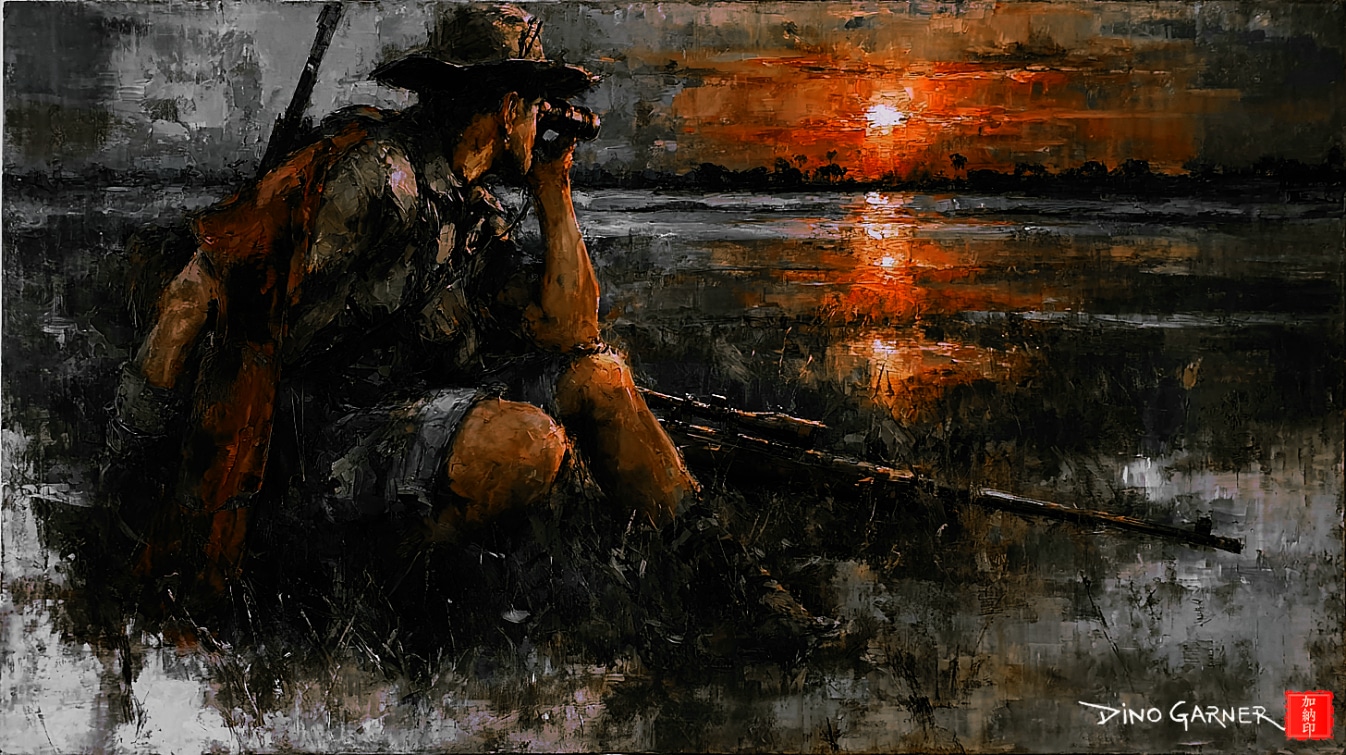
Before I joined the 1st Ranger Battalion in 1994, I was a biophysicist.
I had spent the better part of a decade in electrophysiology labs — Duke Medical Center, USC, Scripps, Mote. NSF and NIH graduate fellowships. I built my own preamplifiers and pulled glass microelectrodes my peers were generous enough to call the sharpest in the world. My doctoral research at USC was on the biophysical mechanisms of memory storage in CA1 pyramidal cells. Before that, at Scripps and Mote, I cultured shark brain explants — the first successful elasmobranch tissue culture in the scientific literature, eventually published in Tissue and Cell. I had also done original work on electroreception in sharks, including the finding that they prefer complex AC fields over DC during prey detection.
Then I dropped it and went to Hunter Army Airfield.
I graduated #2 of 150 from the Ranger Indoctrination Program. I scored a perfect 50 of 50 on the Expert Infantryman Badge; Colonel Ralph Puckett — Medal of Honor — pinned the badge. I rewrote the explosives and demolitions manual for the advanced course. I served a combat tour with SEAL Team Six aboard USS America. After the Army I founded two international private security firms and ran roughly 220 missions across three continents — principal extraction, personnel recovery, persons-of-interest operations. Later, in the bush years that followed, I ran more than thirty counter-poaching operations against industrial wildlife trafficking networks across southern Africa.
The institutions of American power treat those lines on a CV as if they belong to three different men. They do not. They are the same operator solving variants of the same problem in different domains. The problem is always this: extract signal from noise, then close the loop.
When Admiral Frank Bradley told SOF Week 2026 that the force needs “PhDs who can win a bar fight,” he was reaching back to William Donovan’s eighty-year-old framing of the OSS operator. He was right to. But the dichotomy embedded in the joke is false—and the institutional habit of treating it as real is the deepest reason the conventional pipeline keeps failing to produce what Bradley is asking for.
The bar fight is the PhD.
The mental image of a doctoral candidate getting in a fistfight is funny because most people picture intellectual work and violent work as opposites. They are not. They never were. They have just been organizationally separated by a force structure that selects intellect into staff billets and violence into trigger-pulling billets and rarely permits them to mix.
The OSS knew better. Donovan recruited Yale linguists and bank robbers into the same teams and put them behind German lines. The result was not a compromise on either dimension—it was a different category of operator. That category is what Bradley is reaching for now, and the reason he has to reach for it is that the conventional pipeline has spent eighty years building everything except that.
Here is the operational reality.
Moving requires applied physics. When Bradley says modern movement requires evading multispectral surveillance, what he is naming is a physics problem with a deadline. Thermal signature management is a heat-transfer problem. RF discipline is an emissions-control problem. Pattern-of-life randomization is a Bayesian problem—you are explicitly trying to defeat an adversary who is updating priors on your behavior. In Southern Africa, the poaching syndicates ran better SIGINT against the protection units than the protection units ran against them; they had paid informants inside the rangers and used the public patrol schedule to vector their teams in. Beating that meant rebuilding ranger operational security from first principles: cell-phone discipline, vehicle electromagnetic profiles, route entropy. The men who could not work through it did not last the season.
Communicating requires network architecture fluency. A modern team that does not understand the difference between mesh and star topology, between burst transmission and continuous, between a compromised exfil node and a clean one, gets killed by its own radios. In 2005, when I served as the sole test engineer for the U.S. military’s first passive low-frequency RFID demonstration at the U.S. Naval Academy, the problem set I was solving was a recognizable cousin of what I had been doing at the microelectrode bench fifteen years earlier. How does a signal propagate. What corrupts it. What does the noise tell you about the channel. The hardware changes; the physics does not. Operators who learn the physics — not the user interface, the physics — are the ones who can troubleshoot a TAK network under contact at three in the morning, with magazines on their plate carriers, because they understand the system in their hands.
Finishing requires the bar fight. And this is where I would extend Bradley rather than just agree with him: the kinetic finish is not separate from the intellectual work that preceded it. It is the same problem, downstream. Hunting industrial wildlife trafficking networks in Southern Africa is a logistics problem before it is a shooting problem. The syndicate moving rhino horn or pangolin scale out of Mozambique, Zimbabwe, or South Africa is a financial network. You map it with link analysis, predictive geospatial modeling, mobile forensics off captured handsets, sometimes a Cellebrite dump that traces a supply chain across four countries before lunch. Then, because the network has a kinetic edge that will kill the ranger who knocks on the wrong hut, you go close the loop yourself, in the dark, against armed men who took the work because it pays better than any legal alternative inside a six-hundred-mile radius.
The analyst writes the targeting package. The operator executes it. They are the same person. The kinetic act is not the end of the intellectual work; it is the application of it.
This is why I read General Donovan’s caveat at SOF Week as complementing—not qualifying—Bradley’s thesis. Donovan said someone still has to put a foot on the ground to declare victory. He is right. The technologies do not replace the operator; they are the operator’s instrument set. A radiologist is not replaced by an MRI; the MRI is what makes the radiologist’s judgment matter. STEM does not replace warfighters. It is what makes their judgment lethal at modern tempo.
The risk Donovan is naming, that we engineer the grit out of the force in the name of technical sophistication, is real. But the risk runs the other way too. We have spent two decades producing operators who can clear a room and not enough who can read a spectrum trace, exploit a captured device, or reason about a drone swarm under contact. Those are not exotic skills any longer. They are the basics. The next twenty years will be unkind to teams that cannot do both.
So the recruiting argument Bradley makes, that SOCOM needs to attract more STEM-oriented service members, is correct, but the framing is slightly off. SOCOM does not need to find STEM people and teach them to fight. It does not need to find fighters and teach them STEM. It needs to identify and select for the rarer profile: people who are already integrating both, in their habits of mind, before they ever walk into a recruiter’s office.
These people exist. I have worked alongside them. They are usually unhappy at their day jobs because conventional employers can absorb only half of what they are. A network engineer who lifts heavy and shoots competitively on weekends is not a curiosity; he is the next generation of the SOF operator, and we are losing him to FAANG salaries because the personnel system cannot offer him a billet that uses both halves of his brain.
If Bradley wants more PhDs who can win a bar fight, the question is not how to manufacture them. It is how to recognize the ones who already exist, get them inside the wire faster, and build a pipeline that does not waste the half of them the conventional force has historically thrown away. I argued a version of this earlier this year in Choke Points: Critical Minerals and Irregular Warfare in the Gray Zone at the Irregular Warfare Initiative, and I am developing a longer treatment of the personnel question—The Recruiting Myth and the Gap-Year Gamble — currently in prep. The dichotomy Bradley is trying to dissolve is not just a cultural problem inside the force. It is a personnel-system problem, and it is solvable.
A closing observation, from the side of this where the missions actually got run.
Two hundred and twenty operations on the security side. Thirty-plus in the bush. Every one of them began as an intelligence problem before it became a kinetic problem. Every one started with someone—sometimes me, sometimes a partner with a different specialty—doing patient analytic work that produced a window of opportunity measured in minutes. The operators who closed those windows had to be able to do the analytic work and step into the room.
That is the operator Donovan described in 1942. It is the operator Bradley is asking for in 2026.
The institution that produces him at scale wins the next twenty years.
The dichotomy is false. The bar fight is the PhD. We just need a force structure that finally understands they were never two jobs.
Dino Garner served in the 1st Ranger Battalion, 75th Ranger Regiment. He founded two international private security firms, conducting 220+ missions across three continents and 30+ counter-poaching operations against wildlife trafficking networks in southern Africa. He trained as a biophysicist at USC (doctoral research in neurobiology and biophysics), Duke Medical Center, and Scripps, on NSF and NIH graduate fellowships. He is the founder and principal of CRUCIBEL LLC in Bozeman, Montana, mentors at the Three Rangers Foundation, and writes on defense and government policy for CrucibelJournal.com.





This is a very well written article.
Talk about “hitting the nail on the head”
Great article. Answering the initial questions to solve the “kinetic answer” seems to have been a disconnect in the past. Either for lack of understanding or purely from ignorance. Hopefully following this path will eliminate that.
I am also astounded at Dr. Garners insight. I too served in 1/75 RGRS and later 5th SFG. I enlisted on a ‘Ranger Contract’ and went the traditional route into Batt.
Today I am a Civil Engineer with a MBA. If only there had been a way to combine my curiosities with the provided skilset I would most likely have spent another decade in SOF. Alas. To ETS to go to college after my time in service was the only route.
Perhaps Bradley, er al can review the enlisted ranks more keenly. My family was to poor for college but my ambitions were rich!
RLTW!
Recruiting people to be operators from the public isn’t easy. In recon we didn’t. We recruited for Bn but not Force. SgtMaj would speak to graduating classes of infantry school. Volunteers would take a mini indoc. Those who passes went to Bn for recon Indoc program (RIP). At force they came to us. Minimum time in service 8 years, rank Sgt. Screened them for Security Clearance, IQ and vision. Then they ran an all day indoc followed by a written exam.
Well said. Well done.
Great read. Timely, thought provoking and very relevant in today’s world. This has me thinking about what a pre service pipeline looks like and how to mentor potential applicants, or get them interested in such an applicable education and nurturing skill sets that will assist in success.
I’m not pre-service let alone Regiment.
Again, gave me things to ponder and thoughts to share.
“The dichotomy is false. The bar fight is the PhD. We just need a force structure that finally understands they were never two jobs.”
Perfectly said. I am 76, retired Army SF and retired professor of business. It always seemed as though the Agency set the table and we served dinner. We thought better integration was the missing piece, you made a far more important argument. I hope it is heard.
Theodore von Kármán famously stated: “…scientific results cannot be used efficiently by soldiers who have no understanding of them, and scientists cannot produce results useful for warfare without an understanding of the operations..
OODA LOOP.