
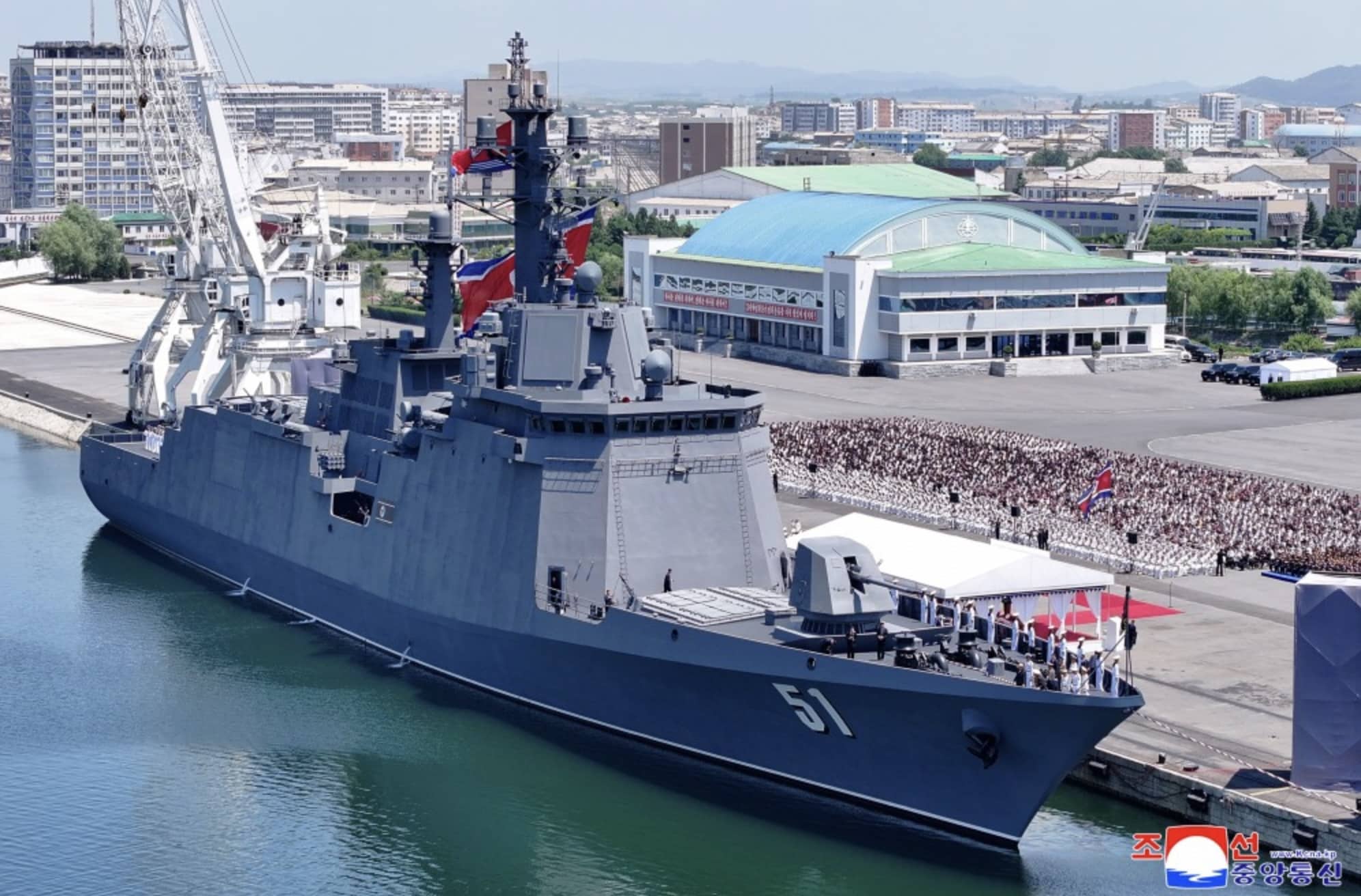
North Korea commissioned its first ocean-going surface warship, the 5,000-ton destroyer Choe Hyon, at Nampho Shipyard on June 23, with leader Kim Jong Un declaring an end to more than 70 years of naval stagnation.
Commissioning Ceremony of New-type Multi-mission Destroyer Choe Hyon Held with Splendor pic.twitter.com/DG742SrVuJ
— DPRKPics (@DPRKpics) June 25, 2026
Kim assigned the Choe Hyon (pennant 51) to the Korean People’s Army Navy (KPAN) West Sea Fleet. “The Navy was the weakest of all the services of our armed forces,” Kim said, according to the Korean Central News Agency (KCNA). “Things have changed obviously now.”
At 5,000 tons, the Choe Hyon is Pyongyang’s first true blue-water warship, a distinction that complicates U.N. arms sanctions enforcement. Carl Schuster, a former director of the U.S. Pacific Command’s Joint Intelligence Center, said “a warship escorting a maritime arms shipment complicates an intercept and boarding operation,” a scenario previously impossible given North Korea’s coastal-defense fleet.
Kim said the KPAN’s nuclearization is “advancing along its own course” and ordered shipyards to produce two surface ships annually through 2030, including 10,000-ton strategic cruisers, North Korea’s term for nuclear weapons-capable vessels.
North Korea’s Kim Jong Un says Pyongyang will build 10,000 tonne warships and arm its navy with nuclear weapons, state media reported, announcing the plans at the commissioning of the 5,000 tonne destroyer Choe Hyon. pic.twitter.com/vXNiPXENXH
— Open Source Intel (@Osint613) June 24, 2026
Kim also called for construction of new naval bases to harbor the enlarged fleet, a directive discussed at a Central Committee plenary the previous day.
The sister vessel Kang Kon (pennant 52), which capsized at its May 2025 launch and was relaunched the following month, completed a navigation trial on June 4 and is slated for commissioning soon.
Leif-Eric Easley, a professor at Ewha University in Seoul, said the construction pace suggests North Korea may be receiving “significant material and technological assistance from Russia,” to which Pyongyang has supplied weapons and troops in support of Moscow’s war in Ukraine.
Schuster said North Korea has “potentially forced the United States, Japan, and South Korea to expand their monitoring” of its navy, though the Choe Hyon’s “survivability is limited during a conflict.”