
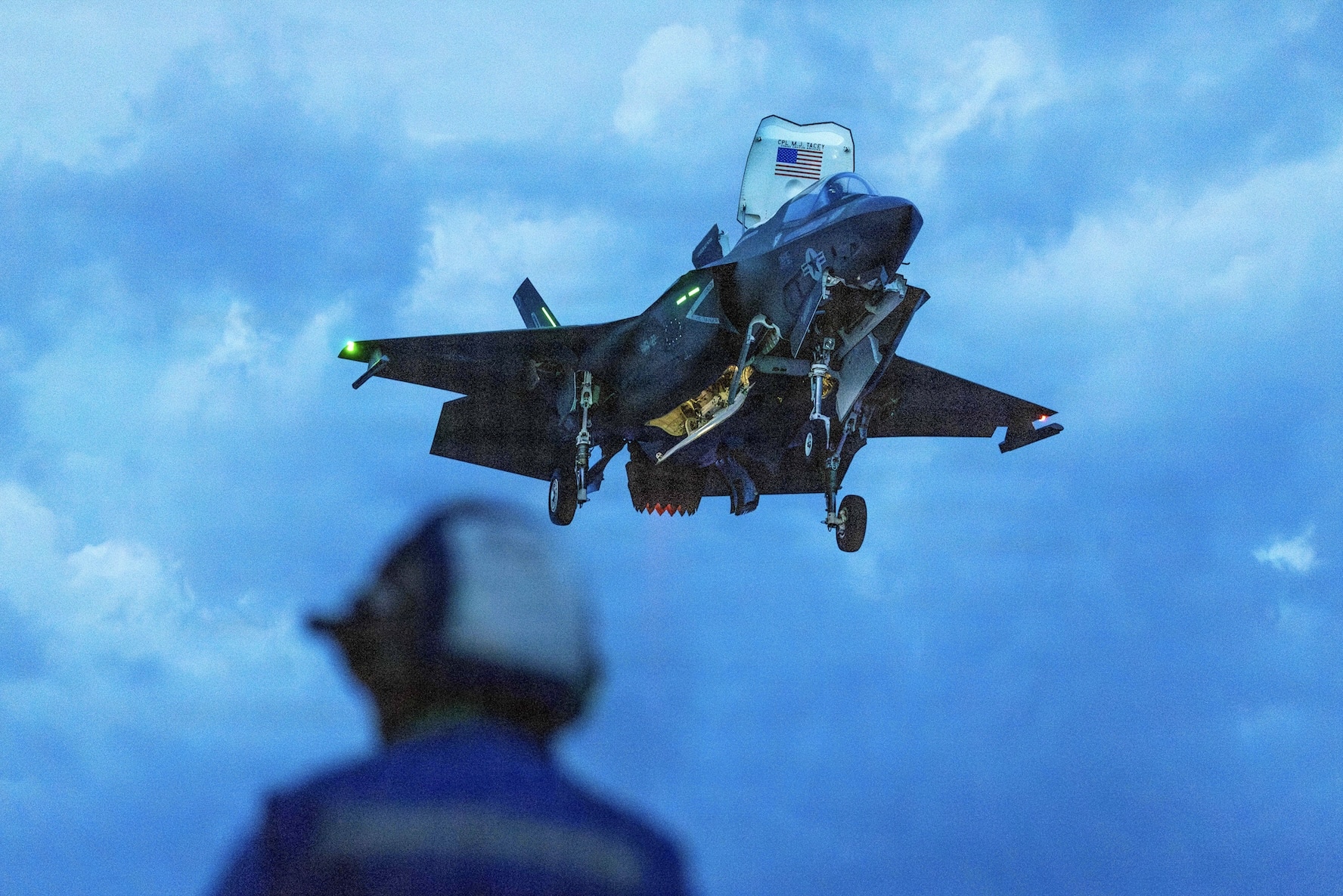
The U.S. Marine Corps has accepted six F-35B Lightning II fighters without their radar systems installed, the head of the F-35 Joint Program Office confirmed to senators last week, as the Pentagon’s costliest weapons program confronts record-low readiness rates and a support infrastructure its own leadership says can no longer keep pace with fleet growth.
Marine Corps Lt. Gen. Gregory Masiello, who took over the F-35 Joint Program Office last July, told the Senate Airland Subcommittee on June 23 that Lockheed Martin delivered the six jets with ballast material in their nose cones where the Northrop Grumman AN/APG-85 active electronically scanned array, or AESA, radar is designed to fit.
The Marine Corps opted to wait for the new sensor rather than accept aircraft fitted with the older AN/APG-81, the incumbent radar the APG-85 is meant to replace. Masiello acknowledged the jets are not fully mission capable. Aircraft delivered without radars are limited to training operations and cannot be committed to combat missions, according to sources familiar with the program.
The Air Force and Navy could face the same situation later in 2026, according to Air & Space Forces Magazine.
A Sensor Delayed, a Program Strained
The APG-85 is a central component of the broader Block 4 modernization package for all three F-35 variants. First production-lot delivery of the radar is not expected until 2028, Masiello’s testimony confirmed. The scale of the accumulated delay has put Northrop Grumman and the program office in an increasingly difficult position: design changes made to accommodate the larger, more capable radar mean the existing APG-81 cannot simply be installed in newer production lots without additional rework.
Lockheed Martin’s chief executive warned the Air Force as early as mid-2025 that the radar’s delivery schedule carried significant risk.
The company subsequently proposed redesigning the F-35’s forward fuselage to accept either radar, a mitigation that is currently centered on aircraft beginning with Lot 20. In the interim, the program is accepting jets with weighted ballast standing in for hardware.
An Air Force acquisition official captured the bind in a March 2026 exchange with defense reporters: “The APG-85 is a helluva radar unless you don’t have one.”
If production delays extend beyond current estimates, the number of radarless deliveries could exceed 100 aircraft. The Air Force is separately planning a $1.7 billion retrofit program to install the APG-85 on 181 F-35As from Lot 17 and earlier production batches once the radar reaches sufficient maturity.
Readiness at Its Lowest Point on Record
The radar problem arrives against a broader sustainment crisis. A Government Accountability Office report published June 11, 2026, found that the F-35 fleet’s full mission capable rate – the share of aircraft able to perform all assigned missions – fell from 38 percent in fiscal year 2021 to 25 percent in fiscal year 2025, the lowest recorded level since the aircraft entered service. The mission capable rate, which measures availability for at least one tasked mission, declined from 67 percent to 44 percent over the same period. The F-35B variant, flown exclusively by the Marine Corps, generated the lowest full mission capable rates of the three variants, roughly half the rate of the Air Force’s F-35A.
Masiello told senators the program’s sustainment architecture is the root of the problem. The support system was built for a fleet of 700 to 800 aircraft; the operational inventory now stands at approximately 1,300. Spare parts shortages, constrained contractor production capacity, software shortcomings, and corrosion issues all compound the gap. The Pentagon paid contractors hundreds of millions of dollars in performance incentives between 2020 and 2025 to improve readiness, according to the GAO, and the incentives produced no measurable improvement.
In 2025, the Department of Defense launched a $13.7 billion sustainment strategy intended to lift readiness rates to acceptable levels by 2030. The GAO report identified constrained industry capacity as a particular threat to the plan’s success.
A $13 Billion Annual Program Under Scrutiny
Masiello testified in defense of a fiscal year 2027 budget request that bundles more than $13 billion for the F-35 program in a single year, including a buy of 85 new U.S. aircraft. The hearing was an open session of the Senate Armed Services Committee’s Airland Subcommittee, giving lawmakers their most detailed public accounting yet of where the program stands.
The F-35 has been the Department of Defense’s most expensive weapons program since formal development began in the late 1990s. Block 4, the hardware and software modernization effort that includes the APG-85, is now more than $6 billion over its original budget and at least five years behind schedule, according to a September 2025 GAO audit.
The program office restructured Block 4 into a formal subprogram in an effort to establish tighter cost and schedule controls, though the September 2025 audit found the revised plans would still require at least two additional years of development before the full upgrade package could enter production.
The short-term outcome is a fleet that continues to grow in numbers while shrinking in combat availability, accepting aircraft that its program director has acknowledged cannot perform their primary missions, and spending $13 billion annually against a maintenance backlog that took four years of sustained decline to accumulate.