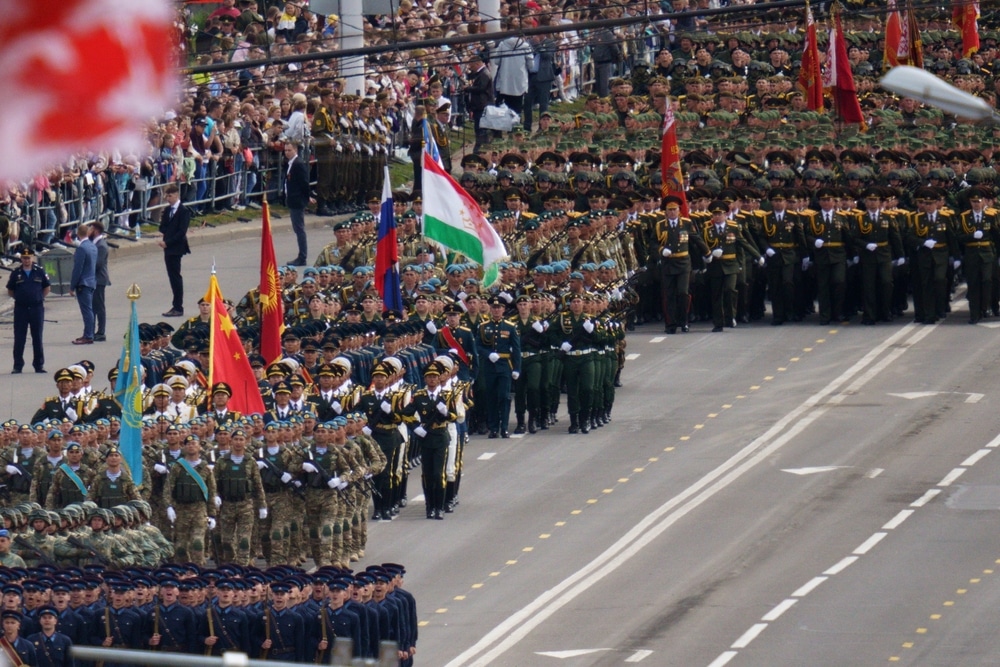
A new Congressional Research Service (CRS) report warns that Russia is expanding its military activities in the Asia-Pacific region and deepening defense cooperation with China.
Authored by analyst Andrew S. Bowen, the report notes that Russia and China conducted seven joint exercises or patrols in the Asia-Pacific region annually in 2022 and 2023, before increasing to 11 in 2024.
The trend continued in 2025, with Russia and China carrying out joint naval exercises in the Sea of Japan and air patrols over the East China Sea and Western Pacific.
The report adds that in recent years, Russia and China have expanded their naval exercises to include other countries, including South Africa and Iran. These multilateral drills began in 2019 and have continued in recent years, with the latest exercise taking place in January 2026.
According to the report, some of the exercises have been conducted near sensitive or disputed areas in Asia.
The Joint Sea exercises in 2016 and 2024 were held in the South China Sea, while Joint Sea 2019 included a circumnavigation of Japan’s Honshu Island through two straits in its territorial waters. In August 2025, Russia and China conducted their first combined submarine patrol in the Sea of Japan and the East China Sea.
“Some observers have suggested that the geographic pattern of Russia-PRC naval exercises in Asia indicates that Russia’s leadership is more willing to engage in exercises that risk antagonizing PRC neighbors than PRC leaders are willing to antagonize European countries,” the report states.
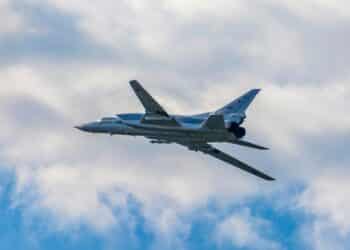
Beyond naval activity, the report says Russia–China air exercises and training have grown more complex since 2014, marked by increased coordination and communication, including the use of bilingual command information systems, and an expansion into more sensitive operations such as strategic bomber patrols.
The report highlights a July 2024 combined bomber patrol near Alaska as evidence of closer coordination between the two militaries. It notes that the mission involved access to sensitive strategic bomber airbases.
In testimony before Congress in March 2024, then–Indo-Pacific Command chief Adm. John Aquilino warned that the growing tempo of joint activity is “cause for concern.”
“In addition to naval drills, Russia continues to partner with the PLA in strategic bomber patrols in the western Pacific near Guam,” Aquilino said. “Russia is also increasingly collaborating with the PLA to execute combined air patrols that regularly cross into Japan and the Republic of Korea’s Air Defense Identification Zones (ADIZ), further threatening our allies.”
U.S. Northern Command commander Gen. Gregory M. Guillot said in March 2026 testimony that China and Russia are “advancing their strategic partnership to counter the United States and its allies.”
“While none of the relationships among our principal adversaries constitutes a formal military alliance, their shared perception of the United States as a threat to their core security interests could form the foundation of a wartime partnership, complicating U.S. military planning and advancing each adversary’s ability to threaten the homeland,” Guillot said.
Operational Benefits
The report says that both China and Russia are benefiting from the joint military exercises.
“For the PRC’s People’s Liberation Army (PLA), which has had no major combat experience since the late 1970s, exercising with Russian forces offers an opportunity to train with and learn from a military with combat experience from its full-scale invasion of Ukraine in 2022,” the report notes.
According to the report, the exercises and patrols may have also improved trust and familiarity between Russian and Chinese forces.
“Some exercises have involved the two militaries granting each other access to their respective air and naval bases,” the report notes.
It adds that broader access could extend the reach and presence of joint operations in strategically important areas, including the Sea of Japan and the South China Sea.
The report however notes that while Russia and China have expanded joint military exercises, their cooperation remains limited because they do not share a formal defense pact, and the two countries’ military forces are “not interoperable.”
Even so, the report says both militaries can still benefit from the exercises by learning each other’s command methods and gaining exposure to new technologies, including drone systems.
Joint Ground Operations Decline
While naval drills have become more frequent in recent years, ground-force cooperation between Russia and China has remained limited.
“Compared with naval exercises, Russian and PRC ground forces’ interactions have been less frequent and have involved smaller numbers of troops and command staff especially since Russia’s 2022 invasion of Ukraine,” the report states.
China’s largest ground force deployment to a Russian strategic exercise occurred during Vostok 2018, when more than 3,000 People’s Liberation Army troops reportedly took part.
Policy Suggestions for Congress
The CRS report outlines several policy options for Congress as concerns grow over expanding Russia-China military cooperation in the Asia-Pacific region.
It notes that lawmakers have already taken steps in recent National Defense Authorization Acts (NDAAs) to increase oversight of the relationship, including requirements for U.S. Strategic Command to notify Congress if significant Russia-China cooperation involving nuclear or strategic capabilities is detected.
It also highlights provisions in the FY2023 and FY2024 NDAAs requiring regular interagency reporting on China’s support for Russia during the war in Ukraine, as well as assessments of how the conflict is shaping China’s objectives toward Taiwan.
Looking ahead, the CRS report suggests that members of the 119th Congress could consider additional oversight measures, including expanded reporting requirements on Russia–China military exercises and patrols, and potentially commissioning a National Intelligence Estimate on the trajectory of their defense relationship.
It also says lawmakers could explore establishing new interagency mechanisms or task forces to monitor and respond to growing coordination among U.S. adversaries, including Russia, China, Iran, and North Korea.