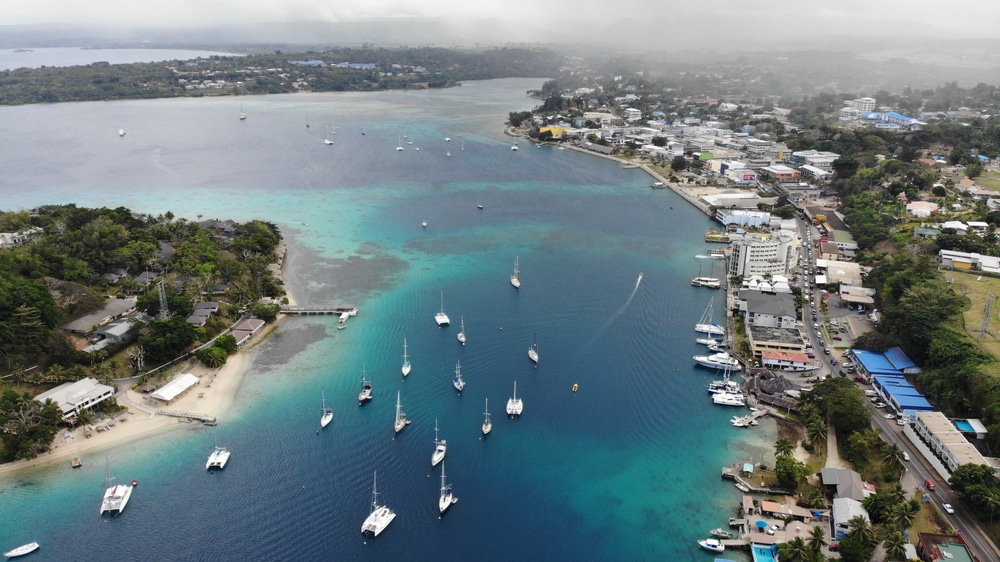
Australia and Vanuatu signed the Nakamal Agreement in Canberra on June 29, barring foreign military bases on the island as Beijing holds a growing presence at a wharf it expanded in Luganville, the site of one of the largest U.S. military bases in the South Pacific during World War II.
Prime Minister Anthony Albanese and Prime Minister of Vanuatu, Jotham Napat, have signed a new treaty, the Vanuatu–Australia Nakamal Agreement, in Canberra. pic.twitter.com/nZAbOerxgf
— Australian Government (@ausgov) June 29, 2026
Albanese said the deal provides “certainty for Australia that there will be no foreign military base” on Vanuatu. Napat said his country had passed a parliamentary act banning militarization of its critical infrastructure.
“As a country, we have in fact passed an act in parliament not to allow any militarisation to actually be used for our critical infrastructure,” Napat said.
The signing came nearly ten months after Napat withdrew from a ceremony in Port Vila over concerns the earlier version gave Australia veto power over foreign infrastructure deals. The final text requires consultation with Canberra but removes that veto.
Chinese naval vessels have made repeated port calls to Vanuatu, and Beijing funded the expansion of the Luganville wharf, which both governments described as cruise ship infrastructure. Media and defense analysts have previously reported that specifications of the 360-meter wharf make it fully capable of docking large warships.
Vanuatu is also pursuing a separate deal with China. Napat described the Namele Agreement as a development cooperation pact and said publication awaited clearance from Beijing.
China’s foreign ministry said the agreement should not “target any third party or be used as a tool for geopolitical rivalry,” spokesperson Guo Jiakun said at a Beijing press briefing on June 29.
Exact funding breakdowns were not released at signing. While the agreement is still expected to cost AU$500 million (approximately $345 million), government sources indicate the funds will be spread over a longer period than the 10 years originally proposed, with specific data to be detailed in the mid-year budget update in December.
“Vanuatu’s long tradition of non-alignment means that it won’t simply abandon its relationship with China. Nor will China abandon its attempts to undermine Australia’s interests in Vanuatu,” former Australian diplomat James Batley told AFP.