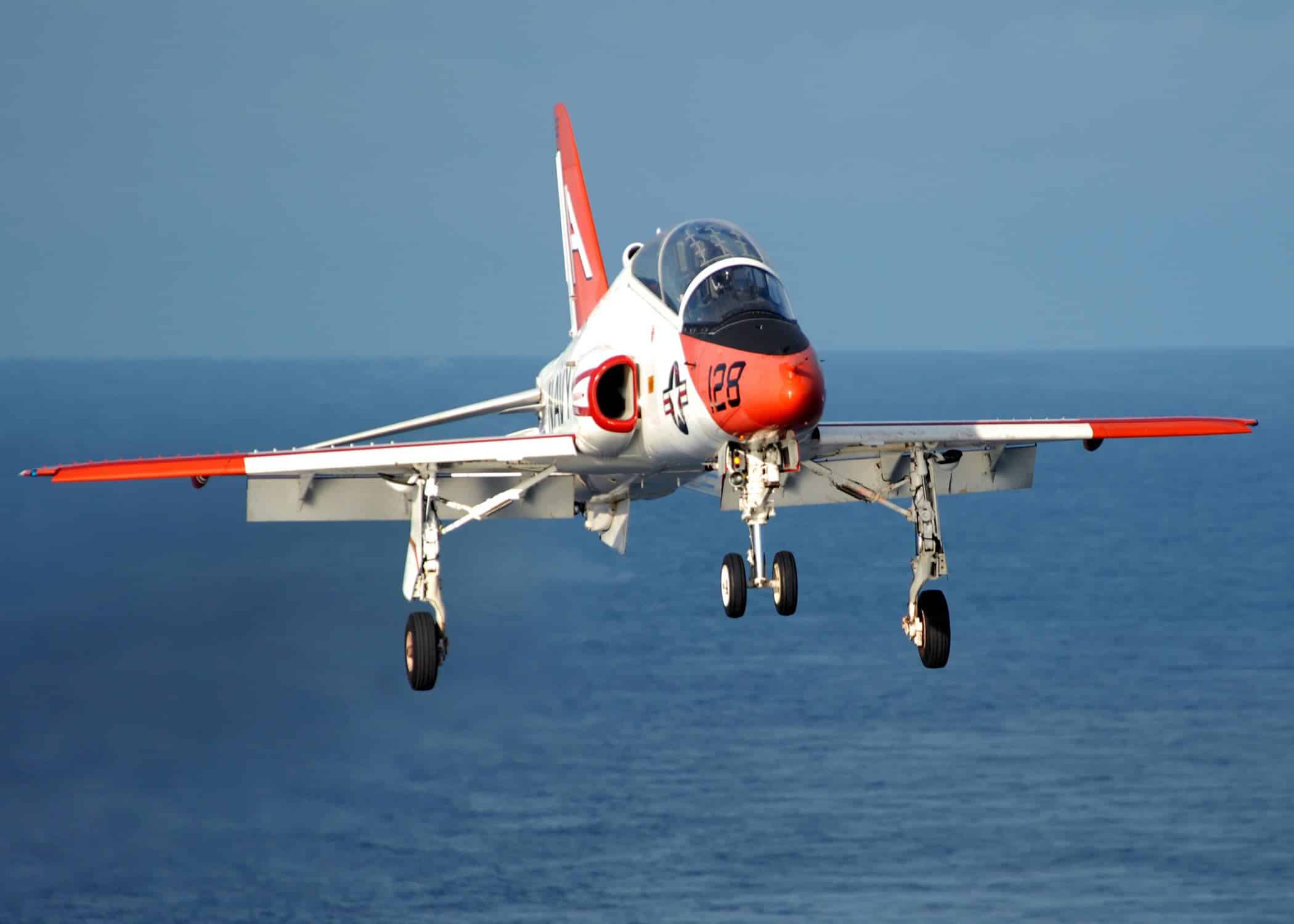
The U.S. Navy released its final request for proposals on March 26 for the Undergraduate Jet Training System (UJTS), the competition to replace its T-45C Goshawk fleet, capping engineering and manufacturing development (EMD) at $1.75 billion and declaring any proposal above that figure “unreasonable and therefore unawardable.”
NEW: The Navy sets the plan and requirements to replace its T-45 trainer, targeting an EMD cost of no more than $1.7 billion to start fielding 216 aircraft
To get there, the Navy has officially settled on not requiring unflared landings/field carrier landing practice pic.twitter.com/YCR6DjKQK2
— Brian Everstine (@beverstine) March 26, 2026
The solicitation sets annual spending limits of $52.8 million in fiscal year 2027 and $181 million in fiscal year 2028. Proposals are due June 29, with contract award targeted for March 2027, according to the RFP.
The hard ceiling arrives as the Navy maintains a parallel sustainment effort on the aircraft it is trying to replace.
Naval Air Systems Command announced in July 2025 that Fleet Readiness Center Southeast had begun inducting T-45C Goshawks into a service life extension program (SLEP), with each full fuselage overhaul requiring approximately 24,000 labor hours, to keep the 193-aircraft fleet operational through 2036. The SLEP launched 13 months after the Navy formally identified the requirement.
The final RFP confirms the Navy will not require the replacement aircraft to perform carrier-representative unflared landings. Student pilots will simulate approaches to wave-off in the new jet, with field carrier landing practice to touchdown moving to later training stages, according to the solicitation.
Sierra Nevada Corporation’s Team Freedom had publicly argued for retaining the carrier landing requirement, a position overruled by the final RFP.
Four teams submitted to compete. Boeing and Saab offer the T-7A Red Hawk. Lockheed Martin and Korea Aerospace Industries pitch the TF-50N. Textron and Leonardo entered the M-346N. Sierra Nevada Corporation, backed by Northrop Grumman and General Atomics Aeronautical Systems, offers the Freedom Trainer.
The Navy plans to field 216 aircraft across four installations: 95 at Naval Air Station Meridian, Mississippi, 95 at Naval Air Station Kingsville, Texas, 26 at Naval Air Station Pensacola, Florida, and four EMD aircraft at Naval Air Station Patuxent River, Maryland.
Low-rate initial production is scheduled to begin in 2032, scaling to 25 aircraft per year across six production years.