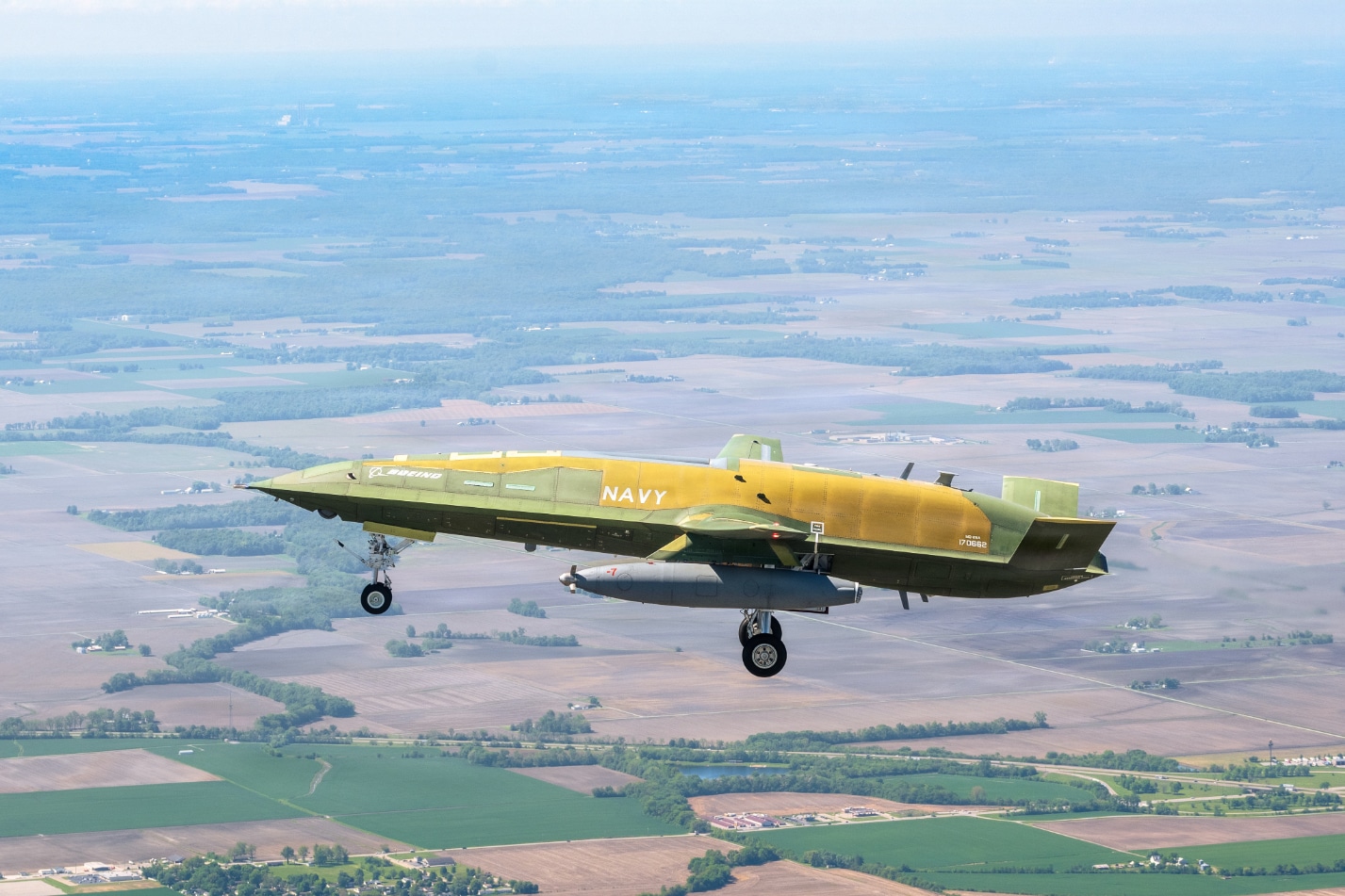
The U.S. Navy’s Boeing-built MQ-25A Stingray received Milestone C approval on Tuesday, clearing the carrier-based unmanned tanker for Low-Rate Initial Production (LRIP) eight years after Boeing won the original $805 million development contract.
Acting Secretary of the Navy Hung Cao announced the decision during a Senate Armed Services Committee hearing. “MQ-25 reached Milestone C, which is huge because now we have in-flight refueling that’s unmanned,” Cao told lawmakers.
The Navy expects to award a Lot 1 contract for three aircraft this summer, with priced options for Lot 2 (three aircraft) and Lot 3 (five aircraft). The Pentagon’s Fiscal Year 2027 budget request includes $1.75 billion for the MQ-25A program, covering three LRIP aircraft and advance procurement for Lot 3.
Today during the Senate Armed Services Committee Hearing, I announced the MQ-25A Stingray is moving into the production phase.
Integrating unmanned refueling extends the lethality of our Carrier Strike Groups and equips our force with a decisive advantage to fight and win… pic.twitter.com/uBs7Gc5mdX
— Acting Secretary of the Navy Hung Cao (@SECNAV) May 19, 2026
The full program of record calls for 76 air vehicles at an estimated total cost of $15.9 billion, roughly $209 million per aircraft, according to a June 2025 Government Accountability Office report.
The approval follows the first flight of a production-representative Stingray on April 25 at Boeing’s MidAmerica Airport facility in Mascoutah, Illinois. The aircraft flew for approximately two hours, demonstrating autonomous taxi, takeoff, flight and landing.
The production milestone, however, arrives alongside a significant schedule delay. Budget documents released in April show the Navy now projects Initial Operational Capability (IOC) for the second quarter of Fiscal Year 2029, a nearly two-year slip from the previous estimate of the third quarter of FY-27.
The program was originally expected to reach IOC in 2024. The Navy had planned to deploy the first MQ-25As aboard USS Theodore Roosevelt (CVN-71) this calendar year, but production delays and carrier availability issues pushed that timeline.
The GAO has previously flagged cost risk associated with beginning low-rate production before flight testing fully matures.
The MQ-25A is designed to provide organic aerial refueling for the Carrier Air Wing (CVW), relieving F/A-18E/F Super Hornets of tanking duties and freeing them for strike missions. The Navy also intends to use the aircraft for intelligence, surveillance and reconnaissance. Additional test flights from MidAmerica Airport are expected before the Stingray moves to Naval Air Station Patuxent River, Maryland, later this year to prepare for carrier qualification trials.
“The aircraft is ready, production is ready, and the program is ready to move this capability forward,” said Capt. Daniel Fucito, the Navy’s Unmanned Carrier Aviation program manager.