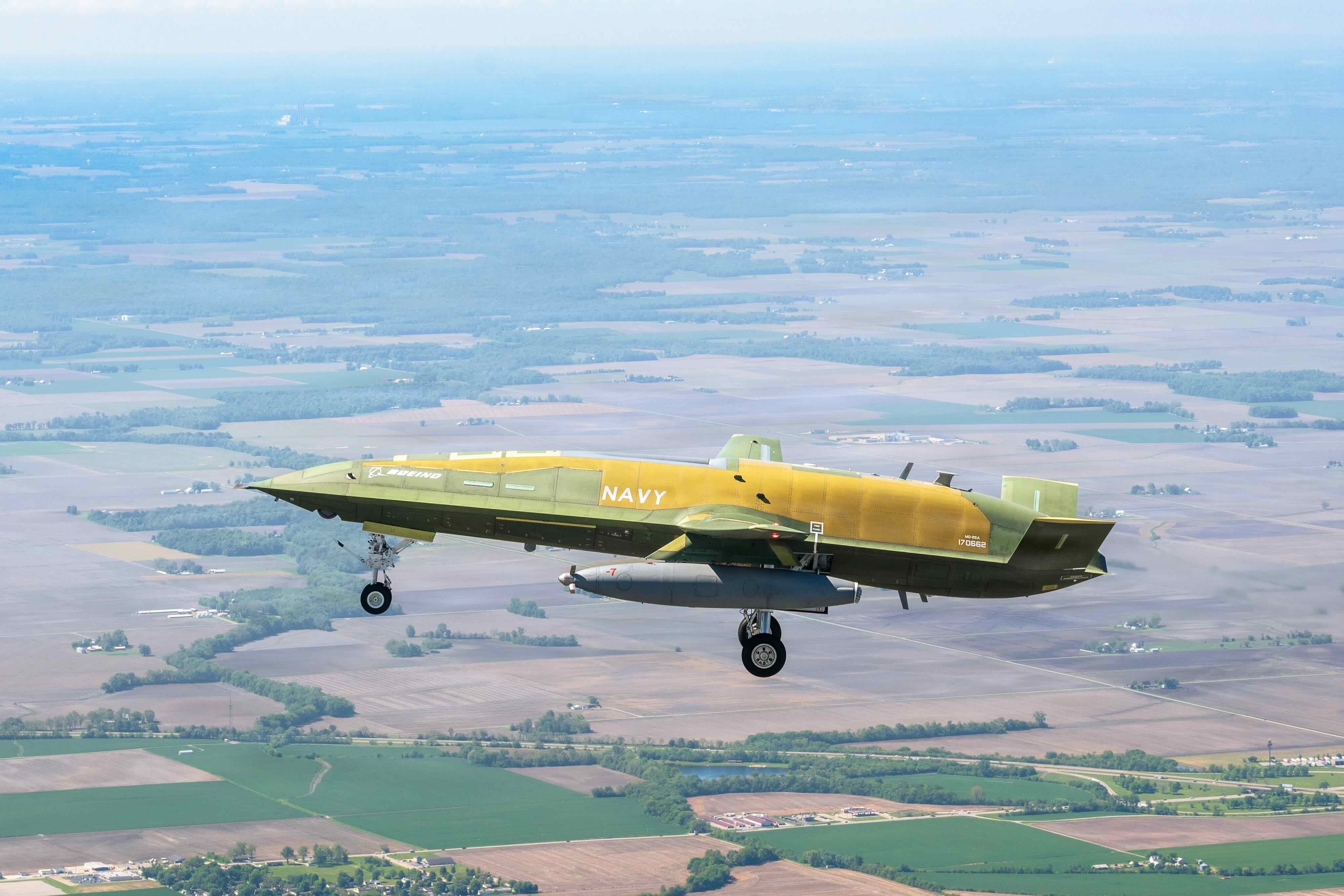
The U.S. Navy’s first production-representative MQ-25 Stingray unmanned aerial tanker completed its maiden flight April 25 from MidAmerica St. Louis Airport in Mascoutah, Illinois.
The aircraft lifted off at 10:49 a.m. CDT and flew for approximately two hours, escorted by a Boeing TA-4J Skyhawk and a Navy UC-12M Huron as chase aircraft.
The MQ-25A Stingray has completed its first flight—marking a major step toward the future carrier air wing.
From increasing range to reducing risk for pilots, the MQ-25 will help pave the way for unmanned carrier operations.
🎥Courtesy of Boeing pic.twitter.com/BUIAhQcdar
— U.S. Navy (@USNavy) April 27, 2026
Navy and Boeing Air Vehicle Pilots (AVPs) commanded the Stingray from the Unmanned Carrier Aviation Mission Control System (UMCS) MD-5 ground control station, built on Lockheed Martin’s MDCX software, putting the Navy’s carrier UAS command-and-control architecture through its first live airborne test.
The flight verified basic flight controls, engine performance, and handling characteristics. An April 22 attempt was aborted for undisclosed reasons, The Aviationist reported.
Rear Adm. Tony Rossi, program executive officer for Unmanned Aviation and Strike Weapons, said the Stingray is “the first step in integrating unmanned aerial refueling onto the carrier deck, directly enabling our manned fighters to fly further and faster.”
Capt. Daniel Fucito, the Unmanned Carrier Aviation program manager, said the flight “officially initiates the rigorous flight test program, which will focus on expanding the aircraft’s performance envelope and verifying all mission systems.”
Dan Gillian, Boeing vice president and general manager of Air Dominance, described the MQ-25A as “the most complex autonomous system ever developed for the carrier environment.”
The Stingray features a retractable electro-optical/infrared (EO/IR) sensor turret absent from the T1 demonstrator, which first flew September 19, 2019, and is powered by the Rolls-Royce AE 3007N engine.
The aircraft is designed to relieve F/A-18E/F Super Hornets from tanker duty, a mission that consumes up to a third of their sorties, per Navy figures.
The Stingray will continue testing at MidAmerica before transferring to Naval Air Station (NAS) Patuxent River, Maryland, later this year for carrier qualification groundwork.
Initial operating capability (IOC), originally targeted for 2024, has slipped to FY29 per budget documents released this month.