Bottom Line Up Front
The line that has held across the Taiwan Strait since the first of October 1949 held again this cycle. Taiwan and the People’s Republic of China remain locked in the longest suspended civil war of the modern age, each refusing the other’s standing as a sovereign entity that can sign a binding instrument. Seventy-six years and seven months. No treaty. No recognition. No declared war, and no peace. We have named this envelope state The Long Refusal, and the first finding of this cycle is that it did not move.
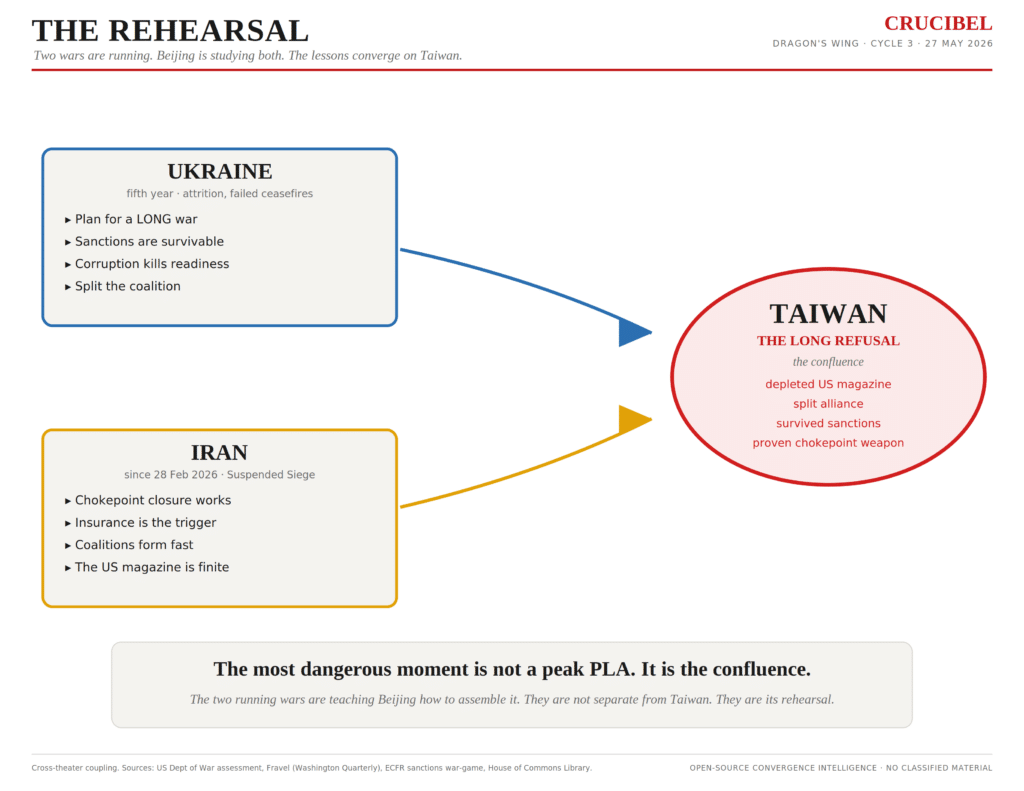
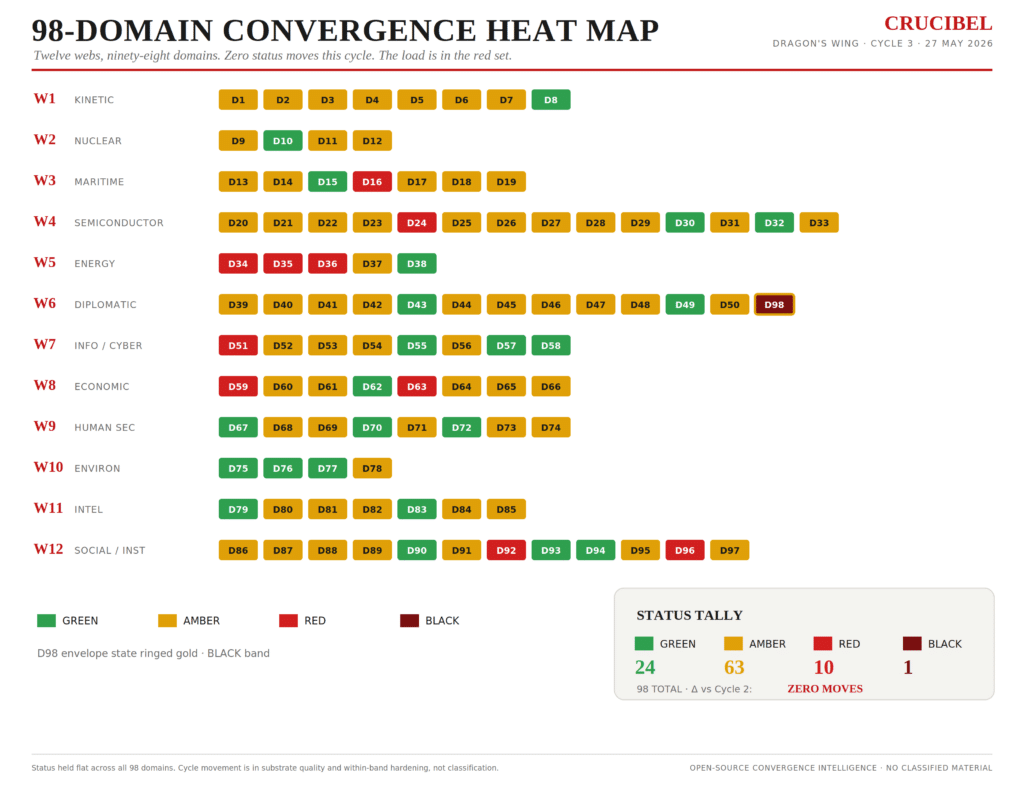
The second finding matters more, because it is the one a casual reading misses. The structure held, but the load on it rose. Across a convergence framework of ninety-eight analytical domains arranged in twelve interlocking webs, not a single domain changed its threat classification this cycle. The distribution stands where it stood: twenty-four domains assessed at the lowest band, sixty-three in the cautionary middle, ten in the red, and one, the envelope state itself, in the highest band. The cascade reading, our measure of how far a shock would propagate through the coupled system, likewise held flat. And yet beneath that flat surface the theater hardened. The evidentiary basis under the assessment improved markedly, moving from inference to primary source across a wide set of domains. And a coherent cluster of domains showed directional pressure that has not yet crossed a threshold but is bending in one direction.
The third finding is where the cycle’s weight concentrates. Reduce the theater to its load-bearing members and a single chain emerges, running from a maritime chokepoint through energy and critical minerals into one semiconductor fabrication complex. Three of the four highest-leverage nodes in that chain are already in the red. The fourth, the fabrication complex itself, is the single highest-consequence point in the entire theater, and it sits one classification step from the red. The theater is structurally loaded. The envelope holds precisely because the pressure has stayed within band. The cycle’s real movement lives in that loading, not in the static classification layer.
For the consumer who reads only this section. The Strait did not break this week. It grew more dangerous beneath a surface that did not change. The most likely path to a discontinuity is not a decision in Beijing but an accident inside a hollowed chain of command, and the highest-leverage target remains a single fabrication complex that held this cycle and would, if it fell, take the theater with it.
A Note on Method
This SITREP is the product of a structured convergence-intelligence framework that decomposes the Taiwan-China theater into a hundred analytical domains grouped under twelve thematic webs, from kinetic operations and nuclear posture through maritime control, the semiconductor supply chain, energy, alliance architecture, the information and cyber contest, the economic instruments, human security, the physical environment, the intelligence picture, and the social and institutional terrain. Each domain carries a threat classification and a directional read. The framework computes a cascade reading that estimates how a shock in one domain would propagate through the coupled system, and it identifies the load-bearing nodes whose failure would carry the furthest.
The discipline of the method is its honesty about its own limits. No classification moves without primary-source grounding in the cycle that moves it. Where a source could not be reached this cycle, the prior assessment is carried forward and marked as carried forward, not laundered into false confidence. Every quantitative claim that reaches a published figure is computed and checked before it ships. What follows is the public account of Cycle 3. The deeper machine state stays in the working files. The analysis is here in full.
The Cascade Reading
The cascade reading is the framework’s estimate of systemic fragility. It asks a simple question with a complicated answer. If a shock lands, how far does it travel before it stops. This cycle the reading held flat against the prior cycle, and the flatness is itself the finding.
The seed count, the number of domains already in the red or the highest band and therefore capable of starting a cascade, stands at eleven of ninety-eight. The first-order reach, the domains a shock touches at the first remove, stands at fifty-seven. The runaway depth, the domains reached when the propagation is allowed to run to saturation, stands at eighty-three. The maximal envelope is the same eighty-three. The trajectory reads eleven, then fifty-seven, then eighty-three, then eighty-three.
Zero change from the prior cycle across all four measures. This is not a defect in the reading. It is the correct consequence of a cycle in which no domain crossed a classification threshold. The cascade measure registers threshold crossings. When the pressure rises inside a band without breaching it, the measure holds flat by design, and the analyst must look past the measure to see the movement. The movement this cycle was real. It was simply sub-threshold, and the honest report is that the system did not become more fragile by this measure even as the pressure on it grew.
One feature of the reading deserves emphasis. The eleven seed domains are high-connectivity nodes. A shock among them propagates widely, which is why the first-order reach is more than five times the seed count. But most of those eleven are individually recoverable. The single exception is the envelope state, which carries a recovery horizon that is effectively permanent. That is the structural signature of The Long Refusal. A field of dangerous but recoverable pressure points, anchored by one permanent floor that does not lift.
The State That Will Not Resolve
Begin with what The Long Refusal is, because the name carries the analysis. It is a suspended civil war fused with mutual non-recognition. One party denies that the other can sign an instrument at all, which means no instrument can end it. There is no armistice to violate, because there is no armistice. There is no peace to break, because there was never peace. Stability is held not by the two parties separating their forces across an agreed line but by a third party standing between them, and by the stronger party preserving the option of force through a posture of permanent rehearsal. It is a state with no exit written into it.
The two nearest historical cousins both found exits. The two Germanys recognized each other in 1972 through the Basic Treaty, and the German question, frozen since 1949, dissolved into a managed coexistence that eventually allowed reunification. The two Koreas signed an armistice in 1953 and froze into a different and more legible state, a suspended war with an agreed line and a mechanism, however brittle, for managing incidents. Neither cousin resolved through the mechanism now operating across the Taiwan Strait. The German exit required mutual recognition, which The Long Refusal forbids by definition. The Korean exit required a signed armistice, which The Long Refusal cannot produce because neither party will grant the other the standing to sign. The analogues ran out. The Strait has not resolved because the precedent book contains no instructions for how a refusal of this exact shape is supposed to stop.
This cycle reaffirmed the structure rather than challenging it. Beijing’s diplomacy was assertive, its senior diplomat active at the United Nations, and its state media sharp, warning Taipei’s leadership against what it framed as reckless provocation. A leaders’ summit this cycle carried a pointed warning from Beijing to Washington over the island. Taipei’s governing party, for its part, kept the cross-strait question off its public face and spoke instead of domestic governance, of population and childcare and a strong quarterly growth figure. Both behaviors are consistent with the envelope, not with its rupture. The Refusal is a structure that absorbs heat without changing shape, and this cycle it absorbed a great deal of heat and kept its shape.
The Spine of the Contingency
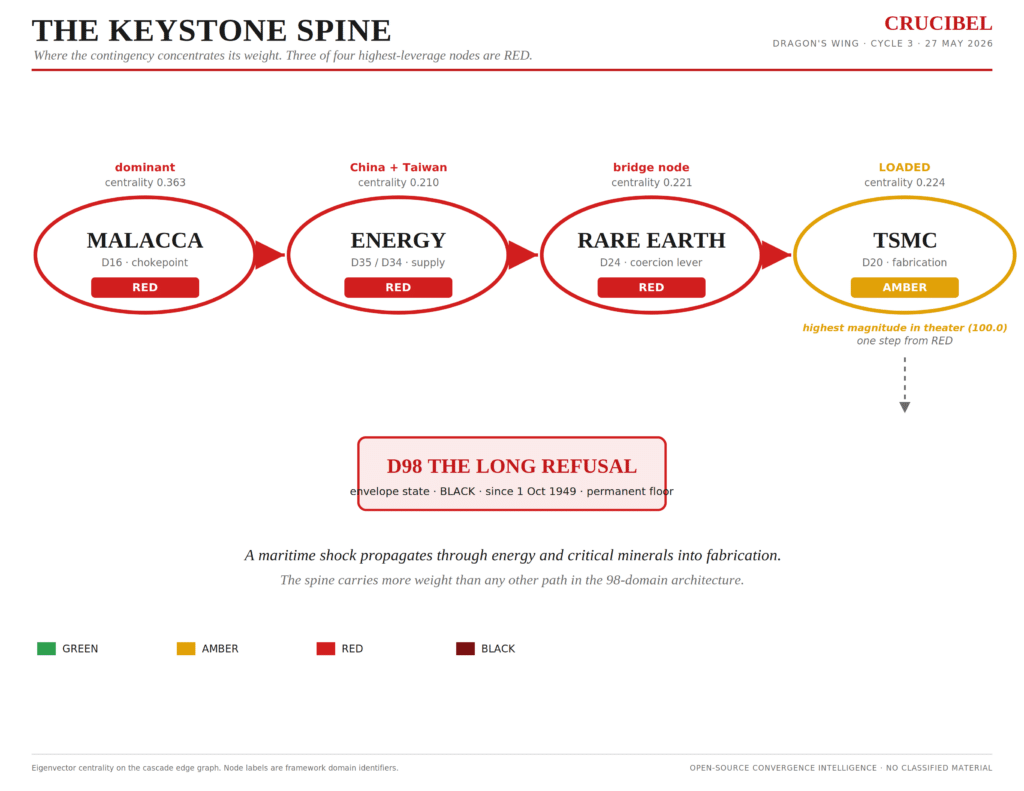
Strip the theater to its load-bearing members and a single chain appears. It runs from the Malacca Strait, through the energy markets and the global trade in liquefied natural gas, through the rare earths that China processes and the world cannot yet replace at scale, and it terminates at one semiconductor fabrication complex on the west coast of Taiwan. Four nodes carry more of the structure’s weight than any others in the ninety-eight. Three of the four are already in the red. The fourth is the one that would hurt the most, and it held.
Malacca, the heaviest node
The Malacca Strait is the single highest-leverage point in the theater by a wide margin. Through it passes the overwhelming share of China’s seaborne crude oil and a vast portion of its trade. Chinese strategists named this vulnerability the Malacca Dilemma two decades ago, and they have organized a great deal of national strategy, from pipeline diplomacy to port acquisition to the very design of the navy, around the problem of a chokepoint they do not control and could not keep open against a determined adversary.
This cycle handed us a live demonstration of the Dilemma from the adjacent theater. When a different chokepoint was contested in the Gulf, China’s crude imports did not merely soften. They fell hard, to their lowest level in several years, as refinery runs dropped and the country chose to draw down stored inventory rather than pay the panic price for cargoes rerouted the long way around. That is the Malacca Dilemma made visible, on a smaller strait, in real time, with the world watching. It is a controlled preview of what a Malacca interdiction would do, and the preview was not reassuring. And in the same weeks, the maritime industry began to speak openly of a precedent that did not exist a year ago. If one strait can be converted into a tollbooth, with transit priced by the nationality of the hull and payment demanded in a currency of the controlling power’s choosing, then what principle stops the same logic from reaching Malacca, or the Sunda Strait, or the Turkish narrows. The doctrine of the weaponized chokepoint has been named aloud in the theater next door. That naming is the development that makes this the hottest point on the board.
The fabrication complex, the loaded chamber
The second node is the one that is not yet red, and it is the one to watch above every other. It is the advanced semiconductor fabrication complex on Taiwan, the single highest-consequence point in the theater and very likely in the global economy. This cycle it held. The advanced-node production ramp proceeded on schedule. The ecosystem investment, including a major new commitment to the domestic Taiwan supply base, continued. No disruption signal appeared. That is the good news, and it is also the entirety of the danger.
This is the loaded chamber. The complex carries the highest consequence weight in the entire framework, and it sits one classification step below the red. A blow against it, whether by a deliberate hand, by a tremor along the fault that runs beneath the island, or by a break somewhere up a supply chain of exquisite and underappreciated fragility, is the highest-leverage event that can occur in the Pacific. It would not merely damage Taiwan. It would cascade through the global electronics economy, through the defense industrial base of the United States and its allies, and through the financial markets that have priced none of this. It did not fall this cycle. It remains the place where the next fall would hurt the most, and the gap between its consequence weight and its current classification is the most important single fact in this SITREP.
Rare earth and the global gas market, the lever and the wire
The third and fourth nodes complete the chain. The third is the suite of rare earths and critical minerals that China refines and, in several categories, dominates. This is the lever Beijing can pull below the threshold of war, the coercion instrument that turns an economic squeeze into a defense-industrial one, because the same processed minerals that build consumer electronics build guided weapons, radar, and the magnets inside every precision system. Diversification efforts outside China are real and advancing, including new processing capacity in North America, but they are not yet at the scale that would break the dependency. The control regime hardened on both sides this cycle, with fresh enforcement actions and fresh export-control extensions. This node is in the red and it is not moving out of the red soon.
The fourth node is the global market for liquefied natural gas, and its profile is the inverse of the fabrication complex. Where the complex carries enormous consequence weight, the gas market carries modest weight of its own. What it carries instead is connectivity. It is the wire along which a Pacific shock travels to the rest of the world. A disruption in the Strait becomes, within weeks, a problem on the desks of European energy ministers, because the gas market is a single global system and a cargo diverted to cover an Asian shortfall is a cargo that does not arrive in Rotterdam. This node is the reason a Taiwan contingency is a transatlantic alliance problem and not merely a Pacific one. It is in the red, and it transmits.
The Theater Across Twelve Dimensions
The spine carries the most weight, but a serious reading walks the whole board. What follows is the theater across all twelve thematic dimensions, the state of each this cycle, and where the pressure is bending.
Kinetic posture and readiness
The People’s Liberation Army held its posture this cycle and hardened within it. The Taiwan side’s official tracking of daily air and maritime activity across the Strait and the air defense identification zone showed an elevated and variable tempo, consistent with sustained gray-zone pressure rather than a step change toward mobilization. Naval modernization continued on both sides of the regional contest, with new surface combatants integrating into carrier operations in the Western Pacific. The single largest gap in the public picture remains amphibious and sealift capacity, the metric that would most directly signal a shift from coercion toward invasion, and it is a gap we mark honestly rather than fill with inference. Taiwan’s own defense readiness held, with civil-military mobilization drills proceeding on schedule.
Nuclear and strategic escalation
The Chinese nuclear buildout continued its steady expansion, sub-threshold and on the trajectory independent analysts have tracked for several years. The more notable movement this cycle was on the periphery. North Korea’s expanding nuclear complex showed fresh evidence of Russian linkages, and the convergence of decision-compressing technologies with nuclear command and control drew renewed analytical attention. The escalation ladder in the Taiwan theater remains coupled to the broader question of how a Pacific crisis would terminate, a question with no current good answer and one we treat as a standing analytical gap rather than a solved problem.
Maritime and strait control
This is the dimension that carries the spine, and it is the most active. Beyond the Malacca demonstration already described, the South China Sea saw continuing militarization across all claimants, with outpost expansion documented by maritime-transparency analysts. The insurance market is the quiet lever here. The underwriters who price war risk maintain a list of the world’s dangerous waters, and this cycle that list named the Gulf, the waters off one South American state, and an East African conflict zone. It did not name the Pacific or the Taiwan Strait. The absence is the signal. The day the Strait is added, the cost calculus of every commercial transit changes overnight, and the insurance lever we have written about at length converts from a latent instrument into an active one. It has not converted. We watch the list.
The semiconductor supply chain
Beyond the fabrication complex at the spine, the broader chip dimension held and in places strengthened. The advanced packaging and test capacity that finishes the most sophisticated devices advanced. The lithography and materials layers, the exquisite and concentrated suppliers of the equipment, gases, wafers, and ultrapure inputs without which no fabrication occurs, held their positions, with enforcement actions and fresh investment signaling a supply chain hardening on both the allied and the adversary sides. The decoupling between the two technology spheres accelerated within its band. No panic, no hoarding, orderly operations under sustained strain.
Energy and the industrial base
Taiwan’s energy vulnerability is among the most acute single facts in the theater. The island imports almost the entirety of its energy and holds limited storage, which means a blockade does not need to defeat its military to defeat its economy. It needs only to interdict its fuel. China’s own energy security runs through the Malacca node already described and showed real strain this cycle in the cross-theater data. The global gas market transmits both vulnerabilities outward. Global industrial supply chains, by contrast, showed a modest easing, with a recovery in Red Sea transit volumes that cuts gently against the disruption reading.
Diplomatic and alliance architecture
The diplomatic temperature ran assertive without a structural break. The United States and Taiwan maintained their engagement under the standing ambiguity. European engagement in the Indo-Pacific deepened, with the continent’s leading China analysts documenting both record Chinese investment flows into Europe and a hardening European posture on technology and security. The alliance architecture among the maritime democracies held. Taiwan’s international space stayed constrained, with continued exclusion from the major international bodies, an exclusion this cycle reaffirmed in the aviation and health organizations. The absence of the island from the rooms where the world coordinates is itself a feature of the envelope.
Information, cyber, and the cognitive contest
This dimension hardened this cycle, and it is the quietest of the dangers. The effort to persuade the people of Taiwan that they are, after all, Chinese intensified, documented by allied analysts who track it as a deliberate and sophisticated campaign rather than ambient noise. It is paired with the mapping of air and maritime coercion as a form of psychological pressure, designed to exhaust and demoralize rather than to defeat. Chinese cyber pre-positioning in critical infrastructure remains assessed in the red, though the dispositive threat-intelligence sources were not reachable this cycle and the classification rests on carried-forward assessment. The contest for the Taiwanese imagination is being fought below the line of any shooting, and it is being fought hard.
Economic and financial instruments
China’s economic coercion toolkit, the export controls and the market-access leverage and the rare-earth dominance, remained structurally intact. Beneath it, the Chinese economy showed the tension its own analysts describe, diplomatic strength layered over genuine economic weakness, a fragility the cross-theater energy data corroborated this cycle. Taiwan’s financial system and the global semiconductor equities showed no contagion and no panic, elevated but orderly. The sanctions architecture that the West would deploy in a contingency hardened, with fresh entity-list extensions, even as the same cycle’s data showed how much resilience the adversary has built against exactly that architecture.
Human security and population
Taiwan’s civilian preparedness is a genuine bright spot and strengthened this cycle, with civil-defense drills institutionalizing across multiple cities and a coordinated mobilization calendar taking shape. Against that resilience sit the standing vulnerabilities. Food security under blockade and pharmaceutical surge capacity both rest on thinner public evidence than the analyst would want, and water infrastructure remains a structural exposure. The diaspora dimensions, the Taiwanese resident on the mainland and the global Taiwanese community, function as both vulnerability and resilience depending on the scenario.
The physical environment
The environment is, this cycle, a stabilizer. The meteorological window matters. The spring period when the Strait is calm enough for a large amphibious crossing is closing, and the summer typhoon season that makes such a crossing nearly impossible is coming on. That is a physical constraint against near-term large-scale operations, and it is real. The seismic exposure is the counterpoint and the blind spot. Taiwan sits on an active fault system, and a major earthquake during a contingency would strike the fabrication complex, the civil infrastructure, and the military readiness at once. We hold the seismic domain at the lowest band as a standalone and flag the compound scenario as a thing the framework does not model well.
The intelligence picture
The collection picture this cycle was itself instructive. Open-source sensing, including near-daily commercial satellite vessel detection across the Strait, is mature and improving. The intelligence the framework most wants, the internal communications and personnel signals inside the PLA, remains the hardest to source, and this cycle the dispositive channels were not reachable. The purge architecture inside the senior ranks, the through-line of the most dangerous thread in this SITREP, rests on carried-forward assessment that the cycle did not refresh from primary source. We mark that honestly. The picture is good where the sensors are commercial and open, and thin where it depends on the adversary’s closed channels.
The social and institutional terrain
Taiwanese national identity held its cohesion under sustained pressure. The island’s governance showed healthy contested pluralism this cycle, with all three major parties active and visible, the governing party foregrounding domestic competence and the opposition pressing its own cross-strait framings. On the mainland, the reunification narrative ran its standard playbook through the state media apparatus. The deepest institutional story remains the one inside the Communist Party itself, where the gap between an outward projection of kinetic confidence and a command structure hollowed by purge is the structural fact that drives the most dangerous of the three threads below.
The Two Wars Already Running
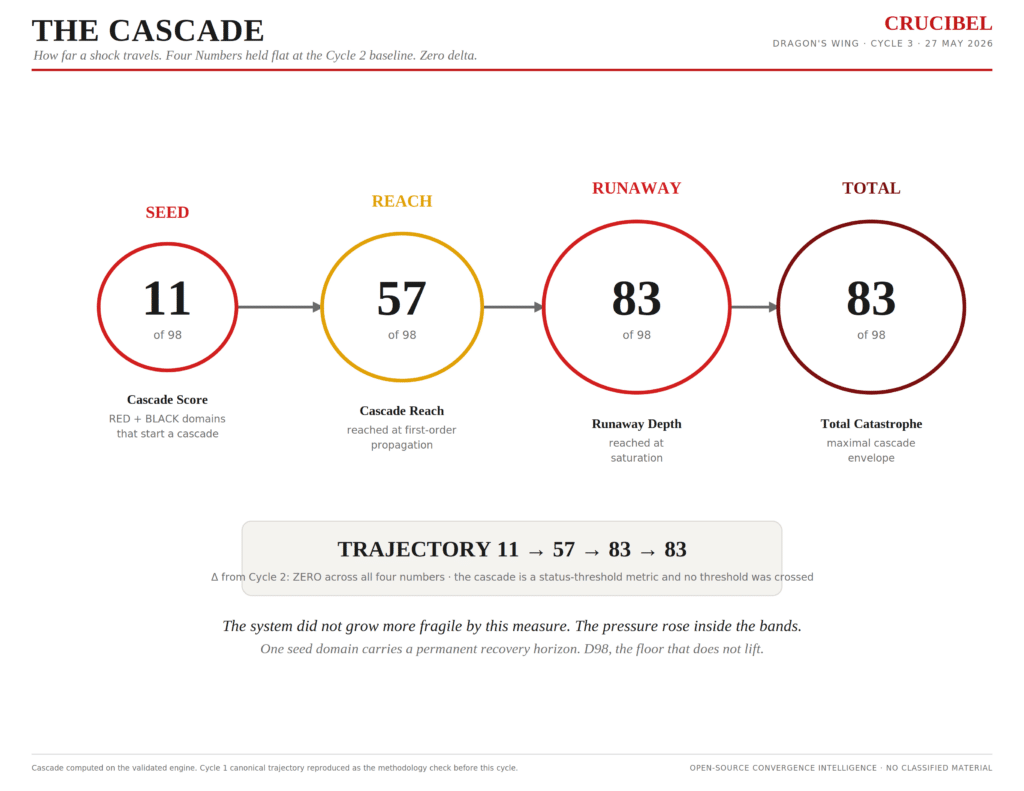
A Taiwan assessment written in the spring of 2026 has an advantage no prior cycle had. Two major wars are running in real time, and Beijing is studying both with more attention than any Western analyst. The war in Ukraine, grinding through its fifth year, and the Iran war that opened in late February of this year are not background. They are the two live laboratories in which the People’s Republic is testing its own assumptions about a move on Taiwan. The lessons cut in both directions, and an honest reading takes both edges.
What Ukraine taught, and what Beijing took from it
The first and largest lesson of Ukraine is that the Western coalition held. The sanctions did not collapse the way some in Moscow and Beijing expected, the alliance did not fracture, and the weapons kept flowing across years rather than months. A United States Department of War assessment late in 2025 concluded that Beijing no longer expects a short war over Taiwan and is instead preparing for a prolonged, high-intensity, multi-domain contest that would test logistics, narrative control, joint command, and sheer endurance. That is the single most important shift in Chinese planning that Ukraine produced. The fantasy of a quick decapitation, a Kyiv-in-three-days for Taipei, did not survive contact with the evidence.
The second lesson is about corruption and readiness, and it lands directly on the thread this assessment has already drawn. Russia’s battlefield failures exposed a military hollowed by graft, its logistics rotten, its readiness a paper figure. The watching Chinese leadership drew the obvious conclusion and redoubled an anti-corruption campaign inside its own forces that had already been running for a decade. The purge of the senior ranks described elsewhere in this assessment is, in part, Beijing acting on the Ukraine lesson. And here the lesson folds back on itself in a way the optimistic reading misses. The very campaign meant to prevent a Russian-style readiness collapse produces, in its execution, the command hollowing that raises the risk of an accident. Beijing learned that corruption kills readiness, and the cure it chose carries its own pathology.
The third lesson is economic and it is double-edged. Western analysts who have war-gamed sanctions against China conclude that the instruments that bit Russia would bite China far less, because it is almost impossible to engineer a balance-of-payments crisis in a country running an enormous current-account surplus. Beijing has watched the West spend its sanctions ammunition on Russia and has spent four years building resilience against exactly that arsenal. The lesson Beijing took is not that sanctions are unbearable. It is that they are survivable with preparation, and the preparation is well advanced. The fourth lesson is strategic and it explains the diplomacy of this very cycle. Russia’s war taught Beijing the supreme value of splitting Europe from the United States and dividing Europe within itself, and the assertive summitry and the courting of European investment documented this cycle are that lesson in motion.
What Iran is teaching, in real time
The Iran war is the more immediate laboratory, because it is testing the exact instrument that sits at the heart of the Taiwan contingency: the maritime chokepoint. When the war opened in late February and Iran closed the Strait of Hormuz, through which roughly a quarter of the world’s seaborne oil and a fifth of its liquefied natural gas had passed, the world ran a live experiment in what chokepoint closure does to the global economy. The answer was severe. Fuel shortages reached across Asia, prices convulsed, and a dual blockade settled into place as the United States moved to interdict Iranian ports while Iran interdicted the strait. Months on, a conditional ceasefire holds on paper while almost no shipping moves, an envelope state we have elsewhere named the Suspended Siege.
Beijing has read three lessons from Hormuz, and all three apply to Malacca. The first is the demonstration already described in this assessment. When the strait closed, China’s own crude imports fell hard, a preview of its own Malacca vulnerability run as a live exercise by someone else. The second is the insurance lesson. The war-risk underwriters repriced Gulf transit overnight, and the cost of insurance, more than any naval patrol, is what actually stopped the ships. Beijing now sees with fresh clarity that the insurance market is a chokepoint weapon in its own right, one that can close a strait without a single mine. The third is the coalition lesson, and it is the one that should sober the optimist. A coalition of thirty-eight nations formed to address Hormuz, and a United Nations resolution on the strait was vetoed by China and Russia together. Beijing learned that a chokepoint crisis draws a broad coalition fast, and it also learned that its partnership with Moscow can blunt the multilateral response at the Security Council. Both lessons are now priced into Chinese planning.
There is a fourth Iran lesson, quieter and graver. The United States analysis emerging from the Iran war finds that American stockpiles of advanced munitions will take years to replenish after the campaign. Every precision weapon spent in the Gulf is a weapon not available in the Pacific, and a munitions base that needs years to recover is a munitions base that cannot fight two major wars at once. Beijing is watching the American magazine empty in one theater and drawing the obvious inference about the other.
How the lessons apply to Taiwan, now and forward
Assemble the lessons and a coherent Chinese reading emerges. A Taiwan operation will be long, not short, so prepare for endurance. Sanctions will come but can be survived, so build the resilience now, which Beijing is doing. The coalition will form fast and hold, so the strategic prize is splitting it before the fact, which the diplomacy of this cycle pursues. The chokepoint is a real weapon and the insurance market is the trigger, so the lever exists and has now been demonstrated. And the American magazine is finite and stretched across two active theaters, so the window in which the United States is distracted and depleted is a window worth watching. None of these lessons makes an invasion imminent. Several of them counsel exactly the caution that has kept the envelope intact for seventy-six years. But together they sketch the conditions under which the caution could lapse, and every one of those conditions is closer this cycle than last.
The forward warning is the synthesis. The most dangerous moment for Taiwan is not a Chinese military at its peak. It is a confluence: an American munitions base depleted by a second theater, a European coalition successfully split by patient diplomacy, a sanctions architecture Beijing has already learned to survive, and a chokepoint weapon proven in the Gulf and transferable to Malacca. The Iran war and the Ukraine war are, between them, teaching Beijing how to assemble that confluence. The lesson for the Western analyst is that the two wars already running are not separate from the Taiwan question. They are its rehearsal.
Three Pressures Beneath the Surface
If the classification did not move, where did the pressure go. Into three threads, each visible this cycle, each grounded this cycle in primary source, none yet decisive on its own. Together they are the cycle’s real movement.
The accident inside a hollowed command
The first thread is the most dangerous, because it does not require anyone to decide anything. The People’s Liberation Army has spent the past two years purging its own senior ranks, with the most senior officers sentenced this spring under suspended capital terms. The posture the force projects outward has grown louder over the same period, even as the command structure that would have to execute that posture has been hollowed by the very purge that demonstrates the leadership’s control. The fusion of those two facts is the danger. An institution can need to project kinetic optionality and simultaneously degrade the operational competence required to manage that optionality safely. The failure mode is not a decision to attack. It is an accident. A junior officer at three in the morning, running a rehearsal his purged superiors are no longer present to supervise, can break a seventy-six-year peace without anyone in Beijing ever choosing to. The Long Refusal does not need to be broken on purpose. It can break by mistake, and the hollowing makes the mistake more likely, not less.
This is the point at which a common reading goes wrong, and the error is worth naming directly, because a great deal of comfortable analysis rests on it. The reading runs as follows. China is purging its military, a purged military cannot mount an invasion, therefore the danger has receded. The first two steps are sound. The conclusion does not follow. A purged force is indeed less able to launch the deliberate, coordinated, high-consequence operation that an amphibious invasion would require, and on that narrow question the risk has genuinely fallen. But less able to attack on purpose is not the same as less dangerous, and treating the two as identical is the mistake. The same purge that degrades the capacity for a planned invasion degrades the capacity to manage an unplanned incident. It strips out the experienced commanders who would calm a confrontation, it teaches the survivors that the safe move is to look strong rather than to step back, and it raises the political cost to a consolidating leadership of being seen to back down. The instability lowers the odds of the war that is chosen and raises the odds of the war that is stumbled into. The net danger does not fall. It changes from a danger that can be deterred into one that cannot, because nothing deters an accident. A reader who concludes from the purge that the Strait is calmer has read half the evidence and stopped.
The contest for the Taiwanese mind
The second thread runs through the mind rather than the muscle, and it is the quietest. The campaign to persuade the people of Taiwan that they are fundamentally Chinese has intensified, documented this cycle by allied analysts who track it as deliberate cognitive warfare. It is met, for now, by a population whose sense of itself has not bent and a government that governs with visible confidence in its own legitimacy. But the campaign is patient and it is sophisticated, and it is designed to work over years, not weeks. It aims to make the island’s defense feel, to the islanders themselves, like a choice not worth the cost. That is a slower danger than a missile, and in some readings a graver one.
The confluence at the top
The third thread is the alignment hardening among Beijing, Moscow, and Pyongyang. A leaders’ summit this cycle carried a warning from Beijing to Washington over Taiwan. The same weeks brought fresh documentation of Russian fingerprints on North Korea’s expanding nuclear complex. No single move crossed a threshold. But three separate currents are bending toward the same confluence, and the convergence of three independent primary sources on the same alignment, in a single cycle, is a signal in itself. This is the thread most likely to force the next real classification move in the cycles to come, and it is the one we will be watching hardest.
What Cuts the Other Way
An honest product carries its own counter-evidence, and there is real counter-evidence this cycle. Taiwan’s ports are not bracing for siege. They are expanding, planning cruise itineraries years into the future even as they upgrade security, which is the posture of a port authority that expects to remain open for ordinary commerce. The Red Sea shipping lanes saw their best week of transits in months, an easing in the global supply picture rather than a tightening. The meteorological calendar argues against near-term alarm, with the amphibious window closing and the typhoon season approaching. And the governing party in Taipei spent the cycle talking about childcare and growth, the public posture of confidence rather than crisis. None of these undoes the hardening described above. All of them belong in an honest ledger, and a reader who ignores them is reading propaganda, not intelligence.
What We Are Watching
Five items, ordered by the weight of their consequence rather than the odds of their occurrence. The intelligence consumer should hold both dimensions at once.
First, the fabrication complex. A move from stable to failing at that single point would expand the damage across the theater faster than any other event available. We judge it unlikely in the near term. We judge its impact severe and discontinuous. It is first on the list because consequence, not probability, ranks this list.
Second, the war-risk insurance list. The underwriters have not named the Pacific or the Taiwan Strait among the world’s dangerous waters. A listing, whether of vessels operating in coordinated formation with maritime militia or of the Strait’s waters outright, would reprice every transit overnight and convert a latent lever into an active one. We judge it unlikely this cycle and high in impact.
Third, the confluence at the top. The Beijing-Moscow-Pyongyang alignment is the thread most likely to drive the next classification move. We judge continued incremental hardening to be roughly an even chance and a threshold break to be low this cycle, with high impact if it comes.
Fourth, the accident risk inside the hollowed command. This is the item least amenable to a probability estimate, because it is a tail risk rather than a trend. We judge it unlikely but structurally elevated, and its impact severe and discontinuous.
Fifth, a move to weaponize Malacca itself, now that the tollbooth doctrine has been spoken aloud in the adjacent theater. We judge it very unlikely in the near term and severe in impact. No current indicator suggests imminence. The doctrine, however, is now named, and named doctrines have a way of finding their moment.
What We Cannot Yet See
The discipline requires naming the gaps. Five matter this cycle. The amphibious and sealift capacity of the PLA, the metric that would most directly signal a shift toward invasion, rests on carried-forward assessment because the dispositive sources could not be reached. The internal communications and personnel signals inside the PLA, the through-line of the most dangerous thread, are sourced thinly for the same reason. Chinese cyber pre-positioning in critical infrastructure is classified in the red on carried-forward assessment without a current-cycle refresh. Taiwan’s food security and pharmaceutical surge capacity under blockade rest on thinner evidence than the stakes deserve. And the compound scenario, a major earthquake striking the fabrication complex during a contingency, is a thing the framework scores as independent pieces and does not model as the simultaneous failure it would actually be. These are not reasons to discount the assessment. They are the honest borders of it.
The Year She Turns Seventy-Seven
There is a number that appears in no cascade and cannot be computed. The Long Refusal is in its seventy-seventh year. It is older than almost everyone now charged with managing it. It has outlived the men who began it and the historical analogues that might have shown it how to end. It holds not because it is stable in any deep sense but because every party to it has, so far, found the cost of breaking it higher than the cost of enduring it one more day.
That arithmetic is not permanent, and this cycle is the clearest illustration of why. The pressure rose without the structure moving. That is the most that can be honestly said and the least that should be comforting, because a load that rises against a structure that does not yield is the precise description of a thing approaching its limit. A line that has held for seventy-six years and seven months can hold for another year. It can also break in an afternoon, by accident, at three in the morning, on a fault no one was watching, in a command no one was supervising. We will be here for the next cycle. So, in all likelihood, will the Refusal. The work is to make sure that the year she turns seventy-seven is not the year the arithmetic finally inverts.
RESONANCE
38 North (2026). DPRK Nuclear Complex and Russian Linkages. Stimson Center. https://www.38north.org/ Summary: The canonical open-source analysis of North Korea documents the expanding nuclear complex and the deepening Russian linkages that anchor the confluence thread.
Australian Strategic Policy Institute (2026). Pressure Points, the Critical Technology Tracker, and Back to the Old Ways. ASPI. https://www.aspi.org.au/ Summary: ASPI maps Chinese air and maritime coercion as psychological pressure and documents the deliberate campaign to persuade Taiwanese of a Chinese identity. The grounding for the cognitive-warfare thread.
Center for Strategic and International Studies (2026). Asia Maritime Transparency Initiative. CSIS. https://amti.csis.org/ Summary: The maritime-transparency program documents continuing South China Sea outpost expansion across all claimants, grounding the maritime-militarization reading.
Council on Foreign Relations (2026). The Ukraine War, China, and Taiwan. CFR. https://www.cfr.org/ Summary: The framing analysis of how the Ukraine war shapes the Taiwan calculus, the untested-military and economic-cost lessons.
European Council on Foreign Relations (2025). Hard, Fast, and Where It Hurts, Lessons from Ukraine-Related Sanctions for a Taiwan Conflict Scenario. ECFR. https://ecfr.eu/publication/hard-fast-and-where-it-hurts-lessons-from-ukraine-related-sanctions-for-a-taiwan-conflict-scenario/ Summary: The sanctions war-game that grounds the finding that Russia-style sanctions bite a current-account-surplus China far less, the economic-resilience lesson.
Federation of American Scientists (2026). Nuclear Information Project. FAS. https://nuke.fas.org/ Summary: The canonical open-source tracker of Chinese and United States nuclear forces, the grounding for the nuclear-posture assessment.
Fravel MT (2023). China’s Potential Lessons from Ukraine for Conflict over Taiwan. The Washington Quarterly 46(3). https://ssp.mit.edu/publications/2023/china-s-potential-lessons-from-ukraine-for-conflict-over-taiwan Summary: The authoritative academic treatment of the political, military, and economic lessons Beijing may draw from Ukraine, including the corruption-and-readiness lesson that anchors the purge thread.
Garner D (2026). The Christmas Cordon. CRUCIBEL. https://crucibeljournal.com/the-christmas-cordon/ Summary: The insurance-lever argument, grounded this cycle by the war-risk list that still omits the Pacific.
Garner D (2026). The Lin Biao Recursion. CRUCIBEL. https://crucibeljournal.com/the-lin-biao-recursion-on-self-replicating-failure-in-ccp-succession-management/ Summary: On self-replicating failure in succession management, the deep current beneath the purge and the accident thread.
Garner D (2026). Taiwan-China Collision Course. CRUCIBEL. https://crucibeljournal.com/taiwan-china-collision-course/ Summary: The founding frame for this theater line.
Garner D (2026). The Tiered Compact. CRUCIBEL. https://crucibeljournal.com/the-tiered-compact/ Summary: The nationality-coded toll regime in the adjacent theater, the precedent that now reaches toward Malacca.
House of Commons Library (2026). Israel and US-Iran Conflict 2026, Reopening the Strait of Hormuz. UK Parliament. https://commonslibrary.parliament.uk/research-briefings/cbp-10636/ Summary: The parliamentary briefing on the Hormuz closure, the dual blockade, and the thirty-eight-nation coalition, grounding the Iran chokepoint lessons.
Lloyd’s Joint War Committee (2026). Listed Areas, Hull War, Piracy, Terrorism and Related Perils. Lloyd’s Market Association. https://www.lmalloyds.com/jointwar Summary: The war-risk underwriters’ list of dangerous waters names the Gulf, Guyana, and Sudan, and not the Pacific or the Taiwan Strait. The absence is the insurance-lever signal.
Mercator Institute for China Studies (2026). China Analysis and the Leaders’ Summit Assessment. MERICS.https://merics.org/en Summary: Europe’s leading China institute frames the tension between diplomatic strength and economic weakness and reports the summit warning over Taiwan.
Peretti A (2026). The Portable Lock. CRUCIBEL. https://crucibeljournal.com/the-portable-lock/ Summary: Commercial coercion as a deployable chokepoint, the conceptual root of the tollbooth doctrine.
Peretti A (2026). She Is Three Hundred and Sixty-Five. CRUCIBEL. https://crucibeljournal.com/she-is-three-hundred-and-sixty-five/ Summary: The Refusal counted in days rather than years, the human register no cascade can carry.
Republic of China Ministry of National Defense (2026). PLA Activities List. ROC MND. https://www.mnd.gov.tw/en/news/plaactlist Summary: The official Taiwan-side daily tracker of PLA activity across the Strait and the air defense identification zone, the primary source for the kinetic-posture read.
Storm T (2026). The Compliance Vise. CRUCIBEL. https://crucibeljournal.com/war-brief-011-the-compliance-vise/ Summary: On the coupling of secondary sanctions and blocking rules, the grounding for the economic-instruments reading.
Storm T (2026). DRAGON’S WING Cycle 1 Update. CRUCIBEL. https://crucibeljournal.com/dragons-wing/ Summary: The baseline cycle for this theater architecture, the trajectory this assessment measures against.
Storm T (2026). The Fabless Trap. CRUCIBEL. https://crucibeljournal.com/the-fabless-trap/ Summary: Why the fabrication complex is the heaviest consequence in the theater.
Storm T (2026). The Forbidden Wing. CRUCIBEL. https://crucibeljournal.com/the-forbidden-wing/ Summary: On the internal dynamics of the PLA, the grounding for the personnel-signal and hollowing reading.
Storm T (2026). The Harvest Window. CRUCIBEL. https://crucibeljournal.com/the-harvest-window/ Summary: On the timing windows of the contingency, the grounding for the seasonal-constraint reading.
Storm T (2026). Reading Xi. CRUCIBEL. https://crucibeljournal.com/reading-xi/
Summary: The leadership read behind the assertive diplomacy.
Storm T (2026). The Sanction Magnet. CRUCIBEL. https://crucibeljournal.com/the-sanction-magnet/ Summary: How an enforcement regime becomes a recruitment signal, the grounding for the talent-flight reading.
Categories Convergence Intelligence, Geostrategy, SITREP
Tags amphibious capability, Beijing-Moscow-Pyongyang, cascade analysis, China-Russia-North Korea, chokepoint warfare, cognitive warfare, critical minerals, Cross-Strait, Economic Coercion, gray-zone coercion, hollowed command, Iran war, Lloyd’s Joint War Committee, LNG, Malacca Dilemma, Malacca Strait, nuclear posture, PLA, PLA purge, rare earths, sanctions resilience, semiconductor supply chain, South China Sea, Strait of Hormuz, Suspended Siege, Taiwan defense, Taiwan Strait, The Long Refusal, TSMC, Ukraine war, war risk insurance