
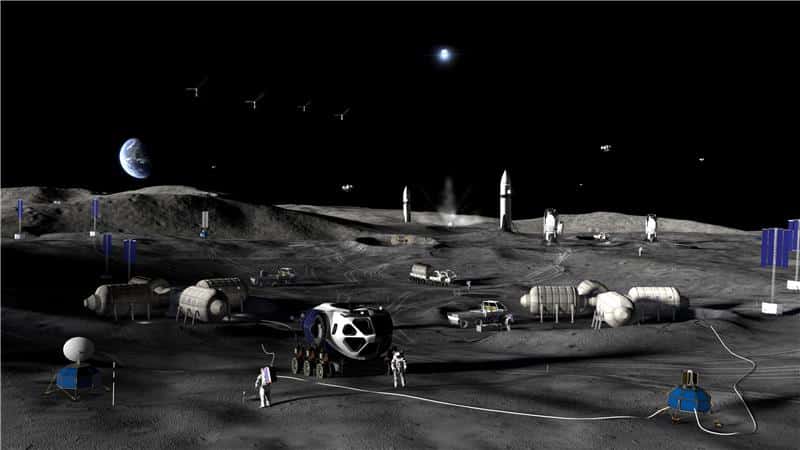
NASA Administrator Jared Isaacman announced Tuesday that the agency is canceling the Lunar Gateway space station and redirecting its resources toward a permanent surface base on the moon, with a $20 billion investment planned over seven years under the accelerated Artemis program.
To return Americans to the Moon, NASA is shifting to an iterative, execution-focused approach – just as we did during Apollo.
We are standardizing rocket architecture, embedding NASA expertise across industry, and increasing launch cadence to support sustained lunar operations.…
— NASA Administrator Jared Isaacman (@NASAAdmin) March 24, 2026
From Apollo to Artemis, the mission endures.
What we begin today will define the next era of human exploration. https://t.co/sWeyCEUAa7
— NASA (@NASA) March 24, 2026
But within the same event, Carlos Garcia-Galan, the former Gateway program deputy manager now heading the moon base effort, presented a three-phase plan requiring $30 billion over a decade. That figure is $10 billion more than Isaacman’s, with each phase drawing roughly $10 billion in investment. Neither official addressed the discrepancy publicly.
“Every asset, every kilogram, all the lunar exploration resources that we have are going to be focused on one thing, and that is to build the moon base,” Garcia-Galan said.
The Gateway, much of which has already been built by contractors Northrop Grumman and Vantor, formerly Maxar, was designed as a staging outpost in lunar orbit. Its near rectilinear halo orbit imposed fuel constraints on landers, and Garcia-Galan said the Human Landing System, or HLS, providers from SpaceX and Blue Origin do not need it to complete their missions.
Isaacman also announced a change to Artemis III, previously targeted as NASA’s first crewed lunar landing since 1972. The mission, now scheduled for 2027, will instead test docked Orion and HLS operations in Earth orbit. The first actual landing has been pushed to Artemis IV in 2028.
“The clock is running in this great-power competition, and success or failure will be measured in months, not years,” Isaacman said, citing China’s own 2030 lunar landing goal as a driving factor behind the overhaul.
Artemis II, a crewed 10-day flight around the moon carrying three NASA astronauts and one Canadian Space Agency astronaut, is scheduled to launch April 1.
We’re flying around the Moon. Come watch with us.
Live coverage of Artemis II prelaunch activities begins Friday, March 27, when the crew arrives at @NASAKennedy. Here’s the full Artemis II event schedule — keep checking back for the latest updates: https://t.co/jroi7BTUA5 pic.twitter.com/9DDkjTdt3K
— NASA (@NASA) March 25, 2026