• Home
  • News
    • Global Operations
      • Asia
      • Africa
      • Europe
      • Latin America
      • Middle East
      • North America
    • Industry
      • Asia
      • Africa
      • Europe
      • Latin America
      • Middle East
      • North America
      • Oceana
    • Special Interest
      • Asia
      • Africa
      • Europe
      • Latin America
      • Middle East
      • North America
      • Oceana
  • Market
    • Wired to Win
    • SOFX.NET
  • Intelligence
    • USMC Deception Manual
  • Resources
    • Contact Us
    • About Us
    • Editorial Policy
    • Privacy Policy
  • Home
  • News
    • Global Operations
      • Asia
      • Africa
      • Europe
      • Latin America
      • Middle East
      • North America
    • Industry
      • Asia
      • Africa
      • Europe
      • Latin America
      • Middle East
      • North America
      • Oceana
    • Special Interest
      • Asia
      • Africa
      • Europe
      • Latin America
      • Middle East
      • North America
      • Oceana
  • Market
    • Wired to Win
    • SOFX.NET
  • Intelligence
    • USMC Deception Manual
  • Resources
    • Contact Us
    • About Us
    • Editorial Policy
    • Privacy Policy
Login
Join Free
Home
Asia
Africa
Europe
Latin America
Middle East
North America
Asia
Africa
Europe
Latin America
Middle East
North America
Asia
Africa
Europe
Latin America
Middle East
North America
Coming Soon
Job Board
Events
Contact Awards
USMC Deception Manual
Login
Join Free
Home Global Operations

U.S. appears to have mined Iranian missile base to trap launchers underground

  • SOFX Staff Writer
  • March 27, 2026
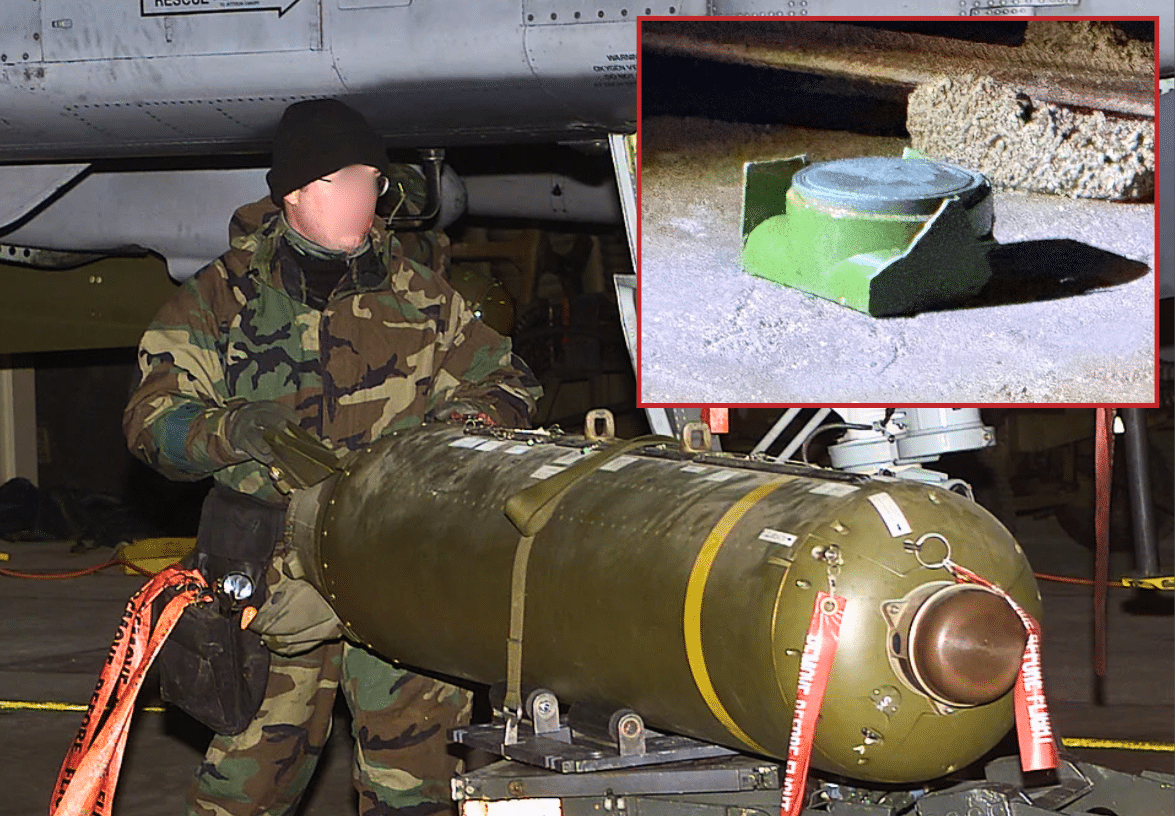
A U.S. Air Force airman guides a CBU-89 Gator mine dispenser onto a munitions handling truck in 2002 (left). Inset: An image posted by Iranian state media outlet Tasnim News Agency showing what it identified as a BLU-91/B anti-tank mine (right). (Photos: SSgt. Johnny Saldivar/USAF; Tasnim News Agency)
Share on FacebookShare on TwitterLinkedIn

The United States appears to have deployed air-delivered anti-tank mines around the approaches to an underground Iranian ballistic missile facility near Shiraz, according to a Bellingcat investigation published Thursday and corroborated by independent munitions experts consulted by The Washington Post.

Iranian state media outlet Tasnim News Agency first reported the incident Thursday morning, claiming U.S. forces had scattered mines from the air over the village of Kafari, in the southern suburbs of Shiraz, killing several people. Including one man who was killed when he attempted to pick up the munition near his car. 

جنایت جدید آمریکایی ـ صهیونی در برخی مناطق کشور

رهاسازی بسته‌های انفجاری با جنگنده

این بسته‌های انفجاری شبیه کنسرو آماده بوده و حاوی مواد منفجره‌ای است که بعد از بازگشایی منفجر شده و باعث تلفات جانی می‌گردد
#انتقام_سخت pic.twitter.com/0mChpxVhLP

— خبرگزاری تسنیم (@Tasnimnews_Fa) March 26, 2026


Bellingcat’s conflict and human rights team subsequently geolocated footage and photographs of the munitions, placing at least three mines approximately 1.2 miles from the reported entrance to Shiraz South Missile Base, part of Iran’s network of hardened underground “missile cities.”

The munitions were identified as BLU-91/B anti-tank mines from the U.S. Gator Scatterable Mine system. The BLU-91/B is an air-delivered, magnetically fuzed anti-tank mine designed to detonate beneath the large metal signature of a heavy vehicle. 

#Iran / #Israel / #USA 🇮🇷🇮🇱🇺🇸: US forces reportedly air-dropped explosive devices in the city of #Shiraz in #Fars Province.

The Explosive Devices seem to be “BLU-91/B” Landmines —which are mostly deployed by CBU-89/B and CBU-78/B Cluster bombs of “GATOR” Mine System. pic.twitter.com/RmW81ZQrPN

— War Noir (@war_noir) March 26, 2026


The Air Force deploys it via the CBU-89/B dispenser, which carries 72 anti-tank and 22 anti-personnel mines in a 1,000-pound cluster munitions unit. The Navy variant, the CBU-78/B, carries 45 anti-tank and 15 anti-personnel mines in a 500-pound unit.
A U.S. Air Force airman guides a CBU-89 Gator mine dispenser on a munitions handling truck (Photo: USAF)

The BLU-91/B incorporates a self-destruct mechanism, but Bellingcat noted that the mines can randomly detonate hours or days after deployment or if disturbed, posing a sustained risk to anyone in the affected area.

U.S.-led airstrikes, including B-2 Spirit bomber missions employing the GBU-72 Advanced 5,000-Pound Penetrator, have targeted tunnel entrances at Iran’s underground missile facilities throughout the campaign. 

CENTCOM commander Adm. Brad Cooper said in a command video released Wednesday that Iranian drone and missile launch rates have fallen more than 90 percent since the opening days of Operation Epic Fury. Iran has nonetheless continued launching ballistic missiles and has demonstrated the capability to reopen blocked tunnel entrances using heavy excavation machinery.

Furthermore, according to a Reuters report published Thursday citing five people familiar with U.S. intelligence assessments, the Pentagon has confirmed the destruction of only approximately one-third of Iran’s missile arsenal. The status of roughly another third remains unclear, with officials saying those missiles may have been damaged, destroyed, or buried inside underground tunnels by successive strikes. 

The figures point to a core limitation of the air campaign. Direct strikes have collapsed tunnel entrances at multiple facilities, but Iran has demonstrated the capability to reopen them using heavy excavation machinery and has continued rolling mobile launchers out to conduct strikes. 

N.R. Jenzen-Jones, director of Armament Research Services, told Bellingcat the weapons appear designed to trap transporter erector launchers (mobile missile systems known as TELs) inside the facilities and prevent equipment from clearing the bombed entrances.

Nicole Grajewski, a researcher at Sciences Po Paris, told The Washington Post that Iranian mobile launchers have continued operating near the bases throughout the conflict, calling the TEL fleet the most persistent part of Iran’s remaining strike capability.

The U.S. Air Force used 1,105 CBU-89 Gator dispensers during the 1991 Gulf War, including on missions meant to limit Iraqi Scud missile launcher movements. A later review by the U.S. Government Accountability Office, published as GAO-02-1003, found that Gator drops on suspected Scud operating areas were not reported to have destroyed any missiles or launchers. Whether the tactic will prove more effective in the current campaign is something observers will have to wait to see.


SOFX Staff Writer

SOFX Staff Writer

The Editor Staff at SOFX comprises a diverse, global team of dedicated staff writers and skilled freelancers. Together, they form the backbone of our reporting and content creation.

Subscribe
Login
Notify of
guest
guest
0 Comments
Oldest
Newest Most Voted
Inline Feedbacks
View all comments
ADVERTISEMENT

Trending News

US Army Special Operations Soldier Arrested for $400K Polymarket Bet on Maduro Raid

US Army Special Operations Soldier Arrested for $400K Polymarket Bet on Maduro Raid

by SOFX Staff Writer
April 24, 2026
4

The Department of Justice arrested Army Master Sgt. Gannon Ken Van Dyke, 38, on charges that he used classified intelligence...

Ukraine Hits Major Yaroslavl Refinery as New Images Confirm Destruction of Half of Tuapse’s Tank Farm

Ukraine Hits Major Yaroslavl Refinery as New Images Confirm Destruction of Half of Tuapse’s Tank Farm

by SOFX Staff Writer
April 27, 2026
0

Ukrainian drones struck the Slavneft-YANOS oil refinery in Yaroslavl overnight on April 25-26, igniting a fire at one of Russia's...

Video Shows Iranian Commandos Storming Container Ships in Strait of Hormuz

Video Shows Iranian Commandos Storming Container Ships in Strait of Hormuz

by SOFX Staff Writer
April 24, 2026
3

Iran has released a new video purportedly showing the seizure of two commercial container ships, the MSC Francesca and the...

Unauthorized Group Gained Access to Anthropic’s Exclusive AI Model

Unauthorized Group Gained Access to Anthropic’s Exclusive AI Model

by SOFX Staff Writer
April 23, 2026
0

Anthropic is investigating reports that an unauthorized group may have gained access to its Claude Mythos artificial intelligence (AI) model,...

ADVERTISEMENT
ADVERTISEMENT
Next Post
Israel strikes Iran’s Arak heavy water reactor for second time

Israel strikes Iran's Arak heavy water reactor for second time

Pentagon Plans Weeks of Ground Operations Inside Iran

Iranian Strike at Saudi Air Base Damages U.S. E-3 Sentry AWACS

997 Morrison Dr. Suite 200, Charleston, SC 29403

News

  • Global Operations
  • Special Interest
  • Industry
  • Global Operations
  • Special Interest
  • Industry

Resources

  • About Us
  • Contact Us
  • Advertise with Us
  • Editorial Policy
  • Privacy Policy
  • About Us
  • Contact Us
  • Advertise with Us
  • Editorial Policy
  • Privacy Policy
No Result
View All Result
  • Home
  • News
    • Global Operations
      • Asia
      • Africa
      • Europe
      • Latin America
      • Middle East
      • North America
    • Industry
      • Asia
      • Africa
      • Europe
      • Latin America
      • Middle East
      • North America
      • Oceana
    • Special Interest
      • Asia
      • Africa
      • Europe
      • Latin America
      • Middle East
      • North America
      • Oceana
  • Market
    • Wired to Win
    • SOFX.NET
  • Intelligence
    • USMC Deception Manual
  • Resources
    • Contact Us
    • About Us
    • Editorial Policy
    • Privacy Policy
Subscribe
This website uses cookies. By continuing to use this website you are giving consent to cookies being used. Visit our Privacy and Cookie Policy.

Log in to your account

Lost your password?
wpDiscuz