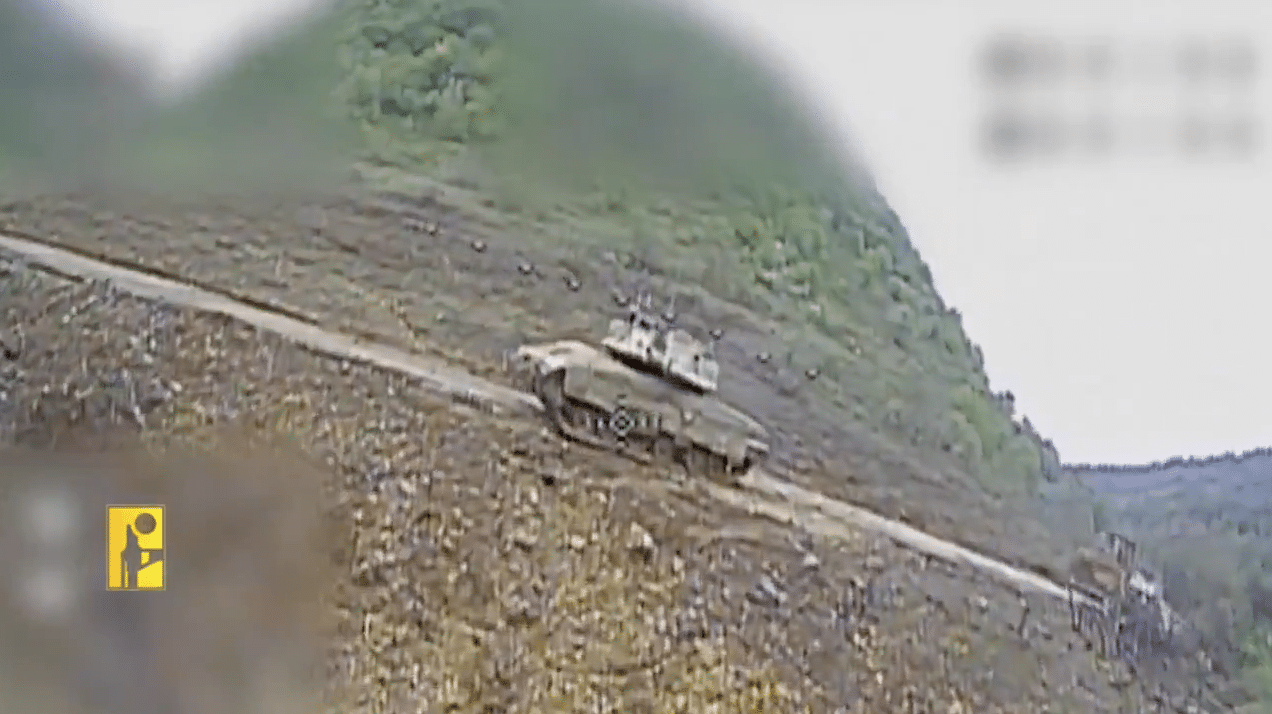
Hezbollah has deployed fiber-optic guided first-person view (FPV) drones against Israel Defense Forces (IDF) armor in southern Lebanon, with footage circulating on social media appearing to show strikes on a rare Namer heavy infantry fighting vehicle (IFV) fitted with an active protection system, two Merkava Mk.4 main battle tanks, and a D9 Caterpillar armored bulldozer.
Hezbollah Ramping Up FPV Drone Attacks On IDF In Lebanon,One video claims to show a compilation of Hezbollah FPV strikes that hit two Merkava Mk.4 main battle tanks, a D9 Caterpillar armored bulldozer, and what appears to be a Namer heavy infantry fighting vehicle (IFV). pic.twitter.com/tpRduSTXSs
— Valhalla (@ELMObrokenWings) April 12, 2026
SOFX has not independently verified the footage.
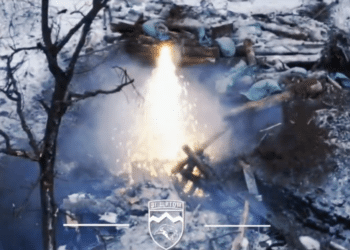
Hezbollah continues to use fiber-optic FPV attack drones to target Israeli armor in southern Lebanon.
Seen here, a pair of FPV strikes that hit Israeli Merkava Mk.4 MBTs. First one hits one of the tanks in its track, while the second hits the heavily armored turret front. pic.twitter.com/A4jQcBGZrM
— OSINTtechnical (@Osinttechnical) April 4, 2026
The Namer variant visible in the footage carries the Katlanit remote weapon station, a Rafael Advanced Defense Systems system that mounts a 30mm Mk44 Bushmaster II autocannon, a Spike anti-tank guided missile (ATGM) launcher, and the Trophy active protection system (APS). Standard Namer armored personnel carriers in IDF service are fitted with a 12.7mm M2HB heavy machine gun.
The Katlanit-equipped variant is among the most protected platforms in the Israeli order of battle. Its appearance in the footage is a significant development highlighted in this SOFX report based on open-source analysis.
Hezbollah vs IDF in Aynata: Explosive-laden FPV quadcopter strike vs IDF Namer troop carrier near Bint Jbeil on 31 March. [Hezbollah 7/4] pic.twitter.com/T6euot4wCM
— Jon Elmer (@jonelmer) April 7, 2026
All Hezbollah footage cuts at the point of impact, leaving battle damage unassessed. A senior IDF official told The War Zone that the clips “do show genuine strike capability, and some hits are probably real,” but said “the videos cannot prove actual damage to a Merkava Mark IV” and that “success rates are likely overstated.”
Ryan Brobst, Deputy Director of the Foundation for Defense of Democracies’ (FDD) Center on Military and Political Power, attributed the increase to higher troop concentrations further north and wider fiber-optic drone availability.
“It seems quite unlikely Hezbollah had significant numbers of fiber optics in 2024,” Brobst said. “They are much more available now.”
Fiber-optic cable guidance resists radio-frequency jamming that would otherwise interfere with standard FPV control links.
Troops from the Nahal Brigade’s 50th Battalion seized a cache of Hezbollah FPV drones along with sniper rifles and rocket-propelled grenades at a site in southern Lebanon on April 3, the IDF announced.
The IDF has scaled up its presence to six divisions in southern Lebanon since the ground campaign began on March 2.
Prime Minister Benjamin Netanyahu:
“Dear residents of the North, I am proud of you. You continue to stand firm.
I wish to inform you: There is no ceasefire in Lebanon. We are continuing to strike Hezbollah with full force, and we will not stop until we restore your security. pic.twitter.com/k2JeKXEMBQ
— Prime Minister of Israel (@IsraeliPM) April 9, 2026
Prime Minister Benjamin Netanyahu said on April 9 that no ceasefire agreement is in place. “We are continuing to strike Hezbollah with full force, and we will not stop until we restore your security,” he said.