
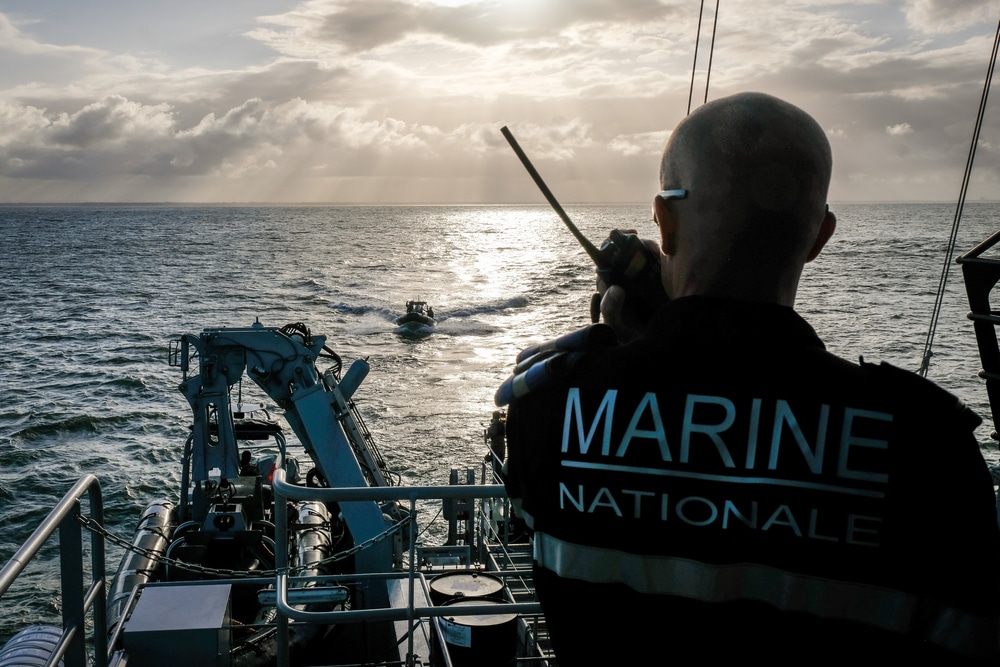
France is organizing a multinational naval escort mission to protect commercial vessels transiting the Strait of Hormuz once active combat in the region subsides, President Emmanuel Macron announced Monday from Cyprus.
Macron described the operation as “purely defensive, purely escort” during a joint press conference with Greek Prime Minister Kyriakos Mitsotakis and Cypriot President Nikos Christodoulides at Paphos military airport. The mission will launch “as soon as possible after the most intense phase of the conflict has ended,” he said, adding that it would involve European and non-European partners.
“This is essential for international trade, but also for the flow of gas and oil, which must be able to leave this region once again,” Macron said.
Nous n’avons pas voulu cette guerre, mais nous avons la responsabilité de tout faire pour protéger nos compatriotes, protéger nos économies, et éviter une escalade dans la région, au Liban et au Moyen-Orient.
Ensemble avec le Président chypriote Nikos Christodoulides… pic.twitter.com/oUTqiXewyp
— Emmanuel Macron (@EmmanuelMacron) March 9, 2026
The Strait of Hormuz carries approximately 20% of global crude oil shipments daily. Since U.S. and Israeli strikes on Iran began on February 28, Brent crude prices have climbed above $100 per barrel, a roughly 50 percent increase.
Macron confirmed the nuclear-powered aircraft carrier Charles de Gaulle had arrived in the eastern Mediterranean.
He announced France would deploy eight frigates and two amphibious assault ships, a force that will operate across the eastern Mediterranean, Red Sea, and potentially the Strait of Hormuz. Two frigates will reinforce the European Union’s Operation Aspides, a naval mission protecting Red Sea shipping since February 2024.
La sécurité de tous les Européens est notre intérêt commun. Nos partenaires peuvent compter sur la France. pic.twitter.com/HJyN2LZPVF
— Emmanuel Macron (@EmmanuelMacron) March 9, 2026
“When Cyprus is attacked, it is Europe that is attacked,” Macron said, referring to Iranian drone strikes that hit the island earlier this month.
Senior Iranian official Ali Larijani dismissed the proposal in a post on X. Security in the strait is “unlikely,” he wrote, while “the fires of the war ignited by the United States and Israel” continue.
من المستبعد أن يتحقق أيُّ أمنٍ في مضيق هرمز في ظلِّ نيران الحرب التي أشعلتها الولايات المتحدة وإسرائيل في المنطقة، ولا سيّما إذا كان ذلك بتصميم أطرافٍ لم تكن بعيدةً عن دعم هذه الحرب والإسهام في تأجيجها. https://t.co/Fn2tcbLhDT
— Ali Larijani | علی لاریجانی (@alilarijani_ir) March 9, 2026