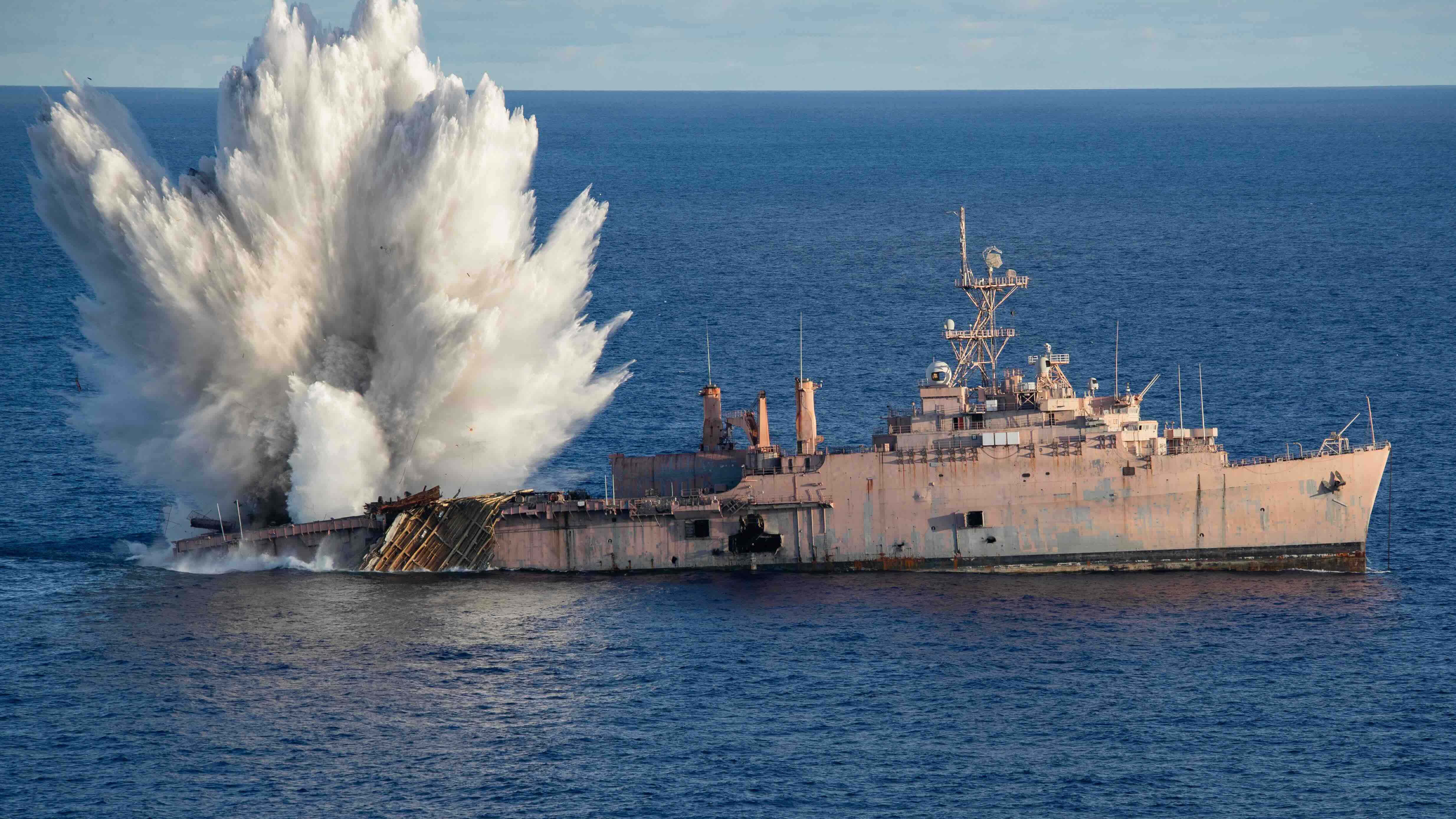
A Japan Maritime Self-Defense Force (JMSDF) submarine fired the torpedo that sent the decommissioned USS Juneau (LPD-10) to the ocean floor during Valiant Shield 2026 (VS26), but the more operationally significant event came earlier in the strike sequence, a B-2 Spirit stealth bomber employed a Long Range Anti-Ship Missile (LRASM), the first publicly disclosed use of the AGM-158C from that airframe.
The U.S. Air Force said a B-2 Spirit stealth bomber fired an AGM-158C Long Range Anti-Ship Missile (LRASM) during a live-fire Sinkex over the Philippine Sea on June 27 as part of Exercise Valiant Shield 2026. The missile struck the decommissioned USS Juneau (LPD 10), marking the… pic.twitter.com/43OyaX7Bwz
— SOFX (@SOFXnetwork) July 1, 2026
The Austin-class amphibious transport dock went down June 27, more than 200 nautical miles off the coast in the Mariana Islands Range Complex. The strike integrated air, surface, and subsurface assets across multiple allied nations. A JMSDF SH-60 helicopter fired an AGM-114 Hellfire missile, and a JMSDF destroyer launched a Type 90 anti-ship missile.
End of the line for USS Juneau LPD-10 as a Japan Maritime Self-Defense Force submarine torpedo detonates under the stern of her during a live-fire sinking exercise (SINKEX) as part of Valiant Shield 2026. The exercise targeted the former amphibious transport dock (LPD) ship USS pic.twitter.com/hn38mD91Ka
— Boneyard Safari (@Boneyardsafari) June 28, 2026
The B-2, assigned to the 509th Bomb Wing, then delivered the LRASM before the submarine executed the final torpedo strike. Aircraft from the George Washington Carrier Strike Group (CSG), comprising USS George Washington (CVN-73), USS Robert Smalls (CG-62), USS Benfold (DDG-65), and USS Shoup (DDG-86) with Carrier Air Wing (CVW) 5 embarked, supported the evolution.
“This SINKEX provided an outstanding opportunity for our joint team to integrate capabilities across domains, honing the lethal precision and coordination essential for high-end maritime operations in the Pacific theater,” said Rear Adm. Eric Anduze, commander of Carrier Strike Group 5 and Task Force 70.
Air Force Gen. Kevin B. Schneider, commander of Pacific Air Forces, said the B-2’s performance “underscores the U.S. military’s commitment to adaptability and flexibility in the face of emerging security challenges” and that prioritizing counter-maritime strike operations would maintain “a decisive edge over adversaries.”
The LRASM is a stealthy, GPS- and infrared-guided anti-ship cruise missile designed to autonomously identify and engage surface targets at extended range with minimal crew input. Its integration with the B-2, previously not publicly associated with the weapon, expands the bomber’s counter-maritime role in Pacific contingency planning.
Prior to the sinking, the Juneau underwent federally mandated environmental remediation, including removal of polychlorinated biphenyls (PCBs), petroleum residues, mercury, and fluorocarbon-containing materials in compliance with Environmental Protection Agency guidelines, the Marine Mammal Protection Act, and the National Environmental Policy Act.
VS26 runs June 22 to July 1 and includes forces from the United States, Japan, Australia, Canada, and New Zealand, conducting multi-domain training across sea, air, land, space, and cyberspace.