
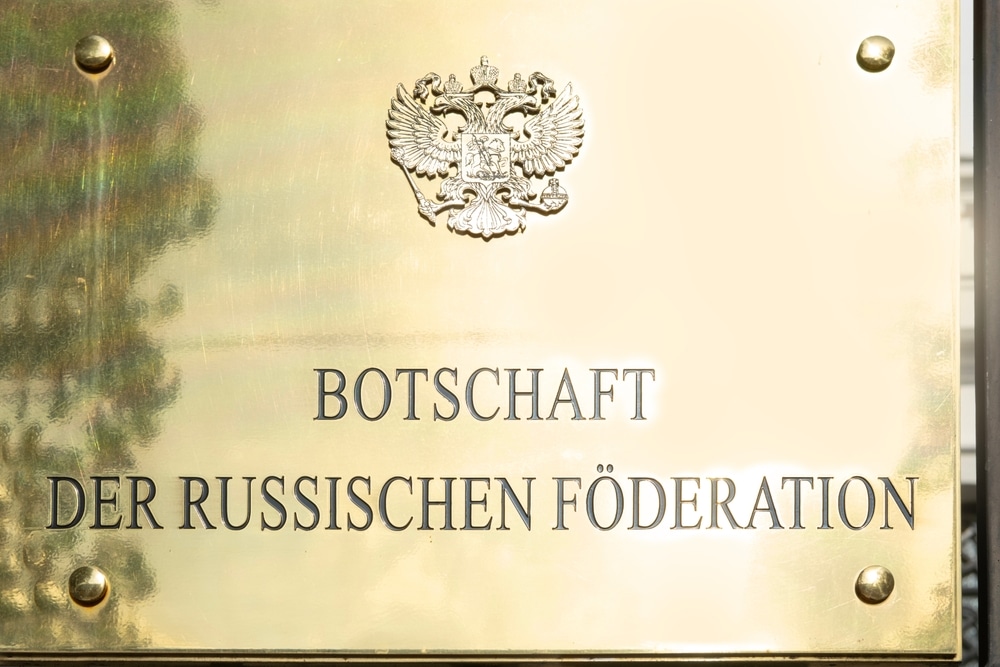
Austria declared three Russian diplomats personae non gratae on Monday after intelligence authorities determined that an array of antennas on Russian diplomatic buildings in Vienna was being used to intercept communications from international organizations based in the city.
Foreign Minister Beate Meinl-Reisinger confirmed the expulsions in an official statement. “It is unacceptable for diplomatic immunity to be used to engage in espionage,” she said. The diplomats had already departed Austria.
The Russian Embassy confirmed in a statement posted to its website that one of the expelled officials held accreditation to the Organization for Security and Cooperation in Europe (OSCE), headquartered in Vienna and responsible for arms control monitoring across the region. The OSCE, the International Atomic Energy Agency (IAEA), and other Vienna-based multilateral bodies rely on satellite internet connections that ORF reported the antenna network had been systematically intercepting.
Sylvia Mayer, head of Austria’s Directorate for State Security and Intelligence (DSN), confirmed the installations posed a threat based on their size and nature but declined to specify further.
Russian Ambassador Andrey Yuryevich Grozov was summoned to Austria’s Foreign Ministry in mid-April and asked to waive the diplomats’ immunity so prosecutors could pursue an investigation. Moscow declined, prompting the expulsions. The decision brings to 14 the number of Russian diplomats Austria has expelled since 2020.
The Russian Embassy called the decision “outrageous,” “unjustified,” and “categorically unacceptable” and warned that Moscow would respond harshly.
Russia MFA: ‘❗We have taken note of the outrageous decision of the Austrian Foreign Ministry to declare employees of the Russian Embassy and Permanent Mission to the OSCE persona non grata. We consider this another unfriendly step by the Austrian authorities unjustified in any…
— CGTN Europe (@CGTNEurope) May 4, 2026
Austria has long faced criticism over a gap in its criminal code that permits foreign intelligence operations on its soil as long as they do not target Austrian interests directly. A Justice Ministry draft law dated March 9, 2026, the Criminal Espionage Act 2026, would extend those protections to Vienna-based international organizations.