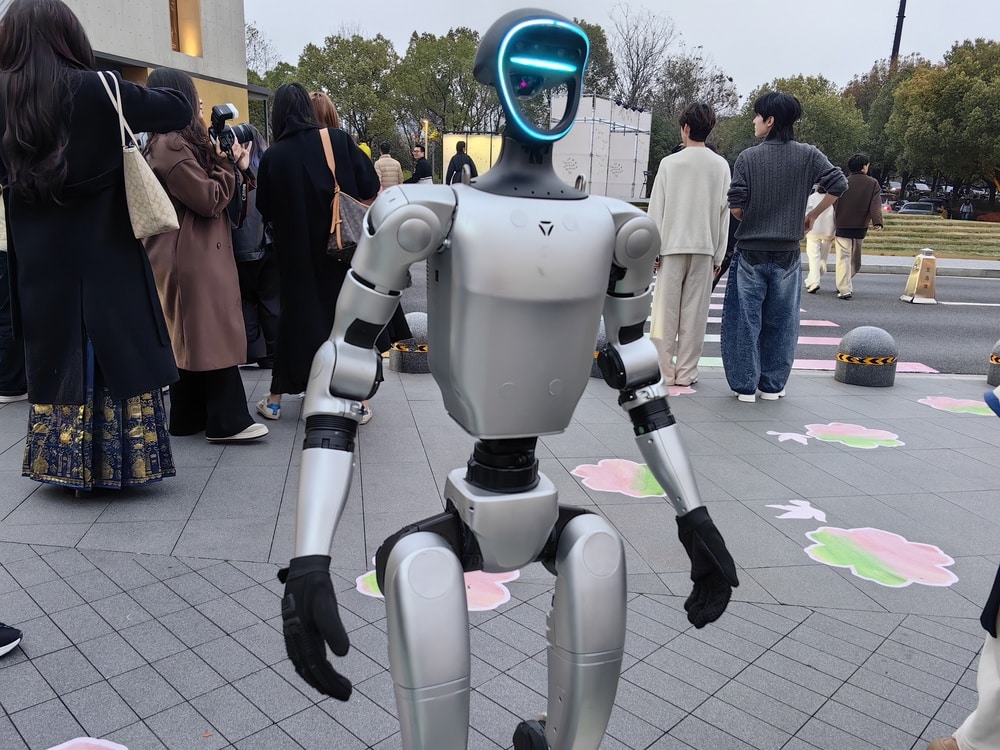
Hangzhou deployed China’s first organized robot traffic police squadron on May 1, stationing 15 traffic management robots at the West Lake scenic area and key intersections in Zhejiang Province for the five-day Labor Day holiday.
Over three days, the robots issued 11,897 warnings for traffic violations, roughly one every one minute and 43 seconds, Hangzhou Daily reported. Hangzhou Traffic Police officer Chen Sanchuan said the machines proved more effective than human officers, telling the paper that people were “more willing to accept” the robots’ reminders.
China has deployed its first robot police squad to help manage crowds during the early May holiday season.
15 humanoid traffic management robots were stationed around the West Lake scenic area, a tourist hotspot in the tech hub of Hangzhou, southern China on Friday (1 May). pic.twitter.com/BU1bUGwkwH— The Independent (@Independent) May 4, 2026
A Hangzhou Public Security Bureau official told CCTV the robots will be integrated into regular duty schedules after the holiday. Officials cited force multiplication as the primary rationale, with the machines operating eight to nine hours daily and freeing human officers for complex enforcement and accident response.
Hello, “RoboCop”! 🤖🤖
This Labour Day, Hangzhou, in east China’s Zhejiang Province, levelled up its traffic management capabilities by unleashing a fully operational “robot police squadron” onto the streets.#ChinaTech
Their mission is to manage non-motorised vehicle and… pic.twitter.com/zqBc5LmvMP— China News 中国新闻网 (@Echinanews) May 4, 2026
Kashgar, in Xinjiang, and Ordos, in Inner Mongolia, also deployed robot traffic controllers on May 1, Xinhua reported. In Shenzhen, humanoid robots manufactured by EngineAI joined a Special Weapons and Tactics (SWAT) team on patrol the same day.
China accounts for roughly 90% of global humanoid robot shipments in 2025, according to research firm Omdia, with Morgan Stanley projecting the market could exceed $5 trillion by 2050.
According to global technology market research and consulting firm Omdia, #China accounted for a staggering 90% of global humanoid robot shipments in 2025, while Morgan Stanley projected a doubling of China’s sales in this field to 28,000 units in 2026. pic.twitter.com/RI11xEcvvX
— China Economy (@CE_ChinaEconomy) March 14, 2026
The Mercator Institute for China Studies (Merics), a German think tank, published an assessment on April 30, one day before the Hangzhou deployment, finding that Chinese humanoid robots remain mostly pre-programmed or tele-operated. “Moving up from test beds and localised applications to large-scale AI embodiment is where the major challenge will lie,” Merics stated.