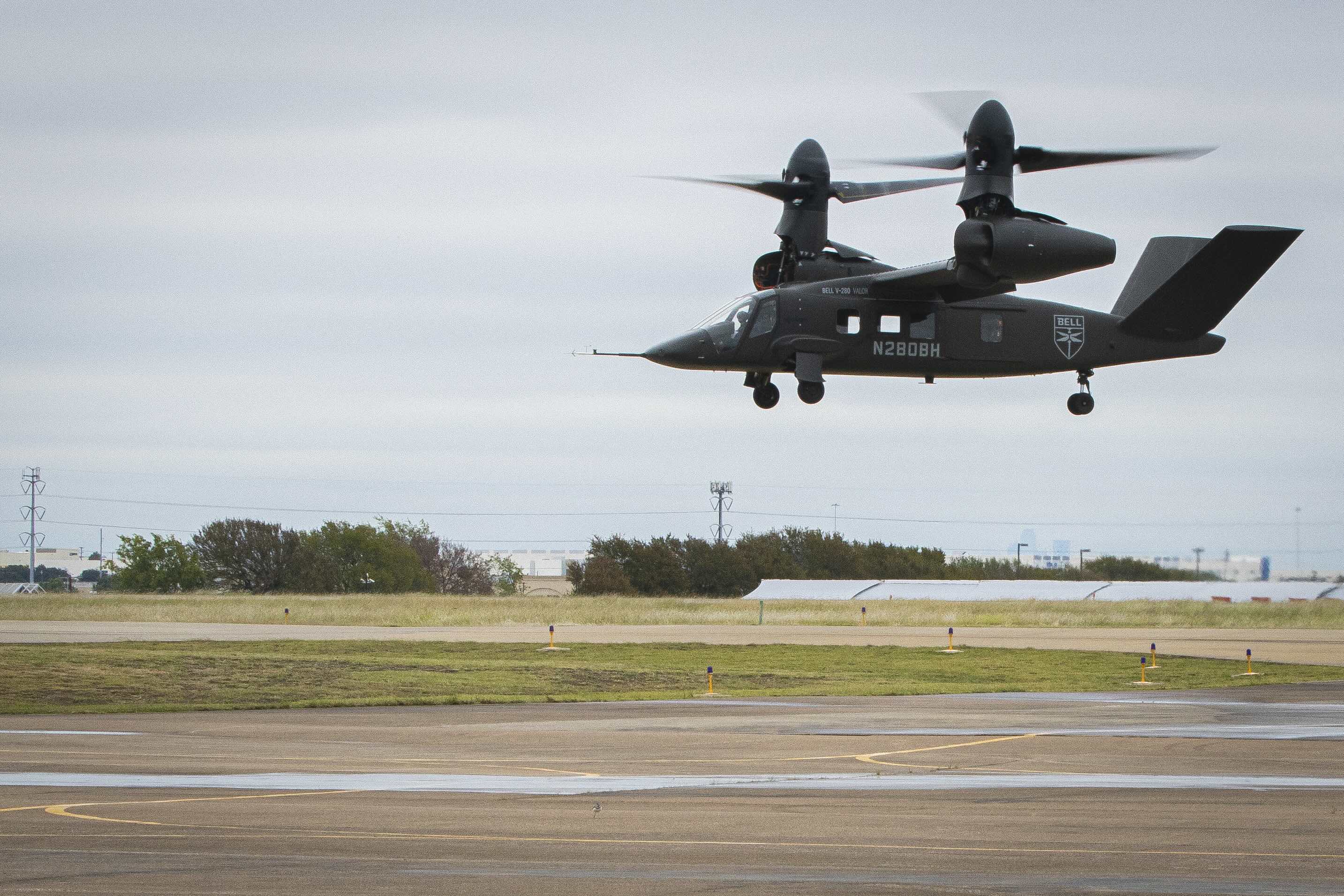
The U.S. Army officially named its Future Long-Range Assault Aircraft (FLRAA) the MV-75 Cheyenne II on April 15 at the Army Aviation Warfighting Summit in Nashville, Tennessee, declining at the same ceremony to commit to a first flight date or production schedule.
Breaking: The U.S. Army has officially named its next-generation MV-75 Future Long Range Assault Aircraft the “Cheyenne II.” Announced today at the Army Aviation Association of America’s annual conference, this advanced aircraft marks a new era in technology and capability.” pic.twitter.com/DzYHvDkQK5
— U.S. Army (@USArmy) April 15, 2026
Under Secretary of the Army Mike Obadal unveiled the designation before members of the Northern Cheyenne Tribe and the Cheyenne and Arapaho Tribes, continuing a 79-year Army tradition of naming rotary-wing aircraft after Native American tribes.
Bell is excited to introduce the MV-75 Cheyenne II, the @USArmy’s official name for the FLRAA weapon system.
Consistent with the Army tradition of naming aircraft after Native American tribes, The MV-75 is named after the Cheyenne Tribes: two federally recognized nations with… pic.twitter.com/j7KR6Fbe7J
— Bell (@BellFlight) April 15, 2026
Officials reviewed more than 500 tribal names before selecting Cheyenne, citing the tribe’s historical attributes of speed, range, and adaptability as matching the aircraft’s design intent.
“The relationship evolved through warfare to mutual respect and finally into an unbroken legacy of patriotic service, with members serving in every major American conflict,” Obadal said.
Program leadership provided no concrete timeline. Maj. Gen. Clair Gill, Program Acquisition Executive for Maneuver Air, told reporters the Army is moving as fast as resources allow. “You all want dates, because it makes a story, but that’s why I can’t give you dates, because I don’t control those variables,” Gill said.
Those variables span a supply chain of roughly 300 tier-one and nearly 2,000 tier three and four suppliers competing globally for specialized raw materials.
Brig. Gen. David Phillips, Gill’s deputy, said the Army has worked with the Air Force and Navy, which operate the V-22 Osprey tiltrotor, to identify sourcing pinch points and avoid acquiring materials “from the wrong parts of the world.”
Funding gaps are an added exposure. Gill warned that government shutdowns and continuing resolutions “kill any momentum” by straining sub-tier suppliers that cannot absorb delays the way Bell Textron can.
The Army’s fiscal year 2027 budget request allocates roughly $600 million more in research, development, test, and evaluation funding than fiscal year 2026.
The MV-75 will carry 14 troops and a crew of four at a cruise speed of 320 mph across a 920-mile range, more than doubling the UH-60 Black Hawk’s 183 mph speed and 367-mile range.
Forged in resilience. Defined by courage. The Cheyenne heritage represents the speed, strength, and endurance the MV-75 will bring to future fight ahead. We honor their legacy with the next evolution of air maneuver.
Meet the Cheyenne II: https://t.co/yrnEqSy0h2#MV75 #FLRAA… pic.twitter.com/d9gAiNiYAE
— Bell (@BellFlight) April 15, 2026
The 101st Combat Aviation Brigade at Fort Campbell, Kentucky, is expected to receive its first aircraft for training and operational testing in 2027 to 2028, with the goal of being the first fully equipped unit by 2030.
Brent Ingraham, Army Acquisition Executive, confirmed the existing Black Hawk fleet will remain in service during the transition.
The Cheyenne II name revives a designation last used for the Lockheed AH-56 Cheyenne, a high-speed attack helicopter developed in the 1960s that was cancelled before entering service.