African jihadist groups tied to al-Qaida and the Islamic State are “unquestionably ascendant,” fielding larger forces, deeper funding, and a growing arsenal of drones and artificial intelligence even as the U.S. has cut its military footprint on the continent by 75 percent.
The finding comes from the Center for Strategic and International Studies (CSIS), whose Global Terrorism Threat Assessment 2026 names terrorism in Africa as the greatest source of uncertainty in the U.S. threat picture.
Nearly 80 percent of all Islamic State activity worldwide during the first 11 months of 2025 took place in Africa, a 50 percent increase over the prior year, according to Armed Conflict Location and Event Data (ACLED) figures cited in the report. The continent has become the group’s center of gravity, and two organizations anchor the threat there.
The report assesses the Islamic State West Africa Province (ISWAP), active across the Sahel and the Lake Chad basin, as probably the largest and most capable Islamic State province anywhere in the world. Its closest rival for that distinction is al-Shabab, the al-Qaida affiliate in Somalia, which the authors call Africa’s most capable group overall and the only one known to have plotted a mass-casualty attack against the U.S. homeland.
Beyond sheer numbers, the groups are growing more sophisticated. They are increasingly using unmanned aerial systems and experimenting with artificial intelligence, technologies whose full effect on both terrorism and counterterrorism the report’s authors describe as poorly understood.
ISWAP has drawn direct help from the central Islamic State organization, which deployed trainers to sharpen its skills in drone operations, advanced explosive assembly, and battlefield tactics.
The same first-person view and fiber-optic drones that reshaped fighting in Ukraine and in southern Lebanon, where Hezbollah’s jamming-resistant FPV drones have strained Israeli armor, are now moving into the hands of jihadist groups across Africa.
SOFX has tracked that proliferation closely, and the African case opens a new front, with ISIS-Somalia already serving as a funding and logistics hub for Islamic State branches around the continent.
Gen. Dagvin Anderson, the commander of U.S. Africa Command (AFRICOM), told lawmakers in May that the withdrawal of American and allied forces had opened “an intelligence black hole” across the continent. He said his command is now operating with the minimum resources needed to track threats and respond to crises, a posture that has narrowed U.S. counterterrorism to two countries.
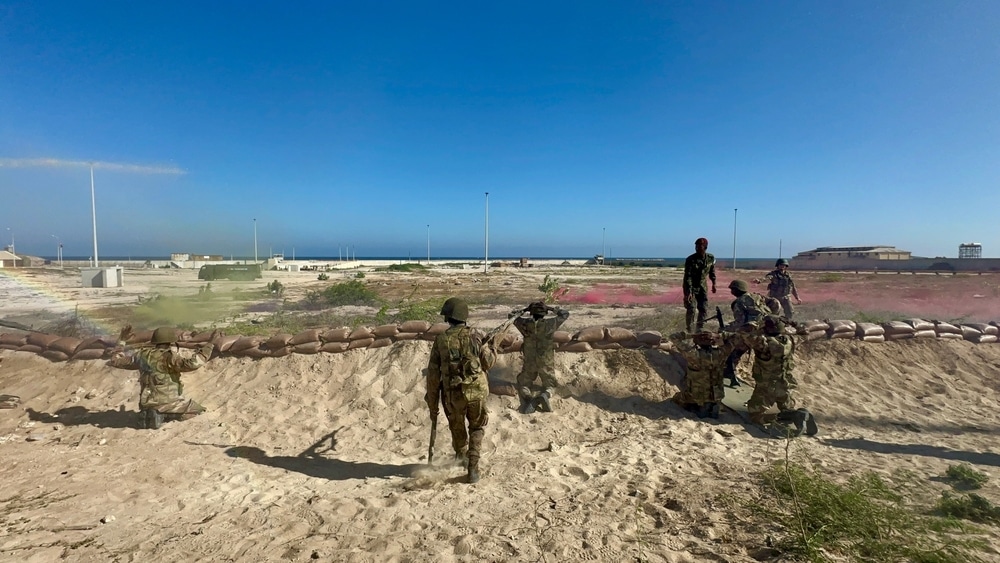
In Somalia, AFRICOM has intensified air and drone strikes against al-Shabab and the local Islamic State branch. Nigeria has become the second focus, where American and Nigerian forces have carried out a series of joint airstrikes against ISWAP and Washington deployed roughly 100 troops in February to support training, intelligence-sharing, and technical assistance.
For all the alarm, the report stops short of calling any African group an imminent danger to Americans at home.
Its authors judge that al-Shabab and ISWAP remain focused on local and regional goals, which keeps the odds of a mass-casualty strike on the U.S. homeland low. Their real concern is what happens if that focus shifts while U.S. visibility is at its thinnest.
Reduced U.S. investment raises the chance of a surprise attack and lowers the capacity to prevent one, the authors argue. Cuts to the CIA, the FBI, and prevention programs increase the odds of missed warnings at the same moment the groups most able to exploit them are gaining ground.
Groups written off as degraded have repeatedly come back stronger, the report notes, a pattern its authors reduce to four words: “degradation is not defeat.”