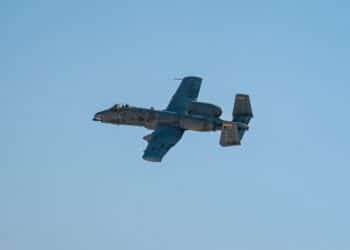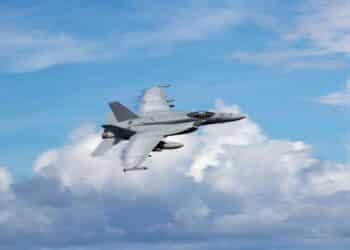

A Russian loitering munition struck a mock-up of an F-16 fighter jet at a Ukrainian air base on January 26, with both open-source analysts and the Russian unit confirming the target was a decoy rather than an operational aircraft.
The BM-35 drone, operated by Russia’s Rubicon unit, hit the full-scale replica at Kanatove airfield near Kropyvnytskyi in central Ukraine, roughly 125 miles from active front lines.
Russian FPV drone strike footage circulating online did not show a real Ukrainian F-16.
The target was an F-16 decoy/mockup placed at an airfield.
No operational jet was lost.Decoys exist to absorb strikes and mislead ISR, and this one did its job. pic.twitter.com/8V4nyrT735
— Aviation Diary (@aviationdiary_) January 29, 2026
The Russian Rubicon unit posted the video of the strike acknowledging the drone targeted “a mock-up of an F-16ADV fighter jet of the Armed Forces of Ukraine, intended for training engineering and technical services.”
Open-source analysts quickly identified discrepancies in the airframe, including incorrectly shaped air intakes and wings drooping unnaturally. However, the decoy’s quality spurred debate over whether it was an unflyable surplus airframe or a purpose-built replica.
The Russian claim that the F-16 aircraft destroyed by a drone was used for training technical personnel is wrong.
It was just a plywood decoy made by the Ukrainian volunteer group Apate, which produces a range of decoys such as Israeli RADA tactical radars.
1/ https://t.co/4Odc50MXhd pic.twitter.com/MKkNWXEV21— Roy🇨🇦 (@GrandpaRoy2) January 30, 2026
It was correctly noted that this is a mockup, primarily indicated by the completely uncharacteristic angular shape of the air intake, which is semicircular on real F-16s, as well as the drooping wings. pic.twitter.com/Vh3nlQbOAP
— Capt (IN) Vikram Mahajan (Veteran) (@vikrammahajan) January 29, 2026
In addition to purpose-built decoys, the Ukrainian air force possesses a significant number of real but unflyable F-16s that serve as instructional airframes for air force trainees but could also function as decoys.
Euromaidan Press has reported that in May 2025, In May 2025, photographers spotted old American F-16 fuselages being loaded onto a Ukrainian Antonov An-124 transport at Tucson International Airport in Arizona. The aircraft reportedly came from nearby Davis-Monthan Air Force Base, home to the U.S. Air Force’s 309th Aerospace Maintenance and Regeneration Group, which stores thousands of surplus military aircraft.
While aircraft and military equipment decoys are not new, the proliferation of cheap, mass-produced unmanned systems has driven a resurgence in practical decoy and camouflage use to counter the threat from drones.
SOFX has previously reported that Seawolf Marine, a South Korean life jacket manufacturer, has entered the defense market with inflatable F-35 decoys.
F-35 Inflatable Decoy System (IDS) pic.twitter.com/dlCHvteDlk
— News IADN (@NewsIADN) April 9, 2025
Ukrainian and Russian forces have also been utilizing anti-drone nets around roadways and critical infrastructure like oil depots, while employing protective cages around armored vehicles and tanks, sometimes called “hairy” tanks.
The Ukrainian air force continues building its operational F-16 fleet, with a Belgian-Danish-Dutch consortium pledging nearly 90 aircraft. The Pentagon announced January 28 a $235.5 million maintenance contract with Belgium’s Sabena Aerospace Engineering to support those jets through 2029.