
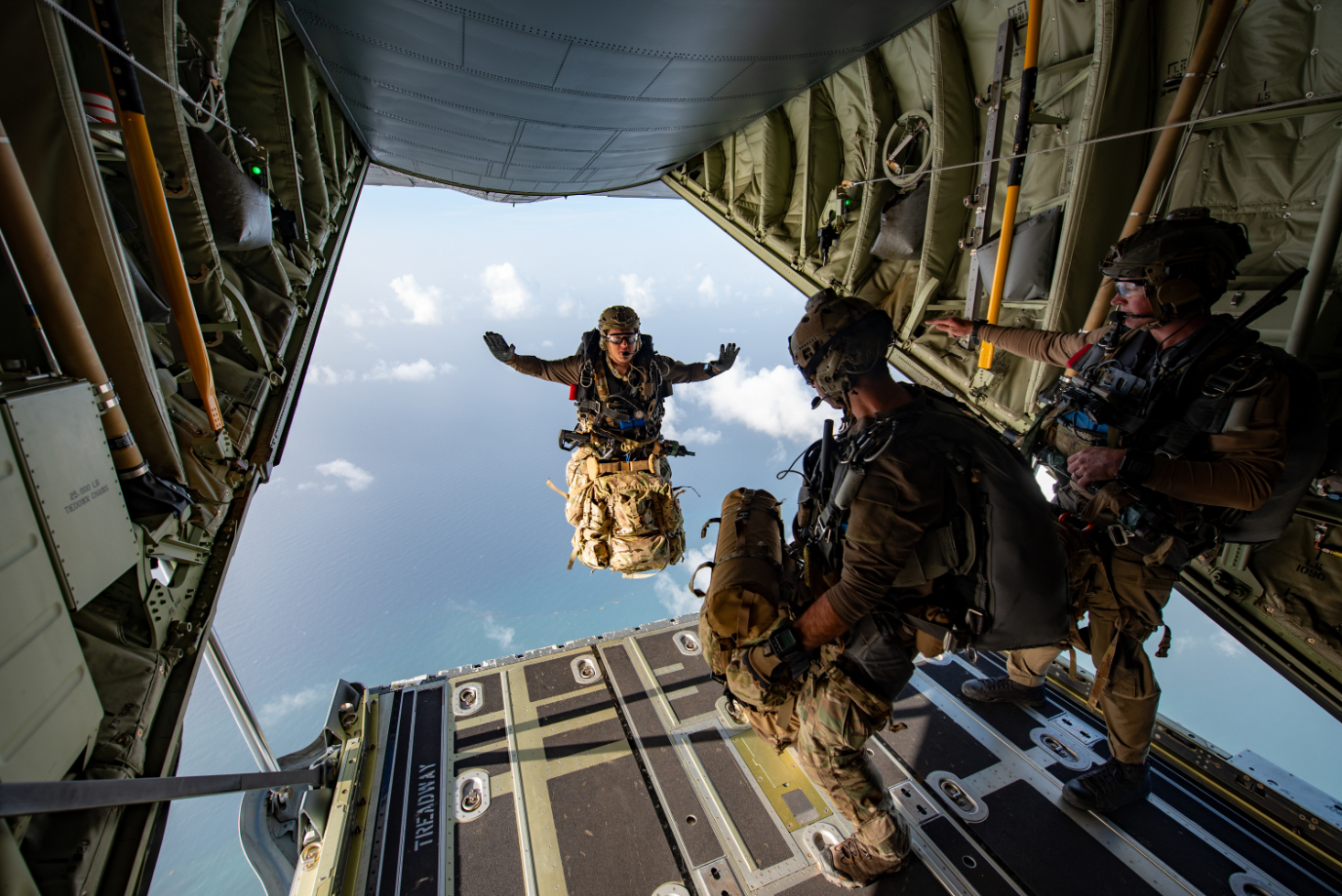
Special operations troops from the US Air Force recently carried out a five-day exercise in the Caribbean, practicing how to seize and secure an airfield under combat conditions. The training came as part of Emerald Warrior 25.2, a large-scale special operations drill that concluded on 30 August.
The exercise began with six Air Force commandos parachuting from a C-130J Super Hercules into the Caribbean Sea off St. Croix in the US Virgin Islands, reaching shore in an inflatable boat. A second team of 11 personnel parachuted directly onto Henry E. Rohlsen Airport, creating a coordinated assault to capture the airfield.
The teams, which included pararescuemen and combat controllers, quickly cleared runways, established perimeter security, and set up air traffic control, enabling the aircraft to land and offload equipment.
“Our airmen exercised their unique skill sets to parachute into contested territory, establish airfield operations, control aircraft, respond to search and rescue scenarios, manage notional medical evacuations and conduct reconnaissance and targeting operations on a very tight timeline,” said the Air Force Special Operations Command officer who planned the drills.
“Operations in the Caribbean simulate many of the geographical features our forces may encounter when deployed around the globe,” the officer added.
Emerald Warrior 25.2 also featured rescue missions and reconnaissance drills.
At present, eight U.S. naval vessels are deployed in the Caribbean region, including three Aegis-class destroyers, the Iwo Jima Amphibious Ready Group, and the fast-attack submarine USS Newport News, supported by about 4,500 sailors and Marines.
Last week, the United States struck a vessel in the southern Caribbean allegedly carrying drugs from Venezuela to the U.S., killing 11 people. Authorities said the vessel was tied to the Tren de Aragua criminal group.







Rangers secure airfields that s their specialty.
Agreed, using the word “commando” was an odd one for PJ’s and FO’s
(duh)
That’s what I thought (“Division” [82nd] can pull it off too).. and they accomplished this – cleared runways, established perimeter security, and set up air traffic control, enabling the aircraft to land and offload equipment; AND, establish airfield operations, control aircraft, respond to search and rescue scenarios (their wheelhouse), manage notional medical evacuations and conduct reconnaissance …
with 17 personnel (?).
I know, there was brief mention of follow on personnel, but really …?
Not the whole story, but a nice story.
If they’re training is up to the rest of SOCOM standards, then it’s a win for SOCOM and 18th Airborne Corp, if the heavy, ‘pn-call’ workload is spread around.
Would be great if after years of planning, we could get critical components to actually train together. Engineers cant even secure flights to carry out training and exercises yet, are expected to be one of the first echelons on the ground to assess, repair and make operable the air strip. Good luck spec ops, filling holes, checking for uxos and cbrn, etc. Guess everyone will meet and see how they work together for the first time, when it hits the fan. Not even gonna mention stadarnd joint service trng thats been talked about for a decade but still doesn’t exist.