
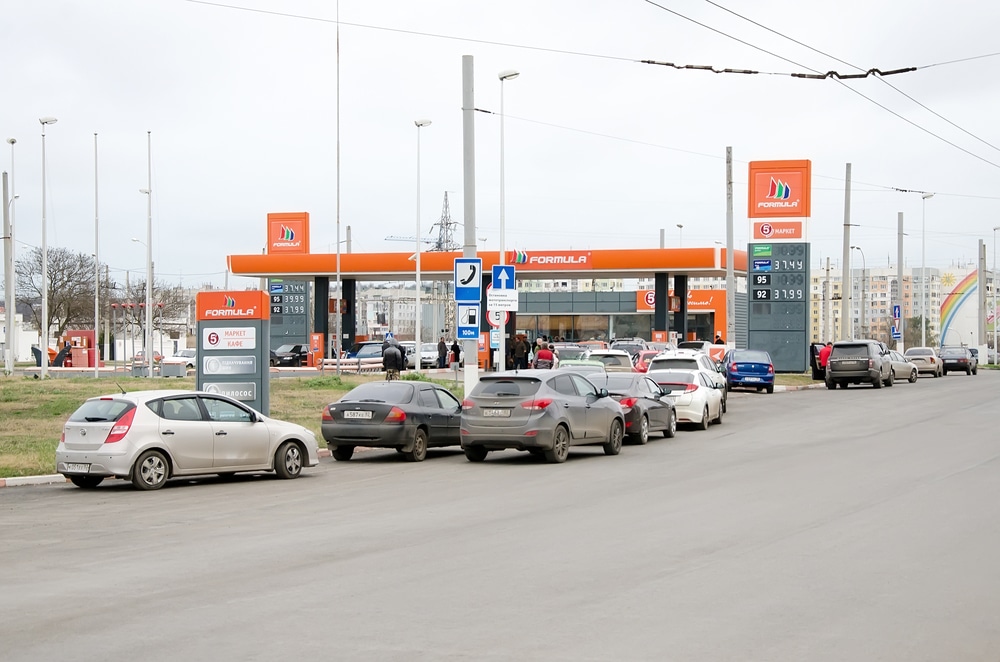
Russian-installed authorities in occupied Crimea suspended all civilian fuel sales on Sunday, reserving gasoline for government and security services after Ukrainian strikes hit oil infrastructure across the peninsula.
Regional governor Sergey Aksyonov said overnight Ukrainian strikes killed four people and wounded 28 others. He did not provide details on the targets of the attack but later announced that gas stations across the peninsula would stop selling fuel to private companies and individuals for an undefined period.
“Fuel will be sold only to government agencies that ensure the functioning and security of the Republic of Crimea,” Aksyonov said. “I ask everyone to remain calm and to only trust official sources of information.”
Ukrainian President Volodymyr Zelenskyy said Sunday that a Crimean oil depot and an oil transport facility in Russia’s southern Krasnodar region were among the targets of Ukrainian operations. He described the strikes as part of Ukraine’s “long-range sanctions” campaign against Russia’s energy sector.
Цієї ночі наші далекобійні санкції застосовувались по воєнній логістиці, нафтовій галузі та протиповітряній обороні окупантів. Все це справедливі відповіді на жорстокі російські удари проти наших людей. Я дякую воїнам СБУ, СБС, ГУР та ССО за успішну роботу на відстані близько 300…
— Volodymyr Zelenskyy / Володимир Зеленський (@ZelenskyyUa) June 21, 2026
Five of the seven oil tanks located at the terminal in the Russian-occupied city of Kerch on the coast of the Crimean Peninsula, along with several vessels in the Kerch Strait, were set ablaze, following overnight drones strikes from Ukraine. pic.twitter.com/Z1r2A09BFb
— OSINTdefender (@sentdefender) June 21, 2026
Crimea is not the only region affected by fuel restrictions following Ukrainian strikes on energy infrastructure in recent weeks.
According to research by the media outlet Agentstvo, fuel limitations of varying severity have been reported in more than 70 Russian regions, including Moscow, St. Petersburg, Kursk, Belgorod, Rostov, and Samara. The shortages have prompted major fuel suppliers to reduce sales volumes in an effort to curb panic buying, affecting at least 7,000 of roughly 29,000 gas stations nationwide.
The fuel crisis in Russia is expanding – restrictions are now in place in at least 14 regions.
After reports of fuel shortages in occupied Crimea, similar problems have started appearing across Russian regions.
In the Kursk, Belgorod, and Pskov regions, some gas stations are… https://t.co/x21l7KllyR pic.twitter.com/AM0biFBOvZ
— Anton Gerashchenko (@Gerashchenko_en) June 4, 2026
Prices have also risen. Data shows that between March and June 15, AI-95 gasoline in Moscow rose gradually by about 0.05 to 0.5 rubles ($0.0007 to $0.007) per liter each week, but last week the price jumped by 1.76 rubles ($0.024) to reach 75.33 rubles ($1.02) per liter.
AI-92 gasoline in the capital also saw a sharper increase, rising by 2.07 rubles ($0.028) to 67.95 rubles ($0.92) per liter, compared with earlier weekly gains of just 0.1 to 0.5 rubles ($0.001 to $0.007).
Meanwhile, in addition to fuel shortages, Ukrainian strikes over the weekend have also disrupted power infrastructure across Crimea, triggering rolling blackouts in several districts, including Sevastopol, Alushta, and Sudak. Occupation authorities said the outages were necessary due to damage to electrical facilities and grid overloads.
Officials added that some areas will be subject to rotating blackout schedules, with electricity cut for several hours at a time, as repair work continues.





Here’s a difference: Russia targets civilians to kill them. Ukraine makes them stay home.