A Ukrainian company operating under a government-backed pilot program has shot down multiple Russian drones in Kharkiv Oblast, Digital Transformation Minister Mykhailo Fedorov announced Monday, marking the first confirmed intercepts by a privately operated air defense unit.
“One of the companies participating in the project has already prepared its own air defense group,” Fedorov said in a statement. “As of today, several enemy drones have been shot down in Kharkiv Oblast, including Shahed and Zala models.”
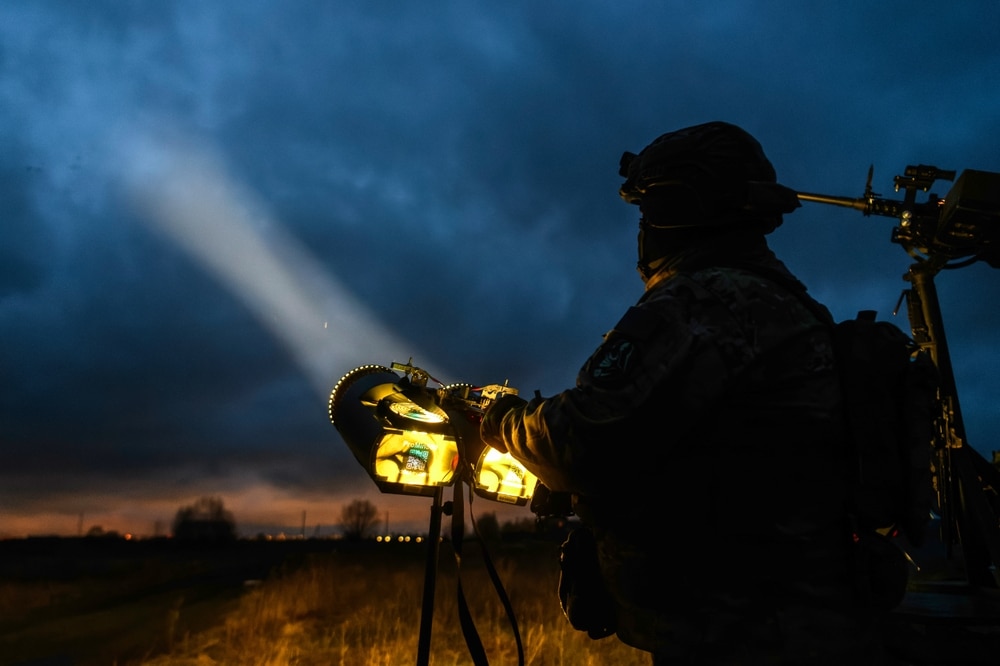
Video posted by Fedorov on X appears to show engagements by Sky Sentinel automated anti-drone turrets, AI-controlled systems equipped with heavy machine guns and capable of 360-degree rotation. The units are also operating Wild Hornet Sting interceptor drones, which Ukrainian manufacturer Wild Hornets produces domestically.
Private air defense working. First Shahed & Zala drones downed in Kharkiv by a private firm. 13 more companies joining. Integrated with Air Force command to scale protection without burdening the front. Opening the market to build a resilient, multi-layered sky. pic.twitter.com/GhXuX6a9dS
— Mykhailo Fedorov (@FedorovMykhailo) March 30, 2026
The Stings entered these engagements with a newly tested upgrade. On March 27, three days before the Kharkiv intercepts were announced, Wild Hornets and the Sternenko Foundation confirmed successful operational testing of HORNET VISION Ctrl, a ground-control system allowing operators to engage targets from a significant distance from the deployment area.
The timing has not been reported in connection with the program’s first confirmed results elsewhere.
Congratulations to @m_zablotskyy for this great life-saving work!
Heartfelt thanks for powerful support for Wild Hornets!
What’s also amazing is these strikes were done remotely with the trailblazing Hornet Vision Ctrl system
Please keep supporting!https://t.co/jQCFg6xVY5
— 🇺🇦Ukraine Resists ruzzian Genocide… Yeah Again (@ArmedMaidan) March 31, 2026
Fedorov said 13 additional companies have received Ministry of Defense authorization and are forming their own units. All are integrated into the Air Force’s unified command structure.
“Private air defense has been integrated into the unified command system of the Air Force and is already operating within it, protecting facilities and participating in the interception of Shahed drones,” Fedorov said. “This is a systemic solution that allows for quickly scaling air defense capabilities without additional burden on frontline units.”
Prime Minister Yulia Svyrydenko expanded the program’s framework on March 3, stating that critical infrastructure enterprises of any ownership type may now establish air defense units. Personnel must complete training and certification at Ministry of Defense-designated institutions.
The Air Force Command may transfer weapons and ammunition temporarily to participating enterprises, applying only to equipment not in use by active combat units. Expended ammunition is replenished through a simplified procedure based on verified usage reports.
As part of the expansion of site-specific protection for critical infrastructure facilities, the government has authorized the provision of additional weapons to strengthen their air defense capabilities.
We are introducing amendments to the experimental project launched in… pic.twitter.com/hlL0MWpcvn
— Yulia Svyrydenko (@Svyrydenko_Y) March 3, 2026
The program launched as a pilot in November 2025. Reuters reported Monday that units consist of a company’s own employees, operating under authorization Ukraine’s government extended last year to energy, communications, and transport enterprises.