
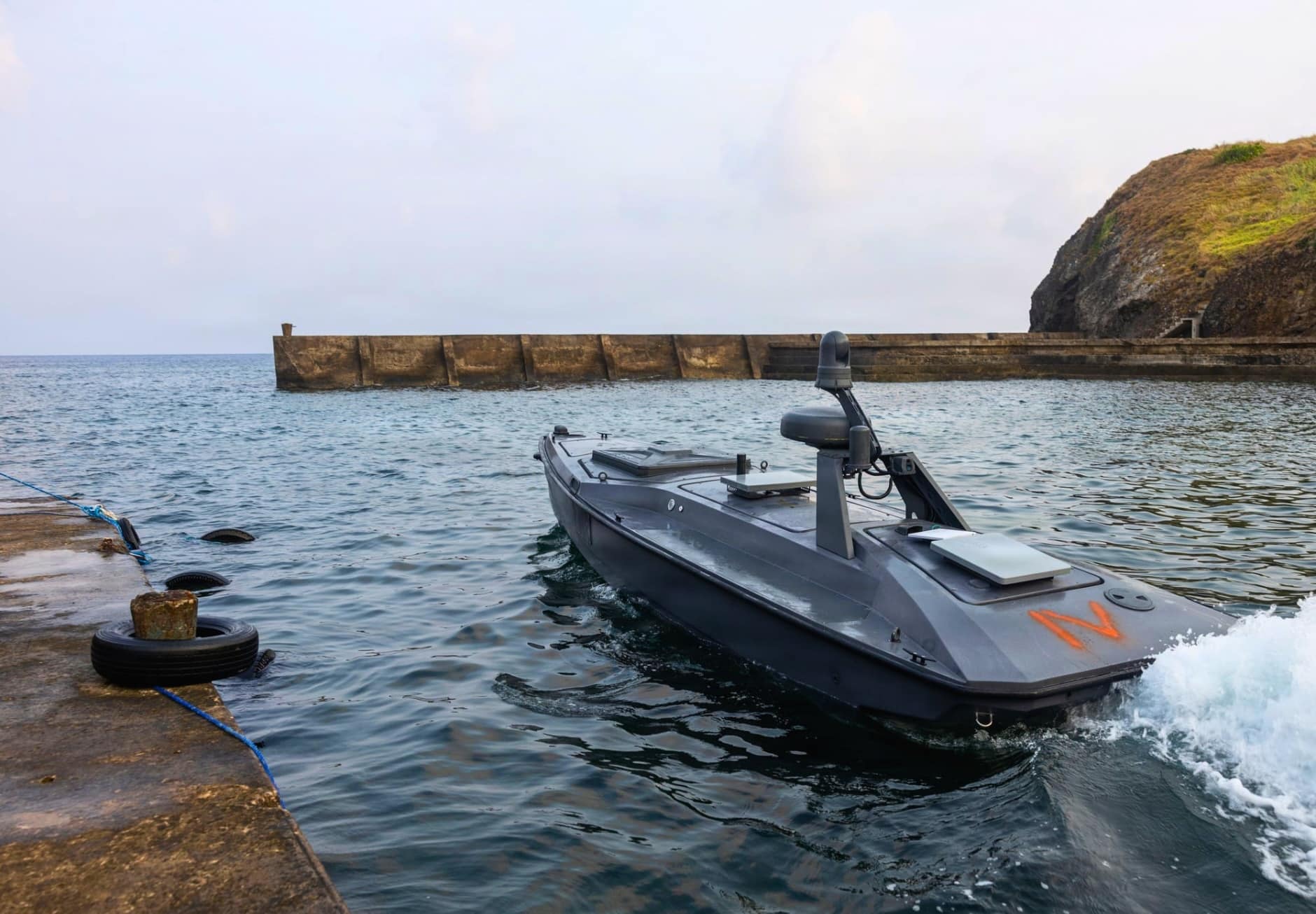
Source: Snake Island Institute, “The Black Sea Blueprint for Taiwan: Ukraine’s Naval Lessons in Asymmetric Warfare.” Full report
The Snake Island Institute, an independent defense analytics center established to strengthen the strategic partnership between Ukraine and its Western allies, published its second major study on the future of naval warfare in 2026. The 55-page report, authored by Polina Semenchenko, Jonas Heins, Jack Carpenter, and Adrien Tardy, applies combat-tested lessons from Ukraine’s unmanned surface vehicle (USV) campaign in the Black Sea to the most dangerous scenario in the Indo-Pacific: a Chinese amphibious invasion of Taiwan.¹
The report examines a single scenario, a People’s Liberation Army (PLA) amphibious crossing of the Taiwan Strait, and asks whether the introduction of small, attritable unmanned maritime systems could alter the assumptions that shape Taiwan’s defense planning, alliance commitments, and wargaming outcomes.²
The Problem: Taiwan’s Conventional Forces Would Not Survive the Opening Hours
The report draws on the 2023 Center for Strategic and International Studies (CSIS) Taiwan conflict simulations. Across CSIS wargame iterations, the pattern is consistent: Chinese doctrine calls for a concentrated first strike against Taiwanese naval and air assets and the command-and-control systems needed to employ them. Taiwan’s surface combatants, constrained by aging missile-defense systems and limited magazine depth, would be destroyed or rendered inoperable early.
The Taiwanese Air Force faces similar projections, with any aircraft not sheltered in one of Taiwan’s two underground facilities likely destroyed on the ground.³ Russia’s early campaign in Ukraine in 2022 closely mirrored this approach, where strikes on airfields and logistics destroyed at least 66 Ukrainian fixed-wing aircraft in the first month alone.⁴
Taiwan’s defensive logic becomes acutely time-dependent under these conditions. The objective shifts from defeating the invasion to slowing PLA consolidation on land and keeping the door open for outside intervention. That intervention, from the United States and Japan, remains fundamentally uncertain. American decision-makers would face escalation with a near-peer nuclear-armed competitor. Japan’s willingness to accept the associated risks is similarly unresolved.⁵
Unlike Ukraine, Taiwan cannot rely on sustained external resupply once hostilities begin. Its island geography becomes a decisive liability under blockade. Most scenarios assume China would impose maritime and air denial from day one. External deliveries of weapons, fuel, spare parts, and ammunition would be effectively impossible for at least the first 30 days. Taiwan would fight under near-total autarky, its endurance constrained by pre-war stockpiles and domestic production alone.⁶
Taiwan’s Internal Doctrine Clash
The report identifies a structural tension inside Taiwan’s Ministry of National Defense. The Republic of China Navy (ROCN) historically sought to rival the PLAN as an equal force. That ambition has run into China’s rapid naval expansion and persistent procurement delays. In 2024, the U.S. arms sale backlog to Taiwan rose roughly USD 2 billion to a high of USD 21.5 billion by February 2025.⁷
Two competing visions divide Taiwan’s defense establishment. The first favors traditional platforms, including indigenous submarines, F-16 upgrades, and advanced air defense systems, which account for an estimated 50–55% of Taiwan’s 2024–2025 defense spending. Asymmetric programs like mobile anti-ship missiles, USVs, and precision rockets account for about 18–22%.⁸ The second vision, outlined in Admiral (ret.) Lee Hsi-min’s “Overall Defense Concept” (ODC) in 2021, argues that large platforms would be destroyed in China’s opening barrage and calls instead for “large numbers of small, dispersed, mobile, and lethal weapons” including sea mines, fast minelayers, man-portable air defense systems, and unmanned systems.⁹
Despite widespread rhetoric embracing asymmetric capabilities, the 2025 Quadrennial Defense Review fails to mention USVs or UUVs altogether. The MND has also failed to integrate electronic warfare capabilities that necessarily supplement unmanned systems.¹⁰
The Ukrainian Model: Attrition by Design
Ukraine’s initial naval successes, the liberation of Snake Island, the sinking of the cruiser Moskva with a Neptune missile, and subsequent Harpoon strikes, forced Russia to abandon amphibious landing plans and withdraw surface forces from the northwestern Black Sea. Those actions disrupted Russian naval operations but did not provide a scalable mechanism for long-term maritime denial. One-way attack USVs emerged as Ukraine’s answer.¹¹
The MAGURA program launched in May 2022 when Security Service of Ukraine (SBU) engineers converted a fishing boat into a remotely piloted vehicle using a Starlink terminal. Within months, the platform progressed through jet-ski propulsion variants to the V3, capable of 80 km/h with a 150 kg warhead and 800 km range. Early deployments failed. Starlink connectivity dropped, and none of the drones reached targets. Subsequent versions integrated redundant communications, including backup Kymeta satellite antennas. On October 29, 2022, seven V3 drones conducted the first successful naval drone strike inside Sevastopol harbor.¹²
By 2023, the Defense Intelligence of Ukraine (GUR) deployed the V5 MAGURA: a 5.5-meter carbon fiber hull with low radar visibility, an 800 km range, and a 200–320 kg warhead. Initial V5 missions failed. Three drones attacked the reconnaissance ship Ivan Khurs northeast of the Bosphorus in May 2023, with two destroyed and a third detonating near the hull without critical damage. Ukraine adapted. Operations shifted to nighttime group attacks involving five or more drones. This contributed to successful strikes that sank the corvette Ivanovets, the landing ship Caesar Kunikov, and the patrol ship Sergey Kotov.¹³
When Russia deployed Ka-27 and Mi-8 helicopters with thermal imagers to hunt USVs at sea, Ukraine responded with V5 variants retrofitted with R-73 infrared-homing missiles. On December 31, 2024, R-73-armed drones downed two Mi-8s and damaged a third near Cape Tarkhankut, the first aerial kills by unmanned surface vessels in history. On May 2, 2025, the larger MAGURA V7, armed with AIM-9 Sidewinder missiles, destroyed two Su-30SM reconnaissance aircraft approximately 50 km west of Novorossiysk, marking the first jet kill by a naval drone.¹⁴
The Sea Baby platform followed a parallel trajectory. Developed by the SBU, it entered combat on July 17, 2023, striking the Kerch Bridge. Subsequent variants carried up to 860 kg of explosives. By December 2025, a “Sub Sea Baby” reportedly struck a Russian Varshavyanka (Kilo)-class submarine in Novorossiysk, extending the maritime drone threat beneath the surface.¹⁵
Across many Ukrainian attacks, USV losses of approximately 40–50% were considered acceptable in yielding successful operations. During the February 2024 attack on the Ivanovets, 10 MAGURA USVs deployed simultaneously. Four drew fire from the ship’s defenses; the other six evaded and sank the corvette. The destroyed ship carried a crew of over 30 trained personnel and was valued at roughly USD 60–70 million. The attacking MAGURA V5 drones cost approximately USD 250,000–273,000 each. Ukraine put no sailors at risk.¹⁶
The Taiwan Translation: Geography as Weapon
The Taiwan Strait is a far harsher operating environment than the Black Sea. Mean significant wave heights fluctuate from around 1 meter in September to peaks of 2.8 meters during the January monsoon. Ukrainian USVs have operated successfully in conditions up to approximately 1.6 meters significant wave height, according to Snake Island Institute geolocation analysis of successful strikes cross-referenced against Copernicus Maritime Service wave data.¹⁷
The report reframes this constraint. On smooth waters, a drone’s wake creates a high-contrast trail visible from high-altitude surveillance for dozens of kilometers. Heavy seas and poor visibility provide concealment. Given the sophistication of Chinese ISR and automated ship-defense systems, rough weather and darkness may be among the few conditions under which USVs can approach high-value Chinese ships without early detection.¹⁸
The Strait’s geography compounds this advantage for the defender. Shallow nearshore bathymetry, tidal currents, mudflats extending up to 200 meters offshore during ebb tides, and the natural funnel of the Penghu Channel force amphibious formations into predictable corridors and tidal-dependent landing windows. Water depth falls below 15 meters within the final 20 kilometers of approach in many areas. Twice-daily tides produce vertical water-level changes of up to approximately two meters. Amphibious forces cannot freely disperse near shore without risking involuntary grounding.¹⁹
Large-deck amphibious assault ships like the PLAN’s Type 075 can operate up to Sea State 4 (roughly 1.25–2.5 m significant wave height). Air-cushion landing craft (LCACs), central to over-the-horizon assault concepts, are limited to Sea State 2–3 (approximately 0.5–1.25 m). USVs lack the human vulnerability to fatigue and rough-weather deck operations that force commanders to suspend manned operations before platform technical limits are reached.²⁰
Taiwan’s Platforms: Two Philosophies
Taiwan is developing two flagship USV platforms. The Kuai Chi is a small monohull craft with twin outboard diesel motors, a ram-charge in the bow, and six launch tubes for Taiwan’s indigenous Chin Feng I loitering munition. The Endeavor Manta is a trimaran-hull multi-role system armed with two light torpedoes, featuring AI-based target recognition and a phased array planar radar.²¹
Both Taiwanese designs sacrifice range and speed in favor of greater sea-state operability. The range gap between the Kuai Chi and its nearest Ukrainian peer is no less than 400 km. The Endeavor Manta’s stealth profile, a smooth angular hull reducing radar cross-section, implies a precision tool designed to penetrate defended environments. The Kuai Chi’s reliance on external ISR from the NCSIST Albatros II UAV for target detection positions it as an attritable strike weapon, a component within a broader architecture rather than a standalone platform.²²
These designs face a significantly more capable adversary than Ukraine confronted. The Type 054A frigate mounts the H/PJ-11 (Type 1130) CIWS firing 11,000 rounds per minute, supported by 3D air/surface search radars with approximately 28 km detection range, and EW systems capable of jamming USV datalinks. Chinese medium-calibre naval guns engage surface targets at distances up to approximately 16 kilometers. China’s defense sector has already fielded counter-USV systems including the UB1 Sharp Shark 10 armed unmanned surface platform and the YLC-48 radar optimized for detecting low-profile targets.²³
The Industrial Bottleneck: Thousands of Drones, Not Dozens
Using CSIS wargame data projecting 113–138 Chinese naval losses in successful defense scenarios, and applying a ratio of 10 USVs per target, the highest documented attack density from the Ivanovets and Caesar Kunikov engagements, the report estimates Taiwan would need a minimum stockpile of approximately 1,100–1,400 strike USVs. Factoring in probable early losses to Chinese missile barrages and port suppression, estimated between 25% and 75%, the total procurement requirement rises to between approximately 1,500 and 5,600 platforms.²⁴
As of mid-2025, Taiwan planned to acquire over 1,300 Kuai Chi USVs over five years, later updated to 1,600 under a special defense budget. Neither platform has entered operational naval service. Assuming serial production begins in 2026, reaching a stockpile of 1,400 USVs would require an average output of approximately 23 units per month. The minimum effective fleet would not be available until 2029–2030.²⁵
Ukrainian manufacturers have stated a capacity to produce up to 50 maritime drones per month, according to the U.S. Naval Institute. Ukraine reached this capacity from a standing start, with the Sea Baby program going from initial prototype to batch production in under six months.²⁶
Taiwan faces constraints Ukraine does not. China controls over 70% of global lithium-ion battery production and 85–90% of global rare-earth processing capacity for the neodymium-iron-boron magnets critical to high-performance USV propulsion. A blockade would sever these inputs. Military-grade thermal cameras essential for navigation in the Strait’s frequent fog remain controlled under U.S. ITAR regulations. Taiwan’s “China-free” unmanned systems ecosystem, built around the “Three Chips and Two Software” framework since 2020, has made progress, but full autonomy from foreign components remains unlikely in the near term.²⁷
Operational Concept: Degrading Tempo
The report frames USV employment as a tool for degrading operational tempo rather than destroying the PLAN fleet. Target prioritization focuses on platforms whose neutralization or delay disrupts the sequencing of an amphibious attack.²⁸
Primary targets include large and medium amphibious ships, specifically the Type 072 family, Type 075 LHDs, and Type 071 LPDs, along with logistics vessels. The PLA’s military-civil fusion framework extends logistics through civilian roll-on/roll-off ferries, shallow-draft cargo vessels, and container ships. These platforms share critical vulnerabilities: most rely on a single engine room, have minimal close-in weapon systems, and depend on fixed loading points and predictable crossing durations. The Russian tanker SIG suffered a total mission kill from a single Ukrainian USV strike to the engine compartment despite remaining afloat.²⁹
The greatest USV leverage comes during initial sustainment and port-centric logistics phases. PLA doctrinal sources identify initial sustainment as one of the most difficult components of a Taiwan operation. Throughput depends on ships arriving in sequence, unloading within narrow windows, and clearing approaches for subsequent waves. Average transit speed across the Strait is approximately 15 knots, requiring roughly eight hours per crossing. Maximum ships unloading simultaneously is estimated at 20, with a 12-hour reload and maintenance cycle per vessel.³⁰
The initial amphibious assault itself offers limited USV leverage. The PLA distributes the first wave across dozens of platforms, including more than two dozen Type 072 heavy landing ships, over a dozen Type 073 medium landing ships, roughly 30 Type 074 landing craft, and high-speed assets including Zubr-class hovercraft and Type 726 LCACs. Risk is dispersed, and the compressed time window makes simultaneous disruption of a large share of this fleet impractical for USVs alone.³¹
The Two Open Challenges
The report concludes that whether Taiwan can translate USV logic into credible deterrence depends on solving two problems.³²
The first is industrial scaling. Taiwan must build a pre-war stockpile of thousands of platforms available for immediate use at the onset of hostilities. Current plans project mass stockpiles around 2030. That window may not align with the threat timeline.
The second is launch and sustainment. Thousands of USVs cannot be stored in a few locations. They require a distributed, hardened infrastructure network protected from pre-emptive strikes and positioned for rapid access. Taiwan’s western coastline is densely populated and directly exposed to the Strait, making launch sites observable and vulnerable. Outlying islands like Penghu and Kinmen offer forward deployment options but impose severe constraints. Penghu covers only 127 km², and Kinmen lies just kilometers from the Chinese mainland. Transit times from Kaohsiung range from 3.5 to 6 hours to Penghu and 7 to 13 hours to Kinmen, depending on vessel type.³³
Deploying enough drones to saturate a defended target within a narrow time window under persistent Chinese ISR and kinetic pressure remains the hardest unsolved problem. Production facilities, storage depots, transport routes, and launch sites all form part of the same vulnerable system. Without this industrial and logistical foundation, the report states, the concept of unmanned asymmetric warfare collapses under wartime pressure.³⁴
Endnotes
All citations reference: Snake Island Institute, The Black Sea Blueprint for Taiwan: Ukraine’s Naval Lessons in Asymmetric Warfare (2026). PDF available at https://www.snakeisland.org/reports/68e5709c540bf2aab76cec85