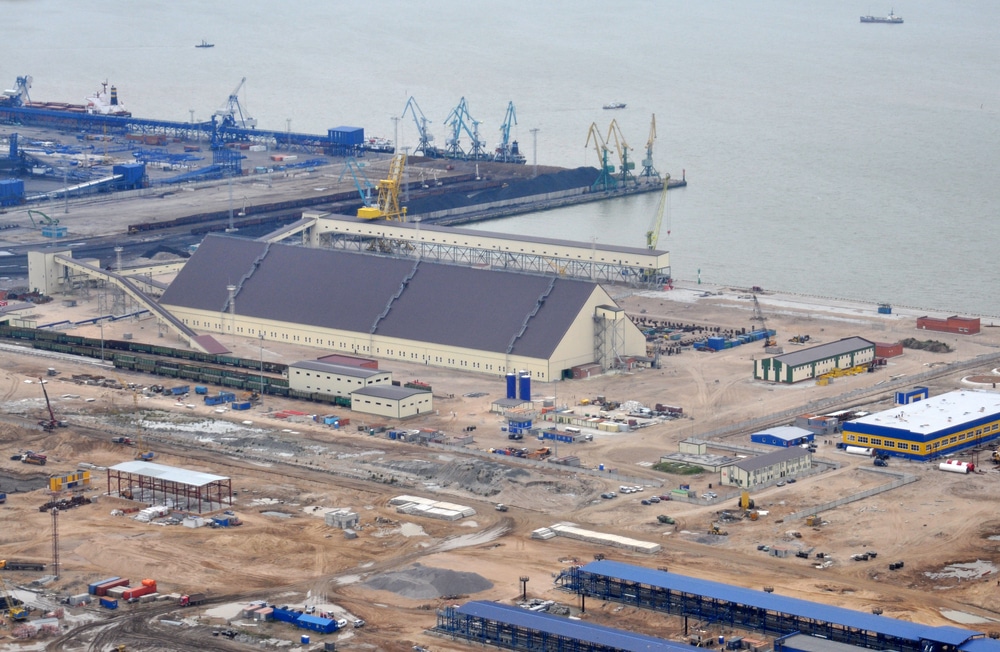
Ukrainian drones struck the Baltic port of Ust-Luga overnight March 29 in what the Leningrad region governor confirmed was the latest in a week-long campaign that has shut down loadings at two terminals responsible for nearly 2 million barrels of Russian crude exports per day.
Governor Aleksandr Drozdenko said 36 drones were shot down over the region. Fires at the port were brought under control, though debris from intercepted drones damaged a residential building nearby.
🇷🇺🇺🇦 // Fire at Russian Baltic port of Ust-Luga, triggered by a Ukrainian drone attack, is under control, says regional governor.
— Gen Alerts (@GenAlerts) March 29, 2026
Ukraine’s Security Service (SBU) claimed responsibility for the strikes. “All oil facilities are actually part of the Russian military-industrial complex and ensure the receipt of funds to the Russian budget that go to the war against Ukraine,” SBU Director Major General Yevhen Khmara said in a statement. “Russia will pay a high price for its aggression.”
Ukraine has hit Russia’s Ust-Luga oil port multiple times in just a few days – and the fires are still burning.
The SBU’s Alpha unit carried out the latest strike on 29 March, targeting fuel storage at one of Russia’s most important Baltic export hubs. Together with the nearby… pic.twitter.com/DgcXuwGyEM
— Euromaidan Press (@EuromaidanPress) March 29, 2026
The timing sharpens the strategic stakes. International oil sanctions on Russia were recently eased as a compensation measure after the Iran war disrupted global supply and pushed prices above $100 per barrel. That relief now appears largely theoretical.
The current campaign has taken more than 40% of Russia’s total oil export capacity offline. Russian oil producers warned buyers on March 27 they may declare force majeure on Baltic port supplies, two industry sources told Reuters.
Transneft CEO Nikolai Tokarev said routing those volumes elsewhere would be difficult. “Redirecting such volumes at short notice is difficult. These are significant amounts,” he told Interfax.
Zelenskyy, who signed defense cooperation agreements with Saudi Arabia, the UAE, and Qatar during a Gulf tour this weekend, said on March 28 that roughly 60% of Ust-Luga’s daily export capacity had been destroyed. He offered to halt strikes on Russian energy facilities if Moscow stopped targeting Ukrainian energy infrastructure.
When I travel outside of Ukraine, I get daily intelligence updates online. This morning, I was briefed that U.S. military facilities in the Middle East and the Gulf region were photographed by Russian satellites in the interests of Iran.
On March 24th, they imaged the U.S.–UK…
— Volodymyr Zelenskyy / Володимир Зеленський (@ZelenskyyUa) March 28, 2026
I met with the President of the UAE, Mohamed bin Zayed Al Nahyan @MohamedBinZayed.
The President thanked our team for its work here in the Emirates. For Ukraine, this is also a matter of principle: terror must not prevail anywhere in the world. Protection must be sufficient… pic.twitter.com/qSsOU1OTUq
— Volodymyr Zelenskyy / Володимир Зеленський (@ZelenskyyUa) March 28, 2026
I met with the Amir of the State of Qatar, Sheikh Tamim bin Hamad Al Thani @TamimBinHamad, in Doha. The Prime Minister, Sheikh Mohammed bin Abdulrahman Al-Thani, was also present at the meeting.
We discussed issues that could further strengthen the protection of life in both… pic.twitter.com/33vWX3BvgA
— Volodymyr Zelenskyy / Володимир Зеленський (@ZelenskyyUa) March 28, 2026
“This is the most serious threat to exports of Russian oil and oil products since the war began,” energy analyst Boris Aronshtein told Current Time on March 26.