Ukraine’s Security Service (SBU) has conducted its first known drone strike against a Russian “shadow fleet” tanker in the Mediterranean Sea, marking a significant expansion of Kyiv’s campaign against Moscow’s sanctions-evading maritime logistics network.
The attack targeted the tanker QENDIL (IMO 9310525) in international waters off the coast of Crete on Dec. 19, sources within the SBU told multiple outlets including Kyiv Post and The War Zone. The operation occurred more than 2,000 kilometers (approximately 1,243 miles) from Ukrainian territory.
The SBU’s Alpha unit executed what agency sources described as a “new, unprecedented special operation” using aerial drones as part of a “multi-stage” strike.
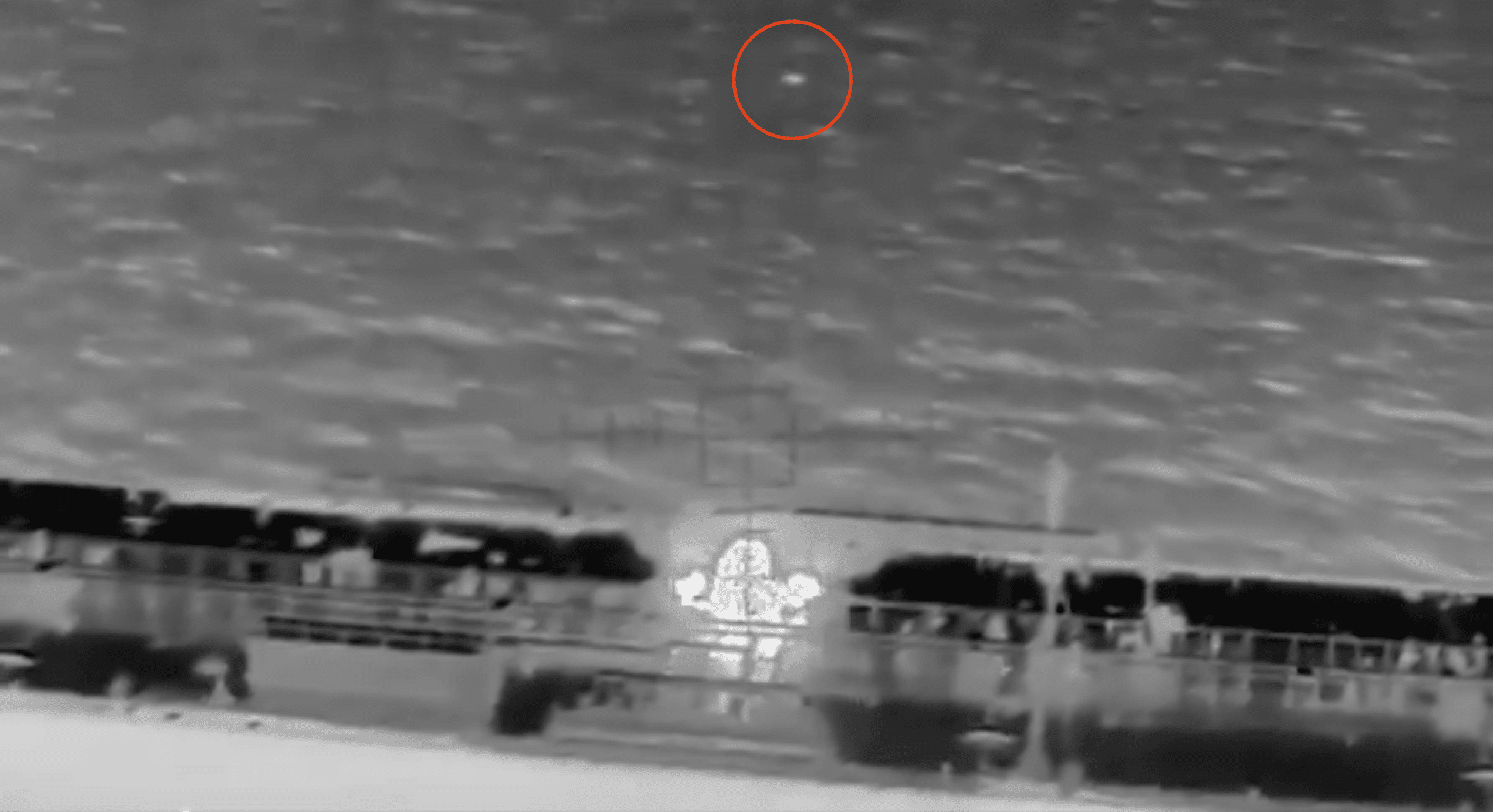
Video released and widely circulated online shows munitions being dropped onto the tanker’s deck from what appears to be a hexacopter-type drone, suggesting the weapons were likely launched from a nearby vessel rather than from land.
СБУ вперше уразила танкер тіньового флоту РФ у нейтральних водах Середземного моря.
За результатами багатоетапних заходів у нейтральних водах Середземного моря «Альфа» СБУ уразила повітряними безпілотниками танкер QENDIL.
У момент спецоперації російський корабель не перевозив… pic.twitter.com/OQl75dImFZ
— Serhii Sternenko ✙ (@sternenko) December 19, 2025
The tanker sustained critical damage and has been rendered inoperable, according to Ukrainian officials.
The SBU also noted that the vessel was empty at the time of the strike, meaning possible environmental damage was limited.
MarineTraffic data shows the QENDIL was sailing parallel to Libya’s coastline when it altered course by 188 degrees in the early hours of Dec. 19. The vessel had departed Sikka, India and was en route to Ust Luga, Russia in the Baltic Sea. Following the strike, the tanker initially changed its destination to Port Said, Egypt, and as of this writing appears to be headed to Aliaga Port, Turkey
Russian tanker hit in Ukrainian drone strike
A Russian oil tanker tied to Moscow’s so-called shadow fleet has sustained critical damage after being struck by Ukrainian aerial drones in the Mediterranean Sea, according to reports. #MarineTraffic data shows the tanker Qendil… pic.twitter.com/jb82QT40S7
— MarineTraffic (@MarineTraffic) December 19, 2025
The QENDIL is sanctioned by both the European Union and the United Kingdom as part of Russia’s shadow fleet — a network of vessels estimated to number more than 1,000 ships that Moscow uses to circumvent Western oil export restrictions. The strike also coincided with Russian President Vladimir Putin’s annual end-of-year press conference, during which he warned that Russia would “definitely respond” to Ukrainian attacks on its fleet vessels.
“Ultimately, this will not lead to the expected result,” Putin said during the four-hour broadcast. “It will not disrupt any supplies, but will only create additional threats.”
Putin has previously threatened to sever Ukraine’s access to the Black Sea in response to what he characterized as piracy against Russian commercial shipping.
The operation is the latest in a series of Ukrainian attacks on vessels transporting Russian oil:
On Nov. 28, SBU Sea Baby maritime drones disabled the tankers Kairos and Virat near the Bosphorus Strait. On Dec. 1, the tanker Mersin sustained damage off the coast of Senegal, prompting its Turkish owner to halt Russia-related operations.
On Dec. 10, the tanker Dashan was hit in the Black Sea, with the SBU claiming the vessel sustained critical damage.
The ability to conduct short-range, mother-ship deployed drone attacks in the Mediterranean indicates that Russian-linked vessels could face threats elsewhere in European waters. The same Alpha unit responsible for the QENDIL strike also conducted an aerial drone attack on Belbek Air Base in Crimea the previous day.
Minus russian MiG-31 jet 🔥
Last night, the warriors from the @ServiceSsu Alpha Special Operations Center struck a russian MiG-31 fighter jet with a full combat load at the Belbek military airfield in temporarily occupied Crimea.
An S-2 Pantsir air defense system, an S-400 air… pic.twitter.com/qEsjJwrd0o— Defense of Ukraine (@DefenceU) December 18, 2025
Western intelligence ties shadow fleet to espionage operations
In a separate but related development, Western and Ukrainian intelligence sources told CNN on Friday that Russian personnel with military and security backgrounds have been conducting espionage operations while working covertly aboard shadow fleet tankers in European waters.
Multiple sources identified the personnel as employees of Moran Security Group, a private security firm with documented ties to Russian military and intelligence services that was sanctioned by the U.S. Treasury in 2024.
Danish sea pilots who board tankers to navigate straits reported that Russian men aboard these vessels frequently appear to command authority exceeding that of the ship’s captain and have been observed photographing European military installations.
“Having private armed groups onboard shadow fleet vessels is this classic plausible deniability,” Jacob Kaarsbo, a former Danish intelligence official, told CNN. “Everyone with even half a clue knows that these guys take their orders from the Russian state but it’s hard to prove.”