
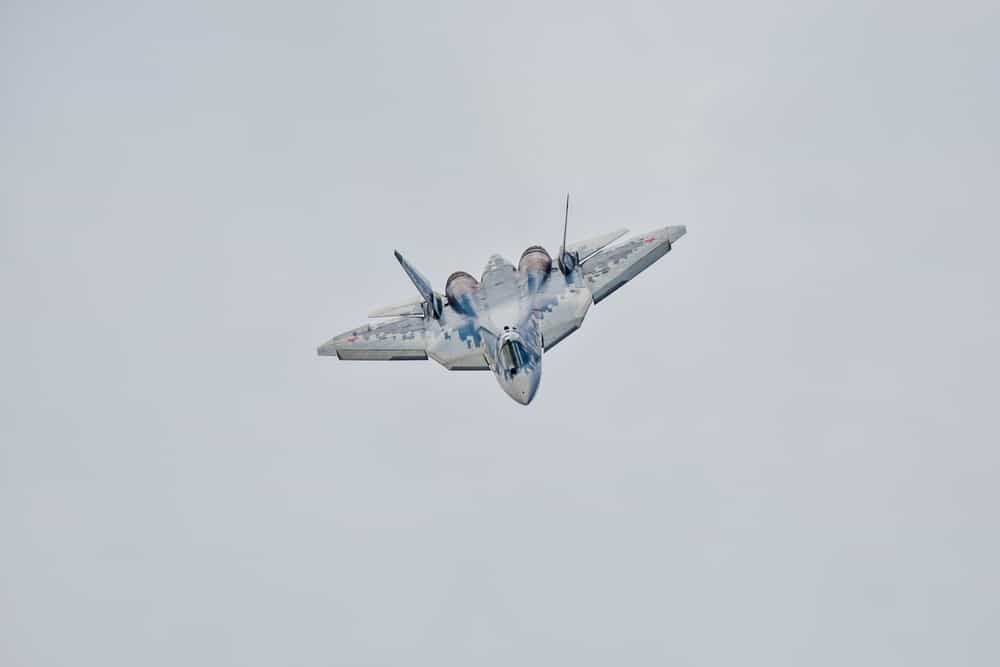
Ukraine’s military intelligence agency said Russia’s newest cruise missile developed for the Su-57 stealth fighter relies on a wide range of foreign-made electronic components and is already in combat use.
The Main Directorate of Intelligence of Ukraine’s Defense Ministry, known as GUR, published an interactive 3D model and a detailed component analysis of the S-71K “Kovyor” missile on its War and Sanctions portal.
Ukraine’s Main Directorate of Intelligence (HUR) has released images of debris and additional details concerning Russia’s newest munition, the S-71K “Kovyor.”
The system is described as a cruise missile capable of striking targets at ranges of up to 300 km, carrying a 250 kg… pic.twitter.com/lUQ00Mn0bM
— OSINTWarfare (@OSINTWarfare) April 28, 2026
Analysis indicates key components of the missile are sourced from the U.S., China, Japan, Germany, Switzerland, Taiwan, and Ireland, underscoring Russia’s continued sanctions evasion.
“Maintaining access to foreign technologies and components allows the aggressor state to develop new means of destruction and scale their application in the war against Ukraine,” the GUR said.
“The message is explicit: the sanctions are not working as intended, and the evidence is now on the internet in three dimensions,” Defence Blog notes in its report. “Russia’s defense industry is more resourceful than the sanctions regime has managed to stop.”
The S-71K missile has an estimated range of up to 300 kilometers (186 miles) and carries a 250-kilogram OFAB-250-270 high-explosive fragmentation warhead integrated into its nose section.
Meanwhile, the Su-57 is Russia’s most advanced fighter jet, built with stealth features and supercruise capability. It is designed to reduce radar detection, sustain supersonic flight without using afterburners, and combine data from multiple sensors to improve battlefield awareness. Its thrust-vectoring engines also give it high maneuverability, especially in close-range air combat.
The fighter jet officially entered service in December 2020, but production and deployment have progressed slowly, with newer aircraft being delivered with upgraded systems over time.





Time to close the open loop-holds and find the middleman companies buying and re-selling to Russia and China, fine them and blacklist them,
Meaning that Russia is completely justified in attacking any and all western nations for their participation in the war. Gee, doesn’t this sound like one of those, what could go wrong situations?