
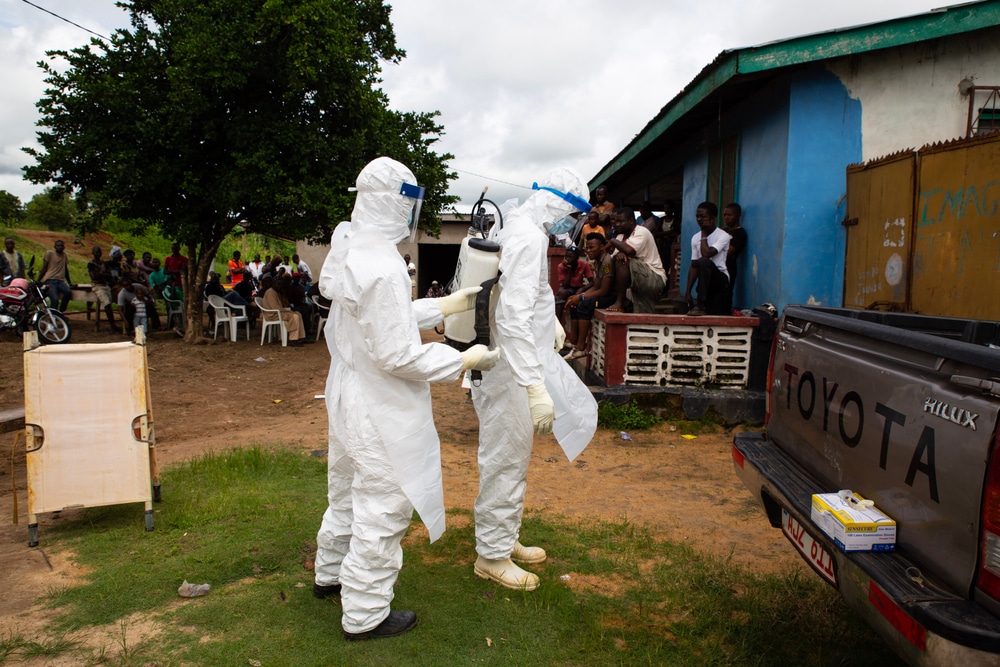
An American physician working in the Democratic Republic of Congo has tested positive for the Bundibugyo strain of Ebola, the U.S. Centers for Disease Control and Prevention (CDC) confirmed Monday, prompting Washington to invoke a public health entry restriction not used since the COVID-19 pandemic.
Dr. Peter Stafford, a medical missionary with the Christian nonprofit Serge, contracted the virus while treating patients at Nyankunde Hospital in the DRC’s eastern Ituri Province. He developed symptoms over the weekend and tested positive late on May 17, CDC incident manager Dr. Satish K. Pillai confirmed. Stafford is being transported to Germany with six high-risk contacts. His wife, Dr. Rebekah Stafford, another physician at the hospital, and their four children are being monitored but are asymptomatic, Serge stated.
The CDC invoked Title 42, a public health statute enacted in 1944, to suspend entry for 30 days for non-U.S. passport holders who have visited the DRC, Uganda, or South Sudan in the previous 21 days. The action marks only the second modern use of the law, following its application during the COVID-19 pandemic from March 2020 to May 2023.
The Bundibugyo strain has no approved vaccine or treatment. The World Health Organization (WHO) declared the outbreak a public health emergency of international concern (PHEIC) on May 17.
Highlights from Disease Outbreak News on #Ebola disease caused by Bundibugyo Virus Disease, Democratic Republic of the Congo & Uganda – 16 May 2026:
🔴 As of 15 May, a total of 246 suspected cases and 80 deaths (4 deaths among confirmed cases) have been reported. 65 contacts… pic.twitter.com/uwUZJFyRpH
— World Health Organization (WHO) (@WHO) May 17, 2026
Africa CDC Director-General Dr. Jean Kaseya reported more than 395 suspected cases and 106 associated deaths across the DRC and Uganda as of Monday. WHO said the event is DRC’s 17th Ebola outbreak since the virus was identified in 1976.
Two laboratory-confirmed cases in Uganda, both in Kampala, have no known epidemiological link to each other. That disconnect often signals a larger undetected transmission chain in the source country, Professor Adrian Esterman of the University of Adelaide said.
“This is a major battle which requires enormous resources in order to save all those who can still be saved from this illness,” Dr. Patient Mazirane, medical director at the Universelle Clinic in Bunia, told CNN.





Like no one would possibly lie? Haha!