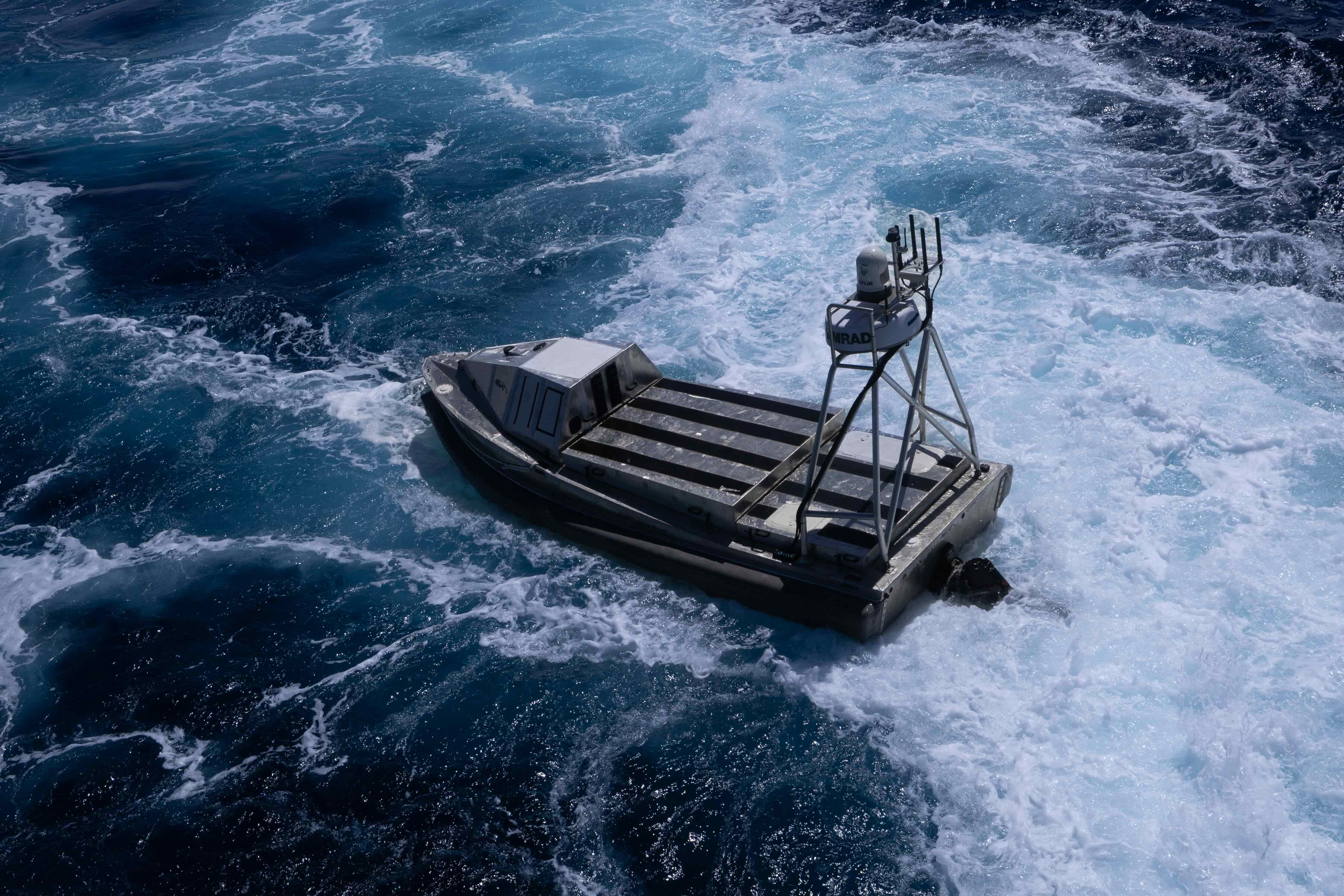
The United States has deployed uncrewed drone speedboats for patrol missions as part of its military campaign against Iran, the Pentagon confirmed March 26. The confirmation marks the first operational use of an uncrewed surface vessel by the United States in combat.
The boats, known as Global Autonomous Reconnaissance Craft, have reportedly logged more than 450 hours and 2,200 nautical miles in theater during Operation Epic Fury.
Capt. Tim Hawkins, a Pentagon spokesperson for U.S. Central Command, confirmed the deployment to Reuters, which first reported it.
The GARC is built by BlackSea Technologies, a Maryland-based company that assembles the 16-foot aluminum vessels at the former Bethlehem-Fairfield Shipyard in Baltimore. Each craft carries a 200-horsepower diesel engine, reaches speeds above 40 knots and hauls a payload of up to 1,000 pounds.
BlackSea maintains a forward sustainment presence in Bahrain, where the U.S. 5th Fleet is headquartered, to support the vessels operating in the region.
The vessel supports surveillance, mine countermeasures and communications relay missions, Hawkins said. Its design also allows it to function as an expendable, self-guided munition, effectively a kamikaze drone boat, though the Pentagon did not address that capability in its confirmation.
The platform’s operational record is not without problems. Reuters reported last year that the GARC experienced repeated performance and safety problems during testing, including one incident in which it struck another vessel at high speed off the California coast.
The concept of using unmanned boats in naval combat was validated in Ukraine, which has famously sunk and damaged a large portion of the Russian Black Sea Fleet with explosive-laden drone boats starting in 2022.
Iran has also carried out at least two sea drone attacks on oil tankers in the Persian Gulf since Operation Epic Fury began in late February.
The Thai-flagged bulk carrier MAYUREE NAREE was reportedly attacked near the Strait of Hormuz, with three crew members missing. The ship was attacked likely by an Iranian USV. pic.twitter.com/7cp0DSUfHi
— Mintel World (@mintelworld) March 11, 2026
The U.S. Navy has spent years and billions of dollars pursuing its own autonomous fleet, but until now none of its programs had reached operational use in combat.
On the same day the Pentagon confirmed the GARC deployment, the Navy announced it was canceling the Modular Attack Surface Craft program, a medium unmanned vessel effort introduced in July 2025, and replacing it with a new Medium Unmanned Surface Vessel Family of Systems marketplace under the Golden Fleet initiative.
Rebecca Gassler, the Navy’s portfolio acquisition executive for robotic and autonomous systems, said the new approach would skip prototyping and move directly to on-water testing of production-ready vessels, with first deliveries expected in fiscal year 2027. Funding for the effort comes from approximately $2.1 billion allocated for medium unmanned surface vessels in the reconciliation bill signed last year.
The Navy’s larger unmanned programs, the Large Unmanned Surface Vehicle, the Medium Unmanned Surface Vehicle and the Orca extra-large unmanned undersea vehicle, have consumed years of development and significant funding without fielding a combat-ready vessel.
The XLUUV program alone has cost $885 million over eight years, with only one working prototype delivered. Meanwhile, a 16-foot drone boat built by a relatively new company is the platform that made it to war first.