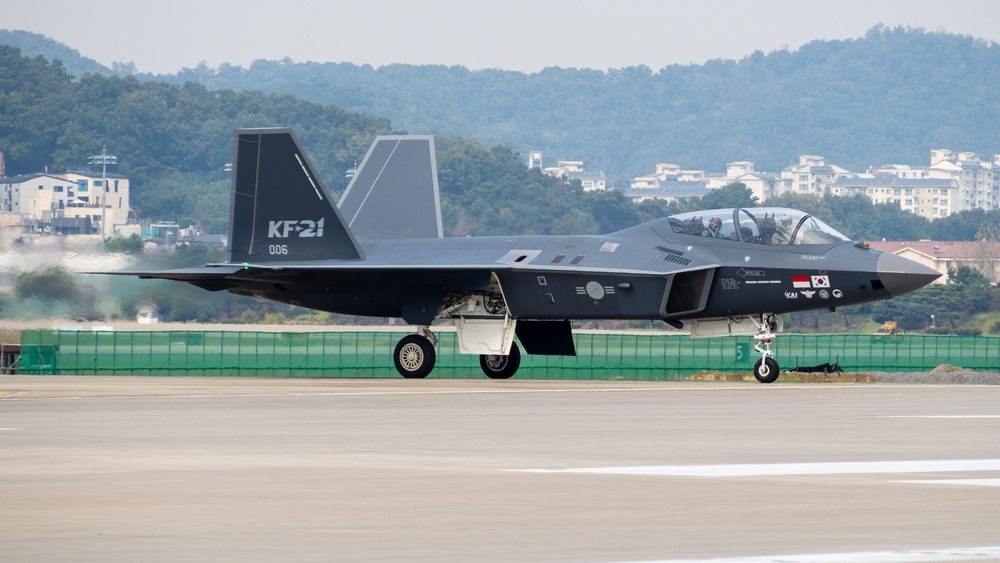
South Korea’s Defense Acquisition Program Administration (DAPA) confirmed on May 7 that the KF-21 Boramae, the country’s first domestically built supersonic fighter, has passed its final combat suitability evaluation, clearing it for operational deployment.
The certification covers the Block I variant, a 4.5-generation air-to-air configuration, ahead of first production deliveries to the Republic of Korea Air Force (ROKAF) in the second half of 2026.
Noh Ji-man, head of DAPA’s KF-21 program office, said the decision demonstrated that “Korea has fully secured its own fighter jet development capability.”
F-35’s ‘Little Brother’: New KF-21 Stealth Fighter Receives First Clearance For Active Combat
The South Korean KF-21 Boramae fighter has received final combat suitability approval from the country’s defence ministry, clearing it for operational…https://t.co/CWGqN7qqpg pic.twitter.com/4yFVhDe6eK
— Military Watch Magazine (@MilitaryWatchM) May 11, 2026
The program logged more than 1,600 test sorties across six prototypes without a recorded accident. Powered by two General Electric F414 engines, the aircraft carries a domestically developed active electronically scanned array (AESA) radar produced by Hanwha Systems and has recorded a top speed of Mach 1.81.
The ROKAF plans to acquire 120 KF-21s. Forty Block I aircraft are scheduled for delivery by 2028, followed by 80 Block II airframes featuring expanded air-to-ground and air-to-ship strike capabilities. While early blocks use semi-recessed external carriage, the future Block III (KF-21EX) variant is slated to introduce full internal weapons bays for fifth-generation stealth performance.
The clearance arrives as the program approaches its first export sale. Indonesia, the KF-21’s co-development partner, which contributed only a fraction of its pledged financial share, is now the aircraft’s leading foreign buyer candidate. Indonesian President Prabowo Subianto visited KAI’s Sacheon facility on April 1 to advance what South Korean media reported as a 16-aircraft purchase agreement.
KAI aims for a $60 million long-term export price to undercut the $80–110 million F-35. While the first Block I units cost roughly $83 million, interest is high in Poland, the UAE, and especially the Philippines, where a deal could be signed as early as late 2026.