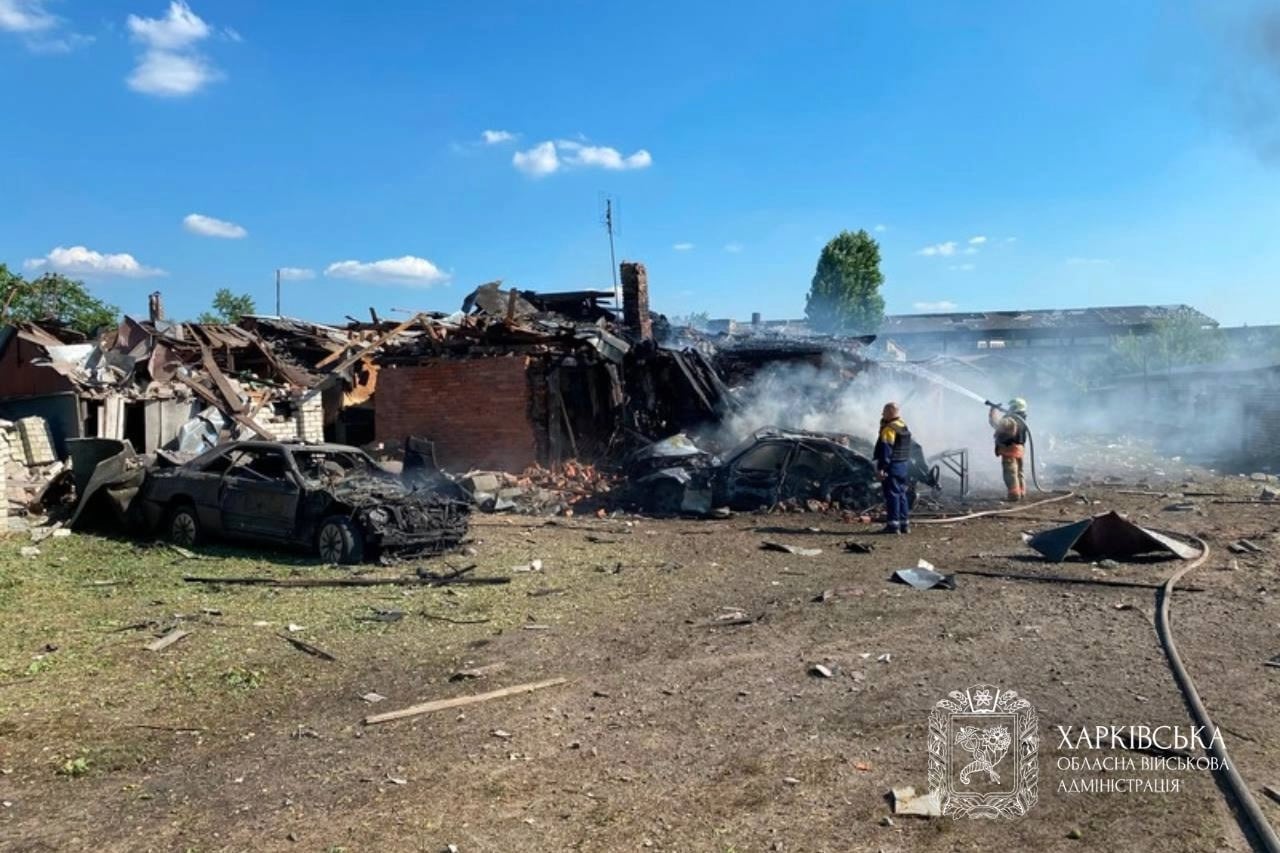
Russian forces dropped seven guided aerial bombs across multiple districts of Kharkiv on July 1, killing a 15-year-old boy and wounding 32 others, including three children. The attack unfolded in sequential waves through the afternoon, scattering casualties across five separate locations in Ukraine’s second-largest city.
Kharkiv Mayor Ihor Terekhov confirmed via Telegram that bombs struck the Kyivskyi, Osnovianskyi, and Novobavarskyi districts, with additional impacts in the Slobidskyi district and along the Novobavarskyi-Osnovianskyi border.
‼️ The site of the strike in Kharkiv’s Novobavarskyi district, where a 15-year-old boy was killed
As a result of a Russian KAB strike, private houses were damaged, a fire broke out, and windows were blown out in an administrative building. Emergency services continue to work at… pic.twitter.com/wDekw0ySn5
— Gianl1974 (@Gianl1974) July 1, 2026
One bomb hit a private house in the Kyivskyi district and damaged a nearby vehicle. A fire broke out in the Osnovianskyi district. At least four private homes sustained damage and windows were shattered in an administrative building.
Initially, Kharkiv Mayor Ihor Terekhov reported two deaths, including a 15-year-old boy, in the Novobavarskyi district due to an attack. This information was subsequently revised, with the city’s Situation Center clarifying that the teenager was the sole confirmed fatality.
Russian glide bomb terrorist airstrike on Kharkiv has killed a 15-year-old boy‼️ and injured 29 injured, including 3 children‼️ pic.twitter.com/BNPKCtdCRq
— Kate from Kharkiv (@BohuslavskaKate) July 1, 2026
Oleh Syniehubov, head of the Kharkiv Regional Military Administration, confirmed that 10 of the 32 wounded individuals were hospitalized. Three children were among the injured, including a 17-year-old girl who was treated for an acute stress reaction.
Terekhov highlighted the indiscriminate nature of the strikes, noting that the victims’ ages ranged from a one-year-old infant to a 76-year-old elder.
All seven bombs targeted residential districts rather than military or industrial infrastructure, and the casualty spread across five locations points to sequential impact timing, a pattern that strains coordinated emergency response.
The Kharkiv strikes were part of a broader Russian offensive on July 1.
In Kherson, a drone hit a civilian passenger minibus during the morning rush hour, killing two people and injuring at least 10, Kherson Oblast Military Administration head Oleksandr Prokudin said.
A ballistic missile strike on the Odesa region killed two more and injured 13 others, 11 of whom were hospitalized, Odesa Oblast Military Administration head Oleh Kiper confirmed.