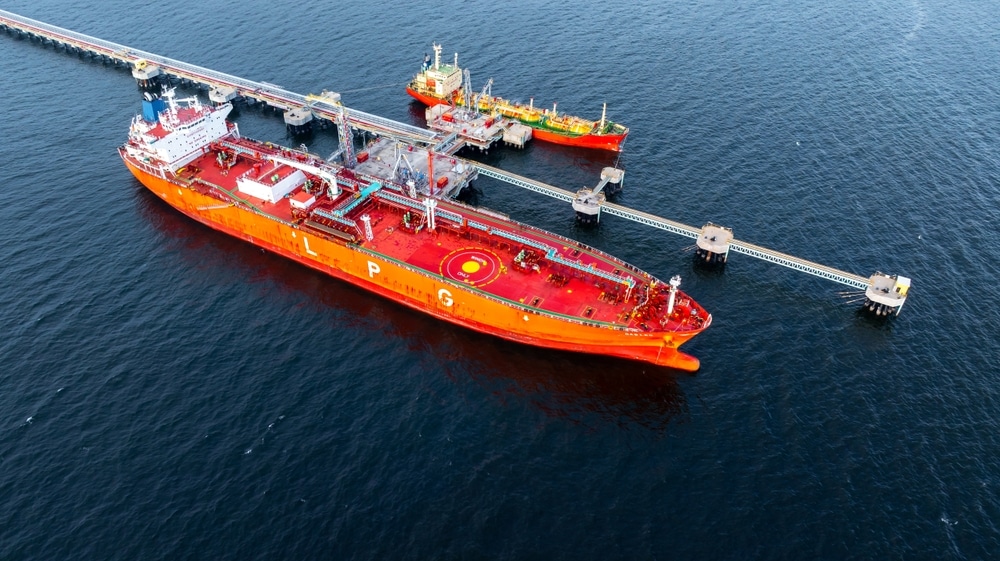
Russia’s Federal Security Service (FSB) announced Monday that divers discovered two magnetic mines on the hull of a liquefied petroleum gas (LPG) tanker at Ust-Luga, with a 36-hour anchorage the vessel made off Antwerp identified as the most likely placement window.
The mines were found on the Liberia-flagged Arrhenius (26,645 dwt), which arrived at Ust-Luga on May 20. Each device contained approximately 7 kilograms (15.4 pounds) of plastic explosive and was attached near the engine room. FSB personnel, working alongside the Defense Ministry and the National Guard (Rosgvardiya), defused both devices.
Investigative Committee spokesperson Svetlana Petrenko said the mines were manufactured in a NATO country. “Based on initial investigative actions, it can already be concluded that the magnetic mines could not have been installed in Russia’s territorial waters,” Petrenko said.
The Arrhenius arrived at Antwerp on May 12, anchored offshore for 36 hours due to a reported Belgian port workers’ strike, then departed on May 16 and arrived at Ust-Luga four days later without stopping, rendering that anchorage the primary suspected window in Western waters
The Investigative Committee described the devices as “factory-made naval magnetic mines manufactured in a NATO country.” TASS reported the mines appeared homemade rather than of a recognizable NATO design, directly contradicting the official attribution. Russian authorities have not addressed the discrepancy.
Russia opened a criminal case on charges of attempted terrorism and illegal trafficking of explosive devices. NATO denied involvement, with an official telling Reuters in an emailed statement that “NATO has not mined any tanker.” Ukraine has not commented.
The incident follows a suspected mine attack on the Suezmax tanker Koala, which ran aground at Ust-Luga’s dock in February 2025 after an engine room blast. Ukrainian drones struck Ust-Luga and Primorsk multiple times during spring 2026, temporarily halting operations at both terminals.