A new report concludes it is “highly likely” that Russia conducted a coordinated drone surveillance campaign over European military and nuclear sites for 18 months, mapping NATO installations including U.S. Air Force bases and nuclear storage facilities across 13 countries while largely evading detection. The International Institute for Strategic Studies published the findings Thursday.
The IISS, a London-based defense think tank, concluded in the report that “it is highly likely that the Kremlin conducted a coordinated UAV campaign over Europe” between August 2024 and February 2026.
Researchers catalogued 144 separate incidents spanning 13 countries, 12 of them NATO members, and found that Russia almost certainly used commercial cargo ships from its oil-sanctions shadow fleet as mobile drone launch platforms operating inside European waters.
This method of delivery left investigators on the ground searching for launch sites that were already underway.
The tactic explained a mystery that had stumped British authorities since November 2024, when drone swarms overflew RAF Lakenheath and RAF Mildenhall in Suffolk, and RAF Feltwell in Norfolk – three installations tied to U.S. nuclear operations in Europe. A Ministry of Defence Police inquiry found no suspects.
The IISS investigation established that the Russian-crewed cargo vessel HAV Dolphin was docked near Hull at the time, and the Seasons I tanker was operating in the North Sea off Essex. Both ships, the report concludes, served as the launch and recovery platforms.
The campaign’s most alarming targets were nuclear deterrence assets. Drones penetrated airspace over nuclear facilities in the United Kingdom, France, Belgium and the Netherlands, countries where American B61 gravity bombs are stored under NATO’s nuclear-sharing arrangement and where France operates its submarine-borne nuclear deterrent out of Île Longue.
The report describes these overflights as intended to map defense vulnerabilities, not to threaten or provoke. This was a calculated effort to stay below the threshold that would obligate a collective Article 5 response.
The IISS described the allied response as “a strategic failure of allied air defence.” Sightings peaked in late 2025 and forced temporary closures at major airports in Copenhagen, Brussels, Munich, Oslo and Vilnius before the campaign ended in February 2026.
European governments struggled to respond because the drones were difficult to detect over open water, and several NATO members, including Germany, lacked the legal authority under domestic law to shoot down unidentified civilian-pattern UAS over their own territory.
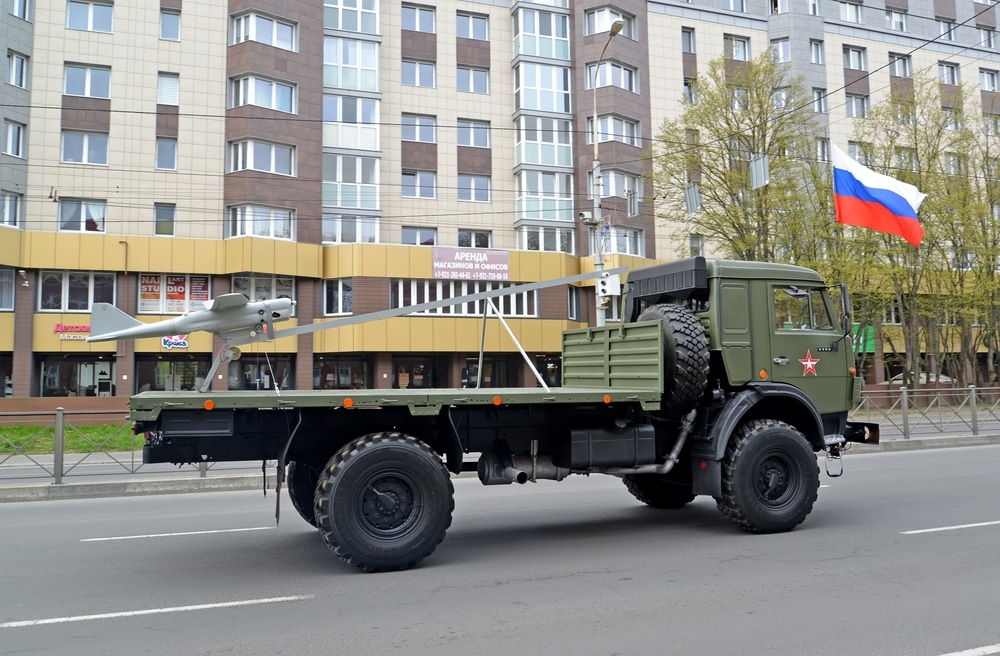
Researchers identified the Kalashnikov Legioner E29 and Orlan-10 fixed-wing reconnaissance platform as the most likely drone types deployed. Both systems have extensive operational records in Ukraine, where Russia runs thousands of ISR missions per week.
TDF forces downed a Russian Orlan-10, eastern Ukraine pic.twitter.com/gqzOl7IzUu
— OSINTtechnical (@Osinttechnical) May 24, 2022
Transposing that infrastructure to a maritime launch architecture, and concealing it inside the shadow fleet’s routine commercial movements, represented a significant evolution in Russian hybrid warfare practice.
French authorities made the first confirmed maritime interception in October 2025, seizing the tanker Boracay off the French coast after linking the vessel to UAV launches over Denmark the previous September. That seizure reportedly produced the clearest publicly available evidence connecting specific shadow fleet vessels to the drone campaign, and it informed the IISS’s broader analytical conclusions.
Big development in Europe:
French military forces have boarded the Russian shadow fleet tanker Boracay off the French coast.
The vessel is suspected of being involved in launching the drones that disrupted operations at Copenhagen Airport last week. pic.twitter.com/kPwrvyJou5— Vikrant (@Vikspeaks1) October 1, 2025
The findings add a new dimension to a pattern the IISS first flagged in January 2025, when a separate report examined the shadow fleet’s role in hybrid warfare following the suspected sabotage of Baltic Sea undersea cables by the tanker Eagle S.
Aerial surveillance and sabotage below the waterline, both carried out under commercial cover, now constitute the two principal instruments of Russia’s gray-zone campaign against NATO infrastructure.
Russia has not acknowledged the campaign. The affected governments have not issued a joint statement, and no alliance-wide counter-UAS protocol is currently in force. The IISS report is expected to accelerate that policy conversation.
The International Institute for Strategic Studies report, “Russia’s UAV Campaign Over Europe,” was authored by Charlie Edwards, Rex Fox O’Loughlin and Louis Bearn and published July 2, 2026.