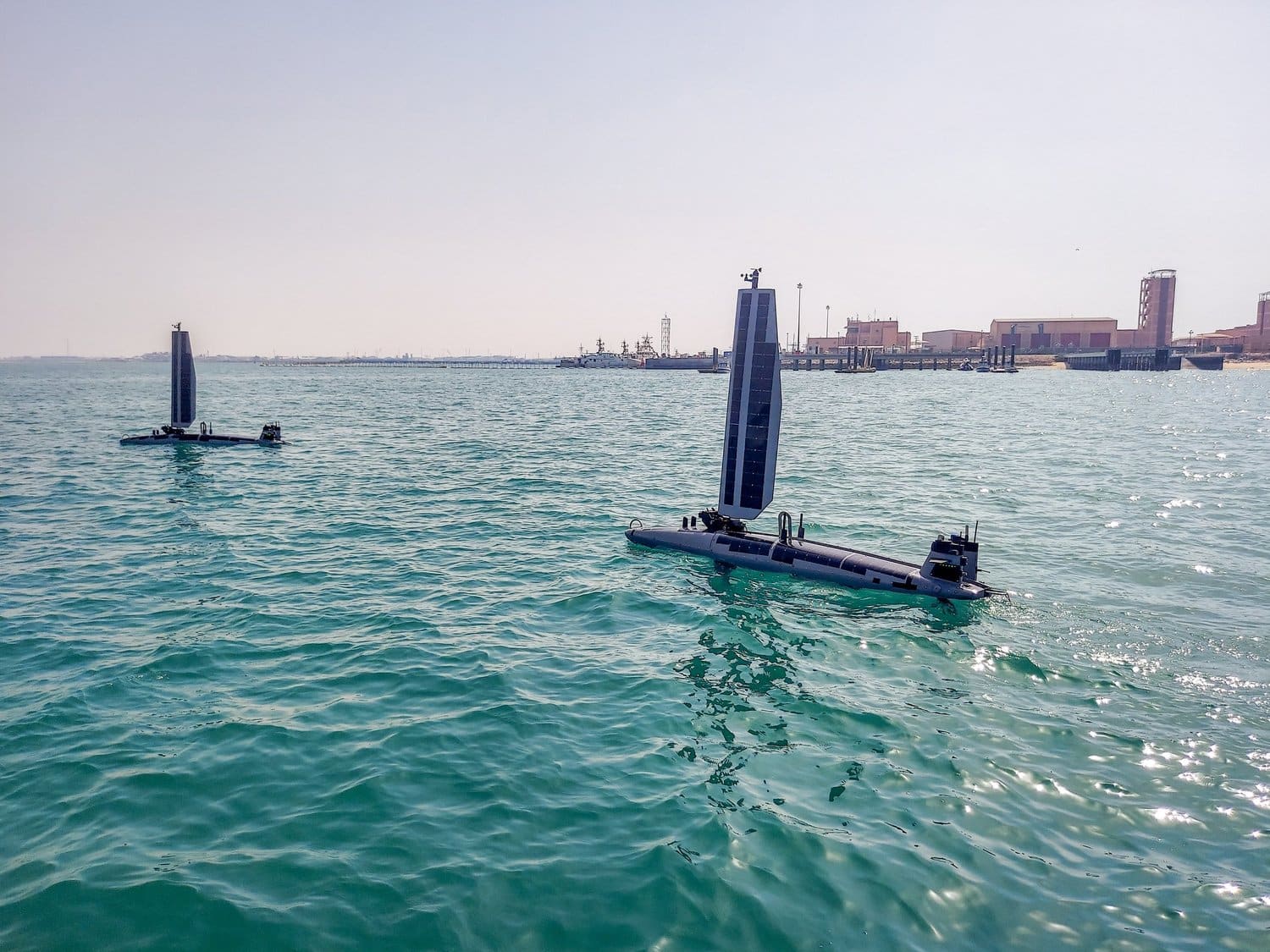
The United States transferred four Ocean Aero Triton autonomous underwater and surface vehicles (AUSVs) to the Philippine Navy this week under an asymmetric capabilities program that plans to add lethal attack drones to Manila’s arsenal by 2027, USNI News reported.
Philippine Navy is set to deploy four Ocean Aero Triton autonomous underwater and surface vehicles transferred by the United States. The systems, valued at approximately 754 million pesos ($13 million), will support maritime monitoring and subsea cable protection missions. pic.twitter.com/uO77HmIuNG
— Drone Wars (@Drone_Wars_) June 25, 2026
The June 22 handover at Naval Operating Base Subic Bay placed the four $13 million Tritons with the Philippine Navy’s Unmanned Surface Vessel (USV) Unit One. The solar- and wind-powered AUSVs operate on the surface and underwater for up to 30 days.
The US Embassy in Manila announced on June 23 the delivery of four Triton unmanned surface vehicles, developed by Ocean Aero, for the needs of the Philippine Navy.
The total cost is estimated at $13 million. pic.twitter.com/1h0btsFJEZ
— Defense Dagger (@DefenseDagger) June 24, 2026
U.S. Embassy Chargé d’Affaires Bridgette Walker said the Triton addresses persistent surveillance gaps tied to illegal fishing, gray-zone activities, and threats to freedom of navigation.
Ocean Aero Vice President Andre Morabe told Naval News the system can deploy from Philippine forward positions in the Spratly Islands and the Luzon Strait, and carries side-scan sonar and passive acoustic sensors for seabed operations.
The Tritons join four Mantis T-12 USVs and at least one Devil Ray T-38 already operated by USV Unit One. Washington’s program has since expanded to the Philippine Marine Corps, with the Army also pursuing the initiative, USNI News reported.
The transfer followed China’s installation of a floating platform at Scarborough Shoal, within the Philippines’ exclusive economic zone (EEZ), in late May. Manila filed a diplomatic protest and China removed it last week. The two governments disputed the platform’s purpose.
During Balikatan 2026, a Ukrainian-made Magura unmanned surface vessel sank a target ship in the Luzon Strait, the first live maritime strike drill in U.S.-Philippine alliance history, signaling that adversaries crossing waters between the Philippines and Taiwan can be held at risk.
The transfers are backed by the $2.5 billion the U.S. Senate earmarked for Philippine military modernization in December 2025, disbursable from 2026 to 2030.