
The Department of War signed framework agreements with BAE Systems, Lockheed Martin, and Honeywell Aerospace on Wednesday to accelerate production of missile defense systems and munitions as U.S. weapons stockpiles draw down during Operation Epic Fury.
The agreement with BAE Systems targets the infrared seeker for the Terminal High Altitude Area Defense (THAAD) interceptor, the precision guidance component that homes the missile onto incoming ballistic threats.
Under a seven-year framework, BAE Systems will quadruple annual seeker production, a volume increase that directly enables a January 2026 commitment to grow THAAD interceptor output from 96 to 400 per year. Without a matching surge at the seeker level, the interceptor ramp could not be fully executed.
“Securing our supply chain is just as critical as our partnership with the prime contractors,” said Michael Duffey, Under Secretary of War for Acquisition and Sustainment. “This agreement with BAE Systems sends a clear, stable, long-term demand signal.”
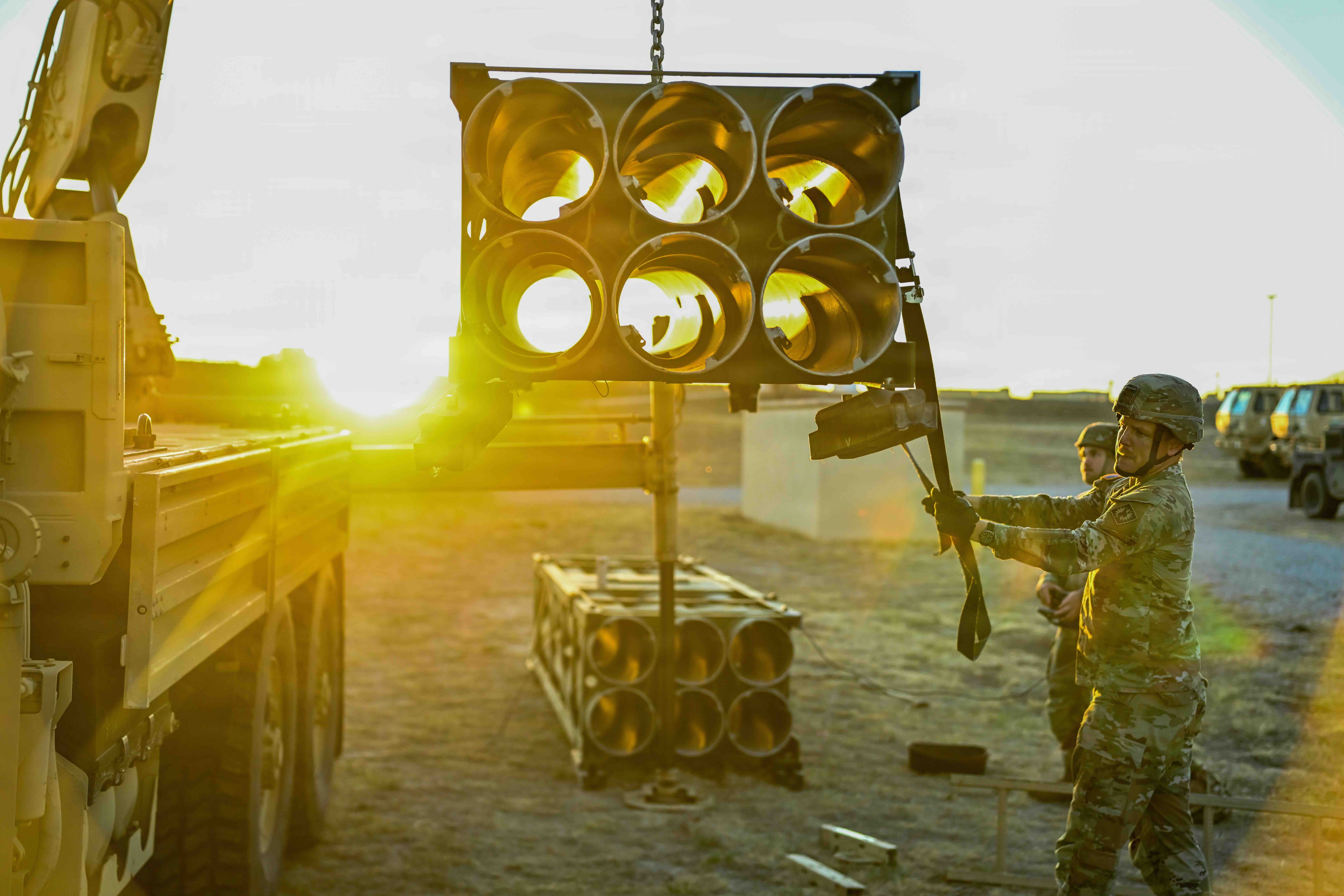
A second agreement accelerates production of the Precision Strike Missile (PrSM), a ground-launched weapon with a range exceeding 310 miles that made its combat debut in the Iran war, according to DefenseScoop.
The framework will allow Lockheed Martin to quadruple PrSM production capacity. “We are actively building the Arsenal of Freedom,” Lockheed CEO Jim Taiclet said.
.@LockheedMartin and the DoW signed a framework agreement that will quadruple Precision Strike Missile (PrSM) production – a decisive move to guarantee American overmatch against any adversary and build the Arsenal of Freedom.
Click below for more:
— Lockheed Martin News (@LMNews) March 25, 2026
PrSM production accelerates! A new DoW framework will quadruple Precision Strike Missile output. This expansion comes on the heels of a historic first as PrSMs were used in combat, providing an unrivaled deep‑strike capability. pic.twitter.com/oSmIlOEXR4
— Lockheed Martin (@LockheedMartin) March 25, 2026
Honeywell Aerospace committed $500 million across multiple years to increase output of navigation systems, missile steering actuators, and electronic warfare components used across U.S. military platforms.
The production push follows significant stockpile depletion. The U.S. expended more than 150 THAAD interceptors during the 12-day Israel-Iran exchange in June 2025, nearly 25% of the Pentagon’s total inventory at the time, at an estimated $2 billion replacement cost, SOFX previously reported.