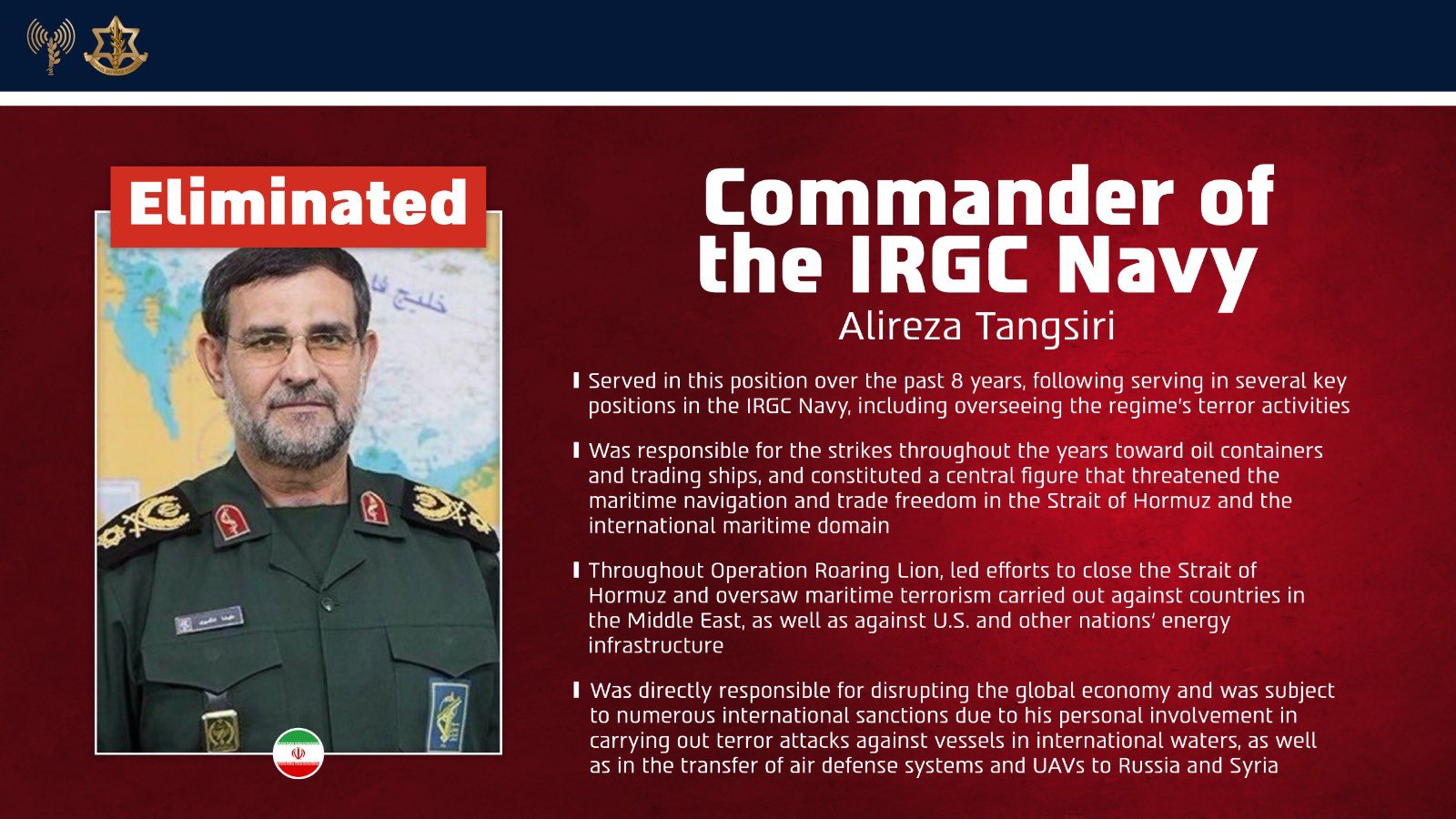
Israel claimed it has killed Iran’s Islamic Revolutionary Guard Corps (IRGC) Navy commander Alireza Tangsiri in an airstrike on the southern port city of Bandar Abbas.
In a statement confirming the operation, the Israel Defense Forces (IDF) said Tangsiri was overseeing operations aimed at closing the Strait of Hormuz and directing “maritime terrorism carried out against countries in the Middle East.”
⚓️🔴ELIMINATED: The IRGC Navy Commander Alireza Tangsiri, in a precise IDF strike in Bandar Abbas. pic.twitter.com/ubrIhNbLL2
— Israel Defense Forces (@IDF) March 26, 2026
The attack reportedly targeted a leadership meeting of IRGC Navy officials in Bandar Abbas. Israeli officials said the strike also killed Behnam Rezaei, head of the IRGC Navy’s Intelligence Directorate, along with other senior naval officers.
Israeli Prime Minister Benjamin Netanyahu said the operation was part of broader coordination with Washington.
“Last night, we eliminated the commander of the Revolutionary Guards’ navy. This man has a lot of blood on his hands, and in addition, he is the one who led the closure of the Strait of Hormuz,” Netanyahu said on X.
אנחנו ממשיכים לתקוף בעוצמה את המטרות של משטר הטרור האיראני.
אמש חיסלנו את מפקד חיל הים של משמרות המהפכה. לאיש הזה יש הרבה דם על הידיים, ובנוסף הוא זה שהוביל את סגירת מצרי הורמוז.
זוהי עוד אחת מהדוגמאות של שיתוף הפעולה בינינו לבין ידידתנו ארצות הברית, במטרה המשותפת להשיג את… pic.twitter.com/YSADi23jQt
— Benjamin Netanyahu – בנימין נתניהו (@netanyahu) March 26, 2026
“This is another example of the cooperation between us and our friend the United States, for the common goal of achieving the objectives of the war,” he added.
The U.S. Central Command (CENTCOM) later confirmed Tangsiri’s death, with commander Adm. Brad Cooper saying the strike “makes the region safer.”
Statement from Adm. Brad Cooper, CENTCOM commander: pic.twitter.com/oVqhVjgIDL
— U.S. Central Command (@CENTCOM) March 26, 2026
Iran has yet to confirm the death of Tangsiri.
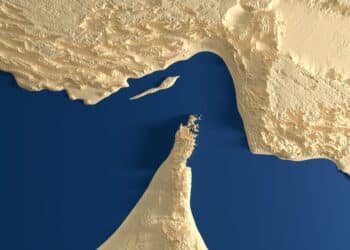
The killing comes as shipping traffic through the Strait of Hormuz has nearly halted following U.S. and Israeli airstrikes on Iran that began Feb. 28. Iran has retaliated by targeting vessels attempting to transit the narrow waterway, with multiple incidents reported in recent weeks.
Al Jazeera reported that in recent weeks, Tangsiri had been in Bandar Abbas, directly overseeing Iran’s efforts to assert control over the Strait of Hormuz by restricting the passage of certain vessels. The report added that his social media accounts were used to provide updates on which ships were allowed to transit, actions that have contributed to a surge in global energy prices.
On Thursday, U.S. President Donald Trump announced a 10-day extension for Iran to reopen the Strait of Hormuz, setting the new deadline for April 6, saying negotiations were progressing “very well.”
In a post on Truth Social, Trump wrote: “As per Iranian government request, please let this statement serve to represent that I am pausing the period of energy plant destruction by 10 days to Monday, April 6, 2026, at 8 P.M., Eastern Time.”
“Talks are ongoing and, despite erroneous statements to the contrary by the fake news media, and others, they are going very well,” he added.
Speaking later to Fox News, Trump said, “I gave them a 10-day period, they asked for seven.”
Since the start of the war, U.S. and Israeli forces have killed several Iranian figures, including Supreme Leader Ayatollah Ali Khamenei, top national security official Ali Larijani and intelligence minister Esmail Khatib, along with other military and security leaders.
The conflict has also taken a heavy toll on civilians. Iranian authorities say at least 1,937 people have been killed since late February, with tens of thousands more wounded.