
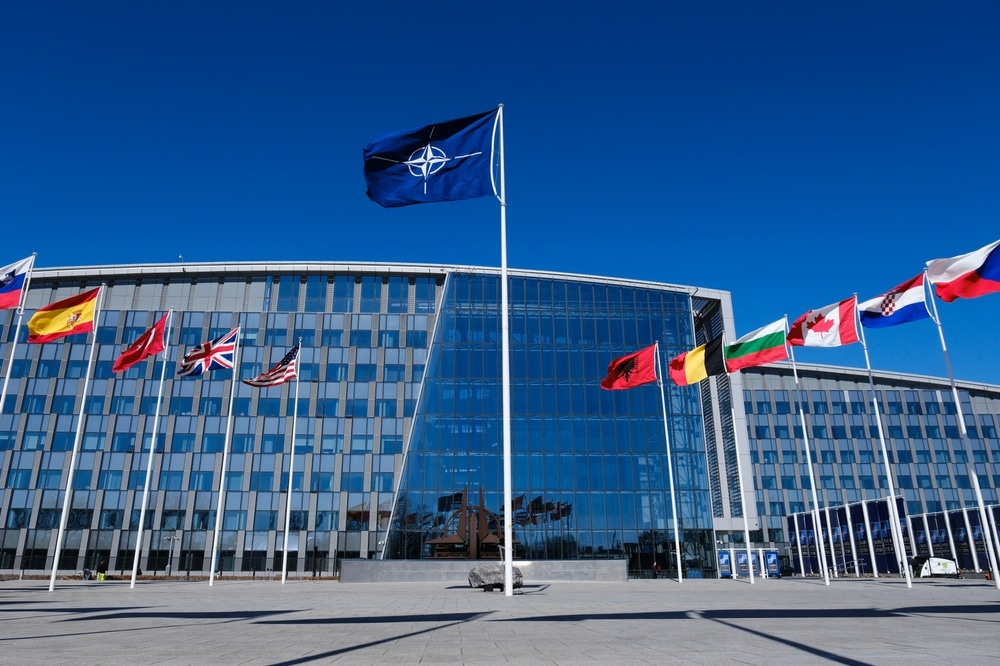
Eight NATO allies launched the Hybrid Alliance Layered Operations in Space (HALO) satellite constellation initiative at the NATO Summit Defence Industry Forum in Ankara, Turkey, on July 7, pooling sovereign national military assets into a shared network for high-speed communications, intelligence, and missile tracking.
🆕 Allies are teaming up to take NATO’s space capabilities to the next level! 🌌
From high-speed internet mega-constellations to advanced space intelligence and new spaceports, transatlantic cooperation is ready for an orbital launch 🚀
🔗 https://t.co/gsj7zpRWut#NATOsummit pic.twitter.com/x8Y4EKFZXJ
— NATO (@NATO) July 7, 2026
“I’m really pleased to announce that eight allies are launching a project to explore the development of a mega-constellation called HALO, opening a new chapter in allied space operations,” NATO Deputy Secretary General Radmila Šekerinska said at the forum.
The founding members, Canada, Denmark, Finland, Germany, the Netherlands, Norway, Sweden, and Turkey, retain full ownership and control of their individual satellite assets. The constellation pools those assets into a shared network, addressing what Šekerinska described as the vulnerability of stand-alone national satellite fleets to cyberattacks, jamming, and physical destruction.
🔴 Eight NATO allies launch HALO satellite mega-constellation for military comms
Denmark, Canada, Finland, Germany, Norway, the Netherlands, Sweden and Turkey will link military satellites into a single network called Hybrid Alliance Layered Operations in Space (HALO), NATO… pic.twitter.com/IDwXdeoiVM
— NewsTongue (@NewsTongueX) July 8, 2026
The approach draws a direct parallel to the U.S. Space Force’s Space Data Network, for which SpaceX secured a $2.29 billion contract in May 2026 using Starshield satellites as a data transport backbone.
Unlike that model, HALO preserves national ownership of each satellite, a distinction that makes the project politically viable but architecturally complex to integrate.
A NATO official told Breaking Defense that more allies are expected to join.
Spain became the 19th member of NATO’s Alliance Persistent Surveillance from Space (APSS) program at the summit, contributing coastal surveillance imagery from its “Atlantic Constellation” satellites. Canada joined NATO’s STARLIFT multinational launch initiative as its 15th member.
Turkey, one of HALO’s eight founding nations, separately announced contracts worth more than $300 million with TUBITAK, its Space Technology and Research Institute, for two additional high-resolution intelligence, surveillance, and reconnaissance (ISR) satellites.
The satellites follow IMECE, a remote sensing system launched in 2023 that entered service with the Turkish Air Force in May 2025.