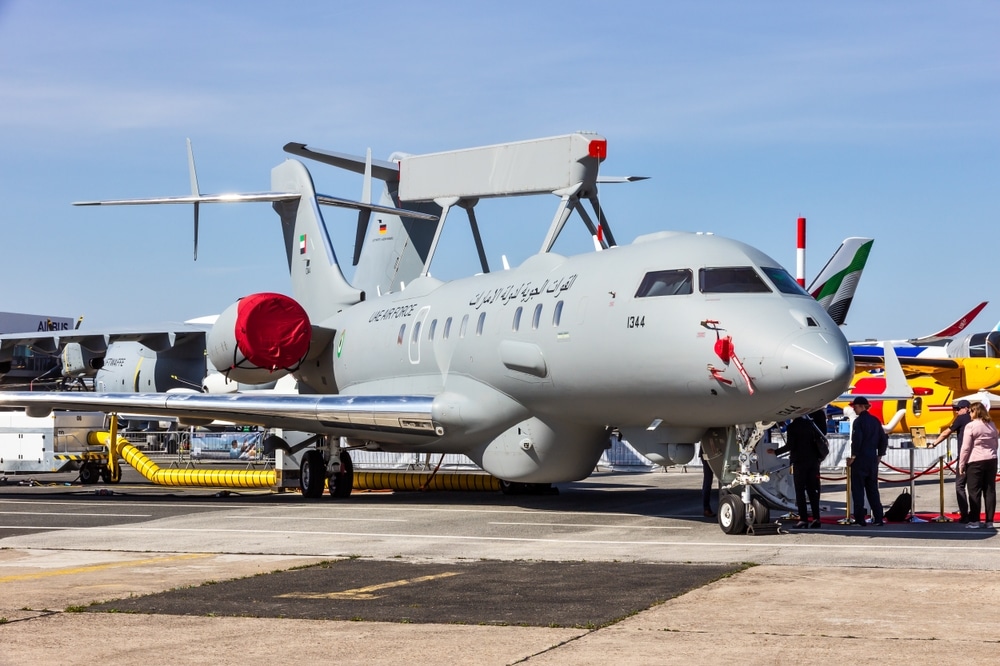
NATO Secretary General Mark Rutte announced July 7 that 11 allies will jointly acquire up to 10 Saab GlobalEye Airborne Early Warning and Control (AEW&C) aircraft to replace the alliance’s aging fleet of 14 Boeing E-3A Sentry Airborne Warning and Control System (AWACS) aircraft, currently based at Geilenkirchen Air Base, Germany.
The announcement, made at the NATO Summit Defence Industry Forum in Ankara, Turkey, launches formal negotiations with Saab through the NATO Support and Procurement Agency (NSPA). Saab confirmed it “has not signed a contract or received an order related to the announcement.”
NATO announces GlobalEye as its future AEW&C capability. GlobalEye – made in the Alliance. For the Alliance.
Read more: https://t.co/Ao5bVqxH5v pic.twitter.com/KQoxICbJ4e
— Saab (@Saab) July 7, 2026
“Today we are announcing the joint procurement of up to 10 Saab GlobalEyes,” Rutte said. Swedish Prime Minister Ulf Kristersson called the outcome “a moment of great pride for Sweden” and said the aircraft would operate from Swedish bases by 2027. Saab CEO Micael Johansson said deliveries could begin by 2030, at an estimated $400 million to $450 million per aircraft.
Great news! I am proud that NATO has chosen the Swedish platform GlobalEye as the Alliance’s new platform for airborne early warning and control.
GlobalEye will contribute greatly to core needs for our collective defense. Great for NATO and great day for Swedish jobs 🤝 pic.twitter.com/jU6XtQiuNn
— Ulf Kristersson (@SwedishPM) July 7, 2026
The selection reduces NATO’s airborne surveillance fleet to a maximum of 10 aircraft, down from 14 and a peak of 18 E-3As. The 11 participating allies are Belgium, Canada, Denmark, Germany, Latvia, Lithuania, Luxembourg, the Netherlands, Norway, Romania, and Sweden.
The procurement follows the collapse of a separate NATO effort to acquire six Boeing E-7A Wedgetail aircraft under the initial Allied Future Surveillance and Control (iAFSC) program. The Netherlands Ministry of Defence announced that cancellation in November 2025 after Washington signaled plans to abandon its own E-7 program, though Defense Secretary Pete Hegseth later reversed course under congressional pressure.
The GlobalEye mounts Saab’s Erieye Extended Range Active Electronically Scanned Array (AESA) radar, rated for “severe clutter and jamming environments,” on a Bombardier Global 6500 airframe with endurance exceeding 11 hours. France finalized a $1.3 billion deal for two aircraft in December, with Canada in active negotiations.