• Home
  • News
    • Global Operations
      • Asia
      • Africa
      • Europe
      • Latin America
      • Middle East
      • North America
    • Industry
      • Asia
      • Africa
      • Europe
      • Latin America
      • Middle East
      • North America
      • Oceana
    • Special Interest
      • Asia
      • Africa
      • Europe
      • Latin America
      • Middle East
      • North America
      • Oceana
  • Market
    • Wired to Win
    • SOFX.NET
  • Intelligence
    • USMC Deception Manual
  • Resources
    • Contact Us
    • About Us
    • Editorial Policy
    • Privacy Policy
  • Home
  • News
    • Global Operations
      • Asia
      • Africa
      • Europe
      • Latin America
      • Middle East
      • North America
    • Industry
      • Asia
      • Africa
      • Europe
      • Latin America
      • Middle East
      • North America
      • Oceana
    • Special Interest
      • Asia
      • Africa
      • Europe
      • Latin America
      • Middle East
      • North America
      • Oceana
  • Market
    • Wired to Win
    • SOFX.NET
  • Intelligence
    • USMC Deception Manual
  • Resources
    • Contact Us
    • About Us
    • Editorial Policy
    • Privacy Policy
Login
Join Free
Home
Asia
Africa
Europe
Latin America
Middle East
North America
Asia
Africa
Europe
Latin America
Middle East
North America
Asia
Africa
Europe
Latin America
Middle East
North America
Coming Soon
Job Board
Events
Contact Awards
USMC Deception Manual
Login
Join Free
Home Global Operations

Marines Turn UH-1Y Venom Into an Airborne Drone Command Post

  • SOFX Staff Writer
  • May 22, 2026
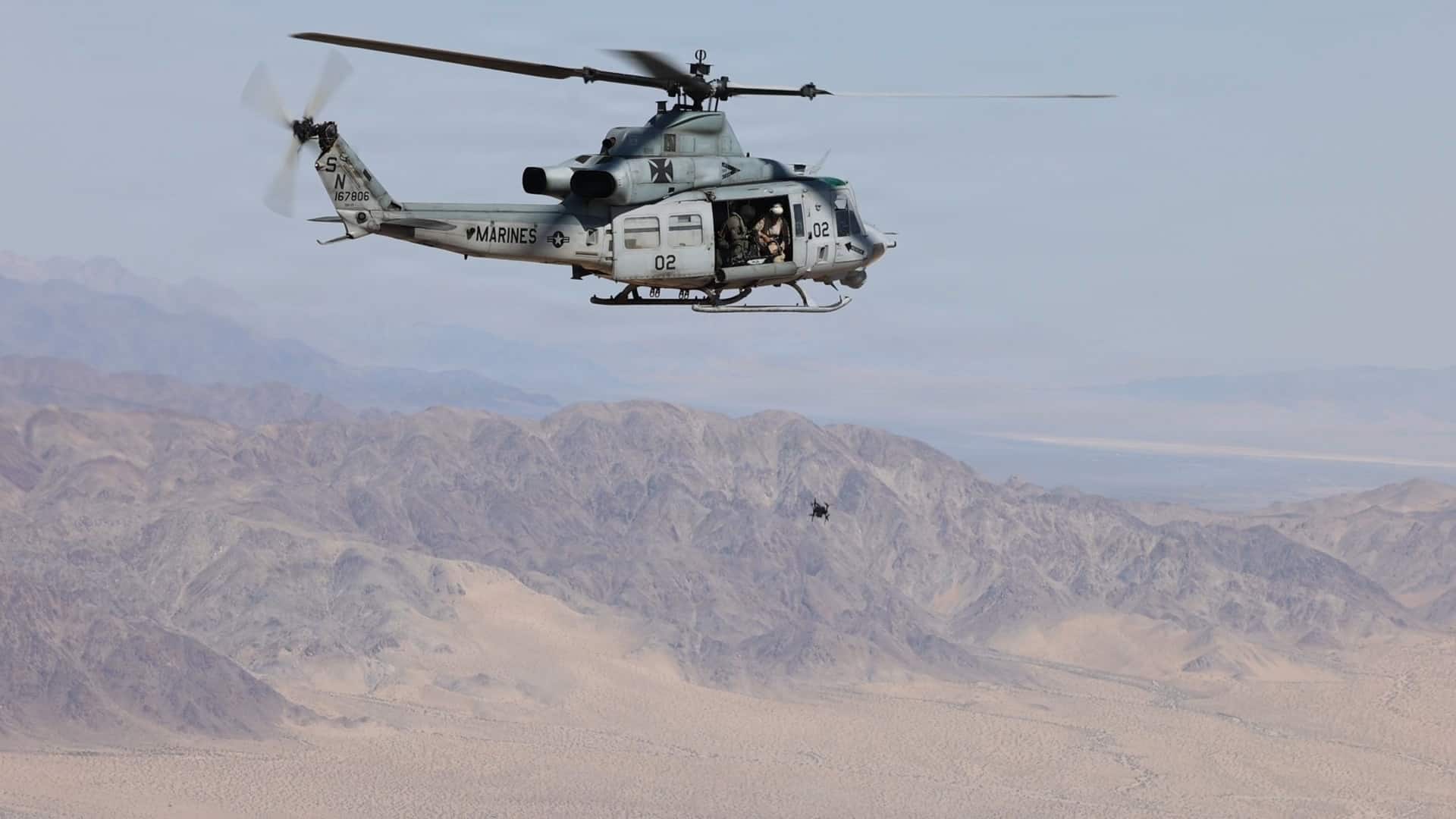
Marines aboard a UH-1Y Venom assigned to Marine Light Attack Helicopter Squadron (HMLA) 169, Marine Aircraft Group 39, 3rd Marine Aircraft Wing, toss a first person view unmanned aircraft system during an integration assessment exercise at Marine Corps Air Ground Combat Center, Twentynine Palms, California, May 13, 2026. (U.S. Marine Corps photo by Sgt. Symira Bostic)
Share on FacebookShare on TwitterLinkedIn

The U.S. Marine Corps has demonstrated a new tactic for extending the reach and lethality of low-cost strike drones, using a UH-1Y Venom helicopter as an airborne signal relay to push a Neros Archer first-person-view drone well beyond the range ground operators could manage on their own.

The integration assessment took place May 13 at Marine Corps Air Ground Combat Center (MCAGCC) Twentynine Palms, California. Marines from Marine Light Attack Helicopter Squadron (HMLA) 169, Marine Aircraft Group 39, 3rd Marine Aircraft Wing, and 3rd Light Armored Reconnaissance Battalion took part in the exercise, according to a Marine Corps release published via DVIDS.

Ground operators launched the Archer FPV drone, then handed control to Marines aboard an orbiting UH-1Y. 

“The primary objective was to test the feasibility of a non-kinetic drop and deployment of a first-person view drone from a moving helicopter, which we were able to do today,” said Capt. Quinton Thornbury, a UH-1Y Venom pilot with HMLA-169. “From there, validate that we can control the maneuver of that drone from the back of the aircraft.” 

The Corps said the broader goal was to evaluate how best to integrate FPV systems into aviation operations to “increase combat capabilities and lethality,” per the release.

The AH-1Z Viper, the Venom’s attack-variant counterpart with which it shares approximately 85% parts commonality, was also identified as a candidate relay platform, according to Marine Corps Times.

FPV drones operating from ground level are constrained by terrain, structures and the curvature of the earth. Their radio signals can only travel as far as a low-altitude antenna permits. Raise the antenna high enough and that ceiling lifts. A UH-1Y orbiting at several thousand feet effectively becomes a flying communications node, pushing the drone’s usable range outward while keeping the crewed aircraft at standoff distance from enemy air defenses. 

The Venom is already rated for offensive air support, utility support, armed escort and airborne supporting arms coordination, per NAVAIR, and the relay mission slots into that supporting-arms role without requiring major hardware modification to the airframe.

The Neros Archer is a domestically manufactured FPV quadcopter and the first platform of its type to earn a spot on the DoD’s BlueUAS approved-vendor list. Built entirely without Chinese components and designed to meet National Defense Authorization Act supply chain requirements. The Archer carries a roughly 4.4-pound payload over a stated range of approximately 12 miles and costs around $2,000 per unit. 

At a fraction of the cost of any munition currently in the Marine Corps inventory, the Archer can absorb attrition at a rate no current conventional strike aircraft can match. Its Archer Strike variant carries a Kraken Kinetics mini-warhead configured for one-way attack missions. 

The Marine Corps awarded Neros a multi-million-dollar delivery order for thousands of the drones in November 2025.

Neros announced the Archer Block 2 in March 2026, a modular, field-reconfigurable version available in 5-, 8-, and 10-inch configurations paired with the company’s new Flatbow ground control station. 

The Block 2 design is intended to allow Marines to adapt the platform to specific mission profiles without returning it to a depot, a capability the Corps has flagged as critical for distributed operations.

The exercise reflects a broader effort to wire lessons from Ukraine into conventional Marine aviation operations. Cheap FPV swarms have complicated armored maneuver at scale in that conflict, forcing a reassessment of how ground formations defend themselves and how attackers can exploit drone density against hardened targets. 

Proliferating air defense systems compound the problem for attack helicopter crews, who have been pushed to greater standoff distances than their onboard weapons can reliably bridge. 

“This tactic allows us to keep our air crews safe and sound while pushing the lethal edge of the battlefield out to where the enemy is,” said Sgt. Matthew Pocklington, a UH-1Y crew chief with HMLA-169. “We are still providing our ground support, and close air support, but in a way that lets the drones close with and destroy the enemy, rather than putting our Marines in harm’s way.”

The May 13 assessment is consistent with a recent pattern of HMLA-169 FPV integration work at Twentynine Palms. DVIDS imagery from earlier this spring shows sUAS integration tests conducted at the Combat Center’s Quackenbush training area, suggesting the squadron has been building toward this relay demonstration for several months. 

SOFX Staff Writer

SOFX Staff Writer

The Editor Staff at SOFX comprises a diverse, global team of dedicated staff writers and skilled freelancers. Together, they form the backbone of our reporting and content creation.

Subscribe
Login
Notify of
guest
guest
0 Comments
Oldest
Newest Most Voted
Inline Feedbacks
View all comments
ADVERTISEMENT

Trending News

SOCOM Commander Says Special Operations Needs ‘PhDs Who Can Win a Bar Fight’

SOCOM Commander Says Special Operations Needs ‘PhDs Who Can Win a Bar Fight’

by SOFX Staff Writer
May 21, 2026
0

U.S. special operations forces need troops who are both combat-ready and technologically skilled as warfare becomes increasingly shaped by digital...

The Bar Fight Is the PhD

The Bar Fight Is the PhD

by Dino Garner
May 22, 2026
2

Before I joined the 1st Ranger Battalion in 1994, I was a biophysicist. I had spent the better part of...

AI Data Center Demand Drove 76 Percent Surge in Wholesale Power Prices Across East Cost Grid

AI Data Center Demand Drove 76 Percent Surge in Wholesale Power Prices Across East Cost Grid

by SOFX Staff Writer
May 15, 2026
1

Wholesale electricity prices across America's largest power grid jumped 76 percent in the first quarter of 2026, driven by surging...

Air Force Tests Special Ops Plane Designed for Rapid Assembly in the Field

Air Force Tests Special Ops Plane Designed for Rapid Assembly in the Field

by SOFX Staff Writer
May 20, 2026
1

The U.S. Air Force Special Operations Command (AFSOC) is testing whether its new OA-1K Skyraider II aircraft can be rapidly...

ADVERTISEMENT
ADVERTISEMENT
Next Post
Ukraine Says Russia Has Lost 145,000 Troops in Five Months

Ukraine Says Russia Has Lost 145,000 Troops in Five Months

The Bar Fight Is the PhD

The Bar Fight Is the PhD

997 Morrison Dr. Suite 200, Charleston, SC 29403

News

  • Global Operations
  • Special Interest
  • Industry
  • Global Operations
  • Special Interest
  • Industry

Resources

  • About Us
  • Contact Us
  • Advertise with Us
  • Editorial Policy
  • Privacy Policy
  • About Us
  • Contact Us
  • Advertise with Us
  • Editorial Policy
  • Privacy Policy
No Result
View All Result
  • Home
  • News
    • Global Operations
      • Asia
      • Africa
      • Europe
      • Latin America
      • Middle East
      • North America
    • Industry
      • Asia
      • Africa
      • Europe
      • Latin America
      • Middle East
      • North America
      • Oceana
    • Special Interest
      • Asia
      • Africa
      • Europe
      • Latin America
      • Middle East
      • North America
      • Oceana
  • Market
    • Wired to Win
    • SOFX.NET
  • Intelligence
    • USMC Deception Manual
  • Resources
    • Contact Us
    • About Us
    • Editorial Policy
    • Privacy Policy
Subscribe
This website uses cookies. By continuing to use this website you are giving consent to cookies being used. Visit our Privacy and Cookie Policy.

Log in to your account

Lost your password?
wpDiscuz